Partimento Theory

What Is an Intavolatura?
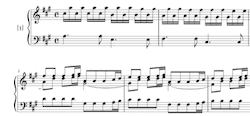
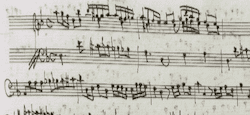
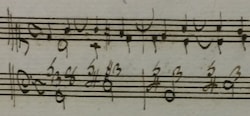
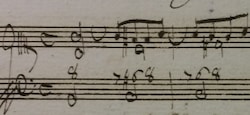
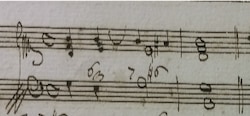
The term intavolatura is used in the partimento tradition to refer to a fully written-out keyboard realization (on two staves). An important collection of intavolature is the so-called Parma Manuscript. It contains 24 keyboard realizations from the third book of partimenti by Fedele Fenaroli (1730–1818). See also disposizione. See also partimento. Select Bibliography Fenaroli, Fedele. METODO […]

What Is an Intavolatura? Read More »
What Is a Partimento?

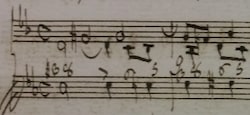
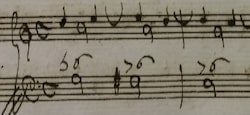
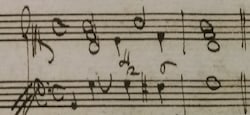
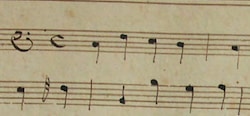
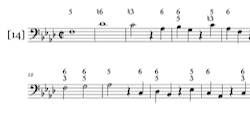
In his book The Art of Partimento, Giorgio Sanguinetti gives the following general definition: “a partimento is a sketch, written on a single staff, whose main purpose is to be a guide for improvisation of a composition at the keyboard”(Sanguinetti (2012), p. 14). It can be provided with or without thoroughbass figures. See also partimento

What Is a Partimento? Read More »

Disjunct Moti del Basso

In my previous three essays (Diatonic Moti del Basso that Rise Stepwise, Diatonic Moti del basso that Descend Stepwise and Chromatic Moti del Basso), I dealt with conjunct moti del basso, both diatonically and chromatically. The topic of this essay is disjunct moti del basso, which are characterized by a sequential progression: a model that consists of

Disjunct Moti del Basso Read More »

Diatonic Moti del Basso that Rise Stepwise

While mastering the first four categories of the regole (cadences, the rule of the octave (RO), suspensions and modulations) was already equivalent to mastering a considerable part of the musical syntax, the assimilation of the moti del basso (or movimenti del basso) proved highly important to the eighteenth-century composer from a structural perspective. (For more

Diatonic Moti del Basso that Rise Stepwise Read More »