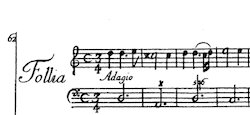
The Folia originated in late 15th-century Portugal and Spain, and by the 17th and 18th centuries had become a widely used framework all over Europe with a number of guises. In this essay, I focus on the so-called ‘late Folia’, which I will refer to simply as ‘the Folia’.
The Folia is a minor-mode schema in 3/4 consisting of two 8-bar phrases. Both phrases share the first 6 bars, each with one structural note: ①—⑤—①—♭⑦—♭③—♭⑦. Phrase 1 ends with a half cadence (①—⑤), phrase 2 with a clausula basizans ①–⑤—①, bar 15 having 2 structural notes, ① & ⑤.
To facilitate the reading of this essay, I use Robert Gjerdingen’s black-circled figures to indicate scale steps in the melody (e.g. ➍–➌) and white-circled figures to indicate scale steps in the bass (e.g. ⑦–①). And I add an accidental to a figure when the specific designation of a diatonic or a chromatically altered scale step is required, although this symbolized notation can differ from the actual one. The list below should suffice to make the system of indications clear. Regardless of the mode,
♭③ always refers to the scale step a minor third above ①
③ always refers to the scale step a major third above ①
♭⑥ always refers to the scale step a minor second above ⑤
⑥ always refers to the scale step a major second above ⑤
♭⑦ always refers to the scale step a major second below ①
⑦ always refers to the scale step a minor second below ①
Note also that I use an em dash to separate circled figures representing structural notes occurring one bar apart, and a hyphen when two structural notes appear within the same bar.
The Folia with the Standard Treble
One of the most rudimentary presentations of the Folia in 17th– and 18th-century repertoire can be found at the opening of the variation cycle Les Folies d’Espagne by the French composer and viol player Marin Marais (1656–1728), published in 1701 as part of his second book of Pièces de viole. (In France, the Folia was often referred to as (les) folie(s) d’Espagne, a name clearly alluding to its Iberian origin. In fact, Job IJzerman opens his discussion of the Folia with this very example in his book Harmony, Counterpoint, Partimento: A New Method Inspired by Old Masters.)
As the ‘theme’, Marais gives not only the standard bass of the Folia but also the standard treble: ➊—➐—➊—➋—♭➌—➋—➊—➐ + ➊—➐—➊—➋—♭➌—➋—➊-➐—➊. In its standardised guise, each structural bass note is set simply with a triad.
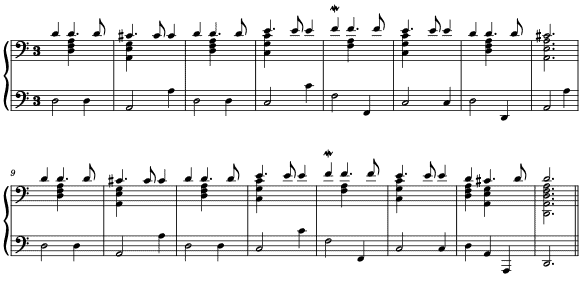
bars 1–16
Note
- the Dorian key signature
- how the second stage of each phrase (with ⑤), as well as ⑤ in the final cadence of the second phrase, is set with a seventh chord instead of a triad
- the characteristic rhythm in the odd-numbered bars: quarter note + dotted quarter note + eighth note —a rhythmic motif also typical of the sarabande
- the rhythm in the even-numbered bars: dotted quarter note + eighth note + quarter note
- that an eighth note following a dotted quarter note is expected to be played unequally or even overdotted (for more on inégalité, see my essays What is Inégalité (Inequality) in French Baroque Music?, Historical Terms Related to Inégalité (Inequality) and Is Cut Time Different From 2/2 in French Baroque Music?)
- that Folias are usually composed in D minor (an exception is Henricus Albicastro’s version in G minor from 1703; see https://ks15.imslp.org/files/imglnks/usimg/e/e2/IMSLP115365-PMLP235242-albicastro_6_vn_sonatas_op5_folia.pdf.)
- the temporary modulation to the relative key of F major in bars 4–6 and 12–14, caused by ♭⑦ —a type of modulation that confirms the Folia as an exclusively minor-mode schema.
To clarify the voice-leading, here is a two-part reduction:
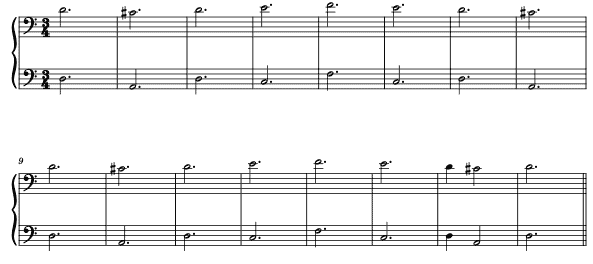
Note:
- As Robert O. Gjerdingen points out, the structural bass notes of the Folia “move up or down fourths or seconds from measure to measure” (Gjerdingen, 2020, p. 23).
- In terms of performance, each pair of two bars functions as a half cadence, except for the clausula basizans in bars 15–16.
- In phrase 1, a half cadence in D minor (bars 1–2) is followed by two half cadences in F major (bars 3–4 and 5–6), which are in turn followed by a half cadence in D minor (bars 7–8), identical to that in bars 1–2.
- Bars 4–5 and 12–13 are sequential transpositions of bars 2–3 and 10–11, respectively. One could argue that bars 2–5 and 10–13 thus function as embedded, off-bar moti del basso that rise a fourth and fall a second in their shortest possible guise (only two segments: model and one transposition). However, as far as I know, no such moto del basso is documented in 18th-century Italian pedagogy. (For more on disjunct moti del basso, see my essay on this topic.)
- Bars 7–8 and 15 (in compressed form) are sequential transpositions of bars 5–6 and 13–14, respectively. As such, bars 5–8 and 13–15 function as embedded, on-bar moti del basso that fall a fourth and rise a second in their shortest possible guise (again: model and one transposition). This moto del basso is also known as the Romanesca, the Pachelbel Pattern or Pachelbel Bass. (For more on this schema, see my essay The Leaping Romanesca (The Pachelbel Pattern): The Basics.)
The Folia with an Alternative Treble
The same Folia bass can be set with an alternative treble that lies a third higher or a sixth lower than the standard treble: ♭➌—➋—♭➌—➍—➎—➍—♭➌—➋ + ♭➌—➋—♭➌—➍—➎—➍—♭➌-➋—♭➌.
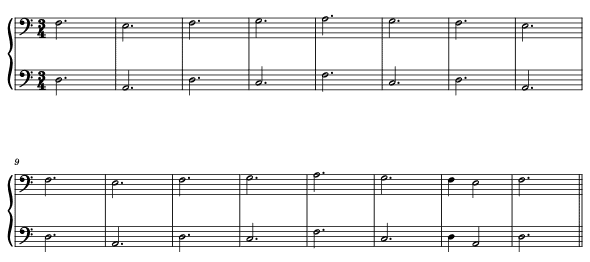
The Folia Combining Both Treble Lines Simultaneously
Both treble lines can also be combined into a three-part version, where either may appear as the upper or middle voice:
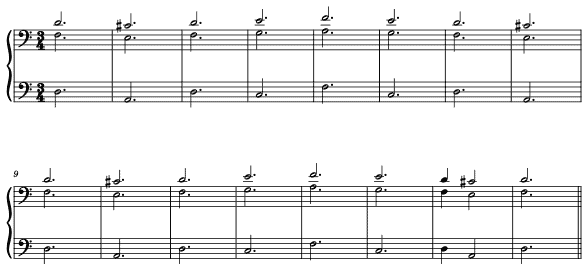
with the standard treble in the upper voice
As IJzerman points out, “note the two upper voices, which move exclusively in parallel sixths. The bass supplements the parallel motion by providing complete and incomplete 5/3 chords” (IJzerman, 2018, p. 130).
Obviously, the upper voices can be swapped, resulting in parallel thirds rather than sixths:
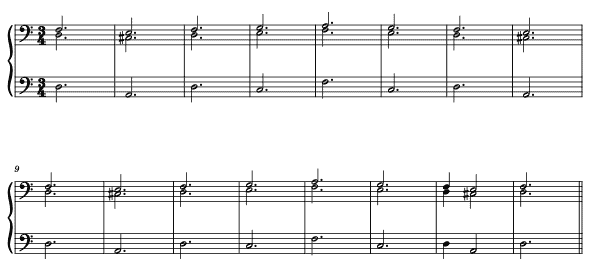
with the alternative treble in the upper voice
The latter three-part setting can also be implied through two explicit parts by means of the compositional technique known as compound line —a technique employed by Marais in the first variation of his Folies d’Espagne (which he labels 2.e couplet, referring to the initial presentation of the ‘theme’ as 1.er couplet):
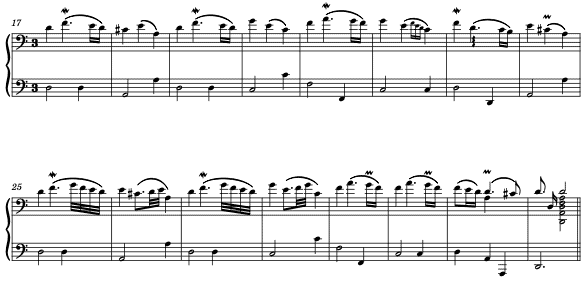
bars 17–32
The Folia Set with a Corelli Leapfrog
While writing my essay on the Corelli Leapfrog, I was struck by how much the bass that accompanies this contrapuntal technique in the minor mode has in common with the bass of the Folia. Below, you can see and hear the opening of Pergolesi’s Stabat Mater —an example I also discuss in my essay on the Corelli Leapfrog:
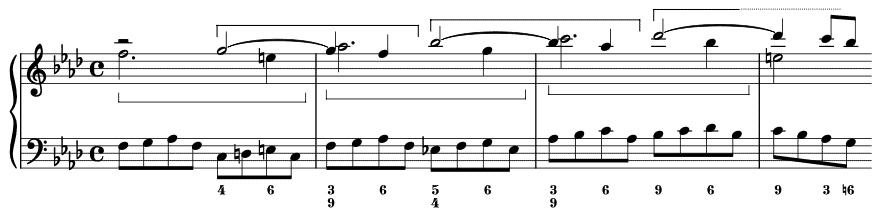
(two violins and BC; viola omitted)
Apart from the fact that the example above is written in 4/4 instead of 3/4, its structural bass notes up to stage 5 are identical to those of the Folia. This gave me the idea that leapfrogging upper voices could be used to set a Folia bass —although I have yet to encounter an actual 17th– or 18th-century exemplar. (Again, if you do know of one, do send me an email.)
However, there is a small technical difference from the leapfrog technique as I describe it in my essay What Is a Corelli Leapfrog?. In the ‘standard’ Corelli Leapfrog, the middle voice begins and the upper voice responds, with both voices in the ‘correct’ relative position when ➏ is reached. In the context of the Folia, however, it is the top voice that should begin, since the highest melodic point is not ➏ but ➎.
For the sake of comparison, I have composed phrase 1 of a ‘Folia schema in 4/4’ using leapfrogging upper voices in F minor:
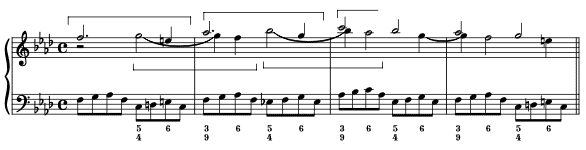
and with leapfrogging upper voices in bars 1–3a,
followed by a descending 2–3 suspension chain in bars 3–4
As you can see —just as in Mattei’s Versetto 4 in G major— after the leapfrogging, the upper voices engage in a descending chain of 2–3 suspensions, during which their relative position remains ‘correct’ throughout.
And this is a hypothetical setting of phrase 1 of a Folia in D minor, in 3/4 and featuring leapfrogging upper voices, again followed by a descending 2–3 suspension chain:

and with leapfrogging upper voices in bars 1–5,
followed by a descending 2–3 suspension chain in bars 5–8
The Folia Set with Extra Harmonies
A fabulous set of keyboard variations on the Folia was composed in Hamburg in 1778 by Carl Philipp Emanuel Bach (1714–1788): 12 Variationes auf die Folie d’Espagne —again in D minor— Wq. 118/9. While the variations themselves are unmistakably ‘C.P.E. Bach’ —highly original and inventive— the presentation of the ‘theme’ itself is remarkably ordinary.
Nevertheless, in bars 14–15, instead of simply moving from ♭⑦ to ① (from c to d), Bach adds ⑦ (c♯) on beat 3 of bar 14, smoothing the final return to D minor. He also introduces a 4–3 suspension on ⑤ in bar 15, transforming the final clausula basizans from a cadenza semplice into a cadenza composta.
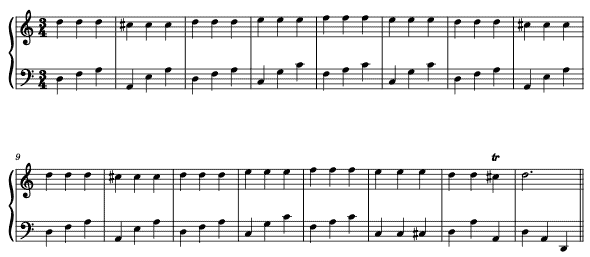
You can listen to my recording of this piece via the following link:
Perhaps the most famous variation cycle on the Folia is the one composed by Arcangelo Corelli (1653–1713) to conclude his opus 5 for violin and continuo. The following example presents the ‘theme’:
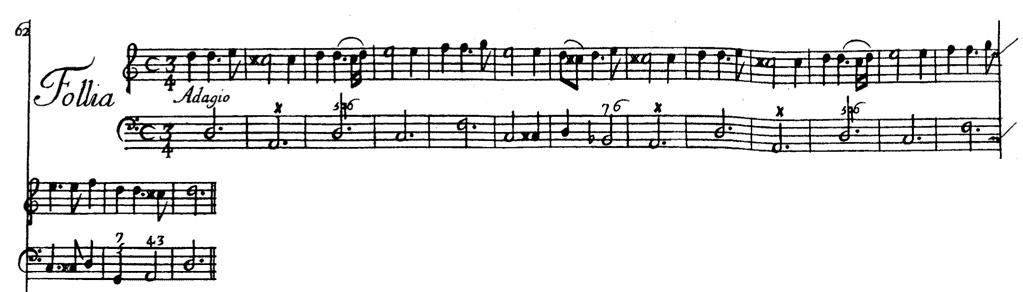
available on https://imslp.org
Let’s first examine phrase 1 to see where and how Corelli elaborates on the prototypical guise of the Folia:
- Bar 3: Instead of sustaining a D minor triad throughout the bar, he adds ♮6 on the d, likely intended to be played on beats 2 and 3, smoothing the progression toward the C major chord of bar 4.
- Bar 6: Whereas C.P.E. Bach reserves the ‘extra’ c♯ in the bass until the end of phrase 2, Corelli introduces it earlier, towards the end of phrase 1, on beat 3 of bar 6.
- Bar 7: Instead of sustaining a D minor triad throughout the bar, Corelli adds a half note B♭ on beats 2 and 3, set with a 7–6 suspension.
And in phrase 2, these are Corelli’s elaborations compared to the prototypical guise of the Folia:
- Bar 11: Just as in bar 3, Corelli adds ♮6 on the d, likely intended to be played on beats 2 and 3.
- Bar 14: Corelli again introduces the ‘extra’ c♯, but unlike in phrase 1 —where it occurs on beat 3— here it appears on the second half of beat 2, lasting only an eighth note and causing the prototypical d on the downbeat of bar 15 to arrive one beat earlier.
- Bar 15: Having anticipated the prototypical d by one beat, Corelli adds an ‘extra’ G on the downbeat, set with a seventh.
Further Reading (Selection)
Gerbino, Giuseppe and Silbiger, Alexander. Folia (Port., It. [It. occasionally follia]; Sp. folía; Fr. folie), Grove Music Online ed. L. Macy (accessed 26 June 2025), http://www.grovemusic.com.
Gjerdingen, Robert O. Child Composers in the Old Conservatories — How Orphans Became Elite Musicians (New York: Oxford University Press, 2020).
IJzerman, Job. Harmony, Counterpoint, Partimento: A New Method Inspired by Old Masters (New York: Oxford University Press, 2018).
Sanguinetti, Giorgio. The Art of Partimento — History, Theory, and Practice (New York: Oxford University Press, 2012).