Some More Montes

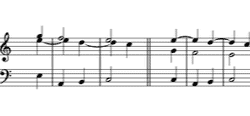
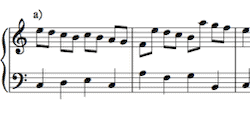
The Monte is a schema widely used in the 17th and 18th centuries and exists in many variants, some of which are discussed in this essay. For the schema’s characteristics see my essay The Monte: The Basics. I will explore five variants of the Monte in this essay: the minor-key Monte ending in v, the

Some More Montes Read More »

What Is a Jommelli?

A Jommelli is a variant of a clausula cantizans (also called a ⑦–① cadence or, in Gjerdingen’s term, a Comma (Gjerdingen (2007), p. 155–157)). While ⑦ of a clausula cantizans is usually realized as a sixth chord or 6/5 chord in a variable number of parts, ⑦ of a Jommelli is set in a three-part

What Is a Jommelli? Read More »

What Is a Hermaphrodite Note and What Is a Zwitter?

Robert Gjerdingen calls a chromatically lowered sixth scale step in a major key (A♭ instead of A(♮) in C major, for instance) a hermaphrodite note, referring to Joseph Riepel (1709–1782), who seems to have associated major with masculine and minor with feminine. A hermaphrodite note is thus the sixth scale step borrowed from the parallel

What Is a Hermaphrodite Note and What Is a Zwitter? Read More »

What Is a Figura Corta?

In the second volume of his monumental Phrynis (Mytilenæus) Oder Satyrischer Componist (1677), Wolfgang Caspar Printz (1641–1717) gives the following definition: “Figura Corta consists of three fast notes / of which one is as long as the other two combined.” “Figura Corta besteht aus dreyen geschwinden Noten / deren doch ein so lang ist /

What Is a Figura Corta? Read More »

Clausulæ

Clausula cantizans = ⑦–① cadence Clausula altizans = ⑤/④–③ cadence Clausula tenorizans = ②–① cadence Clausula basizans (or bassizans) = ⑤–① cadence Treatises up to and including the first half of the 18th century mostly considered cadences from a melodic and polyphonic point of view. Instead of seeing a cadence in terms of a chord

Clausulæ Read More »