Counterpoint

What Does Fauxbourdon Mean?
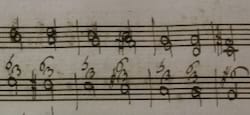
Fauxbourdon is a contrapuntal technique originating in the early Renaissance, often resulting in parallel sixths, though not exclusively so. Today this term is frequently used in a broader sense to indicate any passage of parallel sixth chords, regardless of the musical period. (Very) Select Bibliography Gjerdingen, Robert O. Music in the Galant Style (New York: […]

What Does Fauxbourdon Mean? Read More »
What Does Diapason Mean?

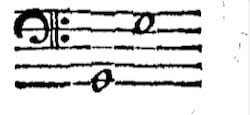
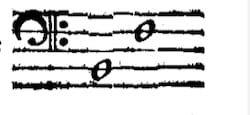
The Greek term diapason has several meanings in English. One of them is used in music as a synonym for the interval of the octave, dia meaning “over”, pason “all”. See also diatessaron, hemidiapente and diapente. (Very) Select Bibliography Baragwanath, Nicholas. Note-Naming, Galant Schemata, and the “Thread” of Vivaldi’s Concerto for Four Violins, Op. 3

What Does Diapason Mean? Read More »

What Does Diatessaron Mean?

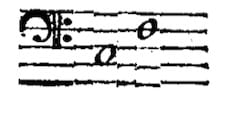
The Greek term diatessaron is used in music as a synonym for the interval of the perfect fourth, dia meaning “over”, tessaron “four”. See also hemidiapente, diapente and diapason. (Very) Select Bibliography Baragwanath, Nicholas. Note-Naming, Galant Schemata, and the “Thread” of Vivaldi’s Concerto for Four Violins, Op. 3 No. 10 (RV 580), in: Music Theory

What Does Diatessaron Mean? Read More »

What Does Diapente Mean?

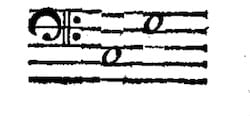
The Greek term diapente is used in music as a synonym for the interval of the perfect fifth, dia meaning “over”, pente “five”. Johann Mattheson, for instance, gives the following description: “The fifth is called diapente, i.e. “over five”, because it comprises five diatonic tones, of which the two outermost, as endpoints, are principally perceived.”

What Does Diapente Mean? Read More »