Counterpoint

What Is Stretto?

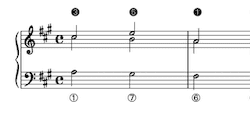
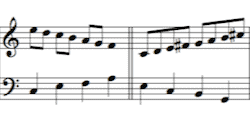
In music, stretto essentially means the overlapping of the same melodic idea/subject in two or more voices. Stretto can thus be considered a canonic technique, although it is usually applied only to a particular passage or passages within a piece that is not itself a canon. Stretto occurs typically in fugues. Paul Walker gives the […]
What Is Stretto? Read More »

What Is a Disposizione?

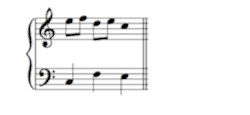
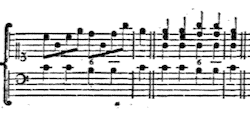
The term disposizione is used in the partimento tradition to refer to a fully written-out realization on as many staves as there are parts (in score) and in the Neapolitan counterpoint tradition to refer to a counterpoint exercise to be worked out in score. See also intavolatura. See also partimento. Select Bibliography Fenaroli, Fedele. METODO PER

What Is a Disposizione? Read More »

What Is an Anticipation?

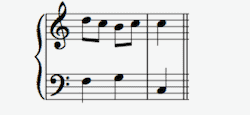
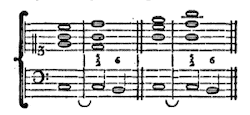
An anticipation is a non-chord note on a weak beat or part of a beat that anticipates the first note of the next chord. This type of embellishment occurs frequently in cadences. Select Bibliography Kennan, Kent. Counterpoint Based on Eighteenth-Century Practice — Fourth Edition (New Jersey: Prentice-Hall, 1999). Schubert, Peter & Christoph Neidhöfer. Baroque Counterpoint (New Jersey: Pearson Prentice

What Is an Anticipation? Read More »

What Is Compound Line?

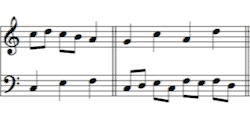
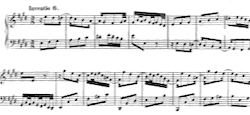
Compound line is a technique where one written part represents two or more implied parts. This technique is characterized by arpeggiation and/or large, often ‘unmelodic’ leaps. Johann Philipp Kirnberger (1721–1783), amongst others, discusses compound line, focussing on arpeggiating per chord, and warns that the implied voice leading should be correct. According to him, the following

What Is Compound Line? Read More »