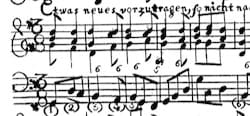
In this essay, I discuss Telemann’s views on which note can be doubled in a sixth chord.
Since Telemann advocates a generally four-part realization, he gives several guidelines as to which note can be doubled. While each note can be selected for this purpose, doubling the sixth and third is preferable, with doubling the bass reserved for cases of necessity (idiomatic or contrapuntal).
The musical examples are taken from Derek Remeš’s digital and freely available edition of the SSGBÜ, which can be downloaded at https://doi.org/10.17877/TUDODATA-2025-MC06WAYR.
Note further that
- the translations of all the quotes are mine
- “bar 1a” refers to the first half of bar 1, and “bar 1b” to the second half
- the term “Oberstimme” refers to the upper part of the thoroughbass realization.
To facilitate the reading of this essay, I use Robert Gjerdingen’s black-circled figures to indicate scale steps in an upper part (e.g. ➍–➌) and white-circled figures to indicate scale steps in the bass (e.g. ⑦–①). And I add an accidental to a figure when the specific designation of a diatonic or a chromatically altered scale step is required. The list below should suffice to make the system of indications clear. Regardless of the mode,
♭③ always refers to the scale step a minor third above ①
③ always refers to the scale step a major third above ①
♭⑥ always refers to the scale step a minor second above ⑤
⑥ always refers to the scale step a major second above ⑤
⑦ always refers to the scale step a minor second below ①
Regarding a number of instances in aria 1, Telemann gives the following directive concerning which note to double in a sixth chord —remember that Telemann advocates a four-part thoroughbass realization (see my essay Telemann’s SSGBÜ: Number of Parts):
“With a sixth chord, it is best to double either the sixth, or also the third, as can be seen in the following examples (6) (7) (8); if, however, this does not suit the fingers, one may double the octave of the bass, as occurs in (5) (9) (10).”
“Beÿ einer 6 ist es am besten, entweder dieselbe, oder auch die 3 zu verdoppeln, wie ferner beÿ (6) (7) (8) zu sehen; will sich aber diss nicht in die finger schicken, so verdoppele man die 8 des basses, wie beÿ (5) (9) (10) vorkömmt.”

That a voicing of a sixth chord that Telemann considers best results in ➐ not rising to ➊ but descending to ➎ is clearly not a problem for him judging from the number of times this occurs in the SSGBÜ; he does not even mention this melodic license. In aria 1 alone, this occurs already four times.1
Despite Telemann’s statement that the bass can be doubled if the doubling of the sixth or third “does not suit the fingers”, the realization on the downbeat of bar 1 of aria 2 and its accompanying comment illustrate that this can also be done for voice-leading reasons:
“at (a), this bass doubling took place in order to avoid a direct fifth [a–e1 in the bass and tenor part on beat 2].”
“beÿ (a) geschahe diese verdoppelung, um eine verdeckte 5 zu vermeiden.”

Later in the aria, in bar 10, the same realization/voice leading occurs, now with an ornamented bass:

(For more information on Telemann’s views on direct fifths and octaves, see my essay Telemann’s SSGBÜ: On Direct Fifths and Octaves.)
While Telemann would normally have doubled the sixth —B♭— at (a) in aria 3, he explains that he has doubled the bass —D— again for voice-leading reasons:
“Here the bass, and not the 6 is doubled, because otherwise octaves and fifths would have resulted at the following note, thus:”
“Hier wird der bass, und nicht die 6, darum verdoppelt, weil sonst beÿ der folgenden note 8 und 5 entstanden wären, also:”


(I also discuss this last example in my essay Telemann’s SSGBÜ: On Direct Fifths and Octaves.)
Still, doubling the D on beat 3 of bar 1 is not the only possibility to avoid voice-leading issues; one could also double the sixth —B♭— on beat 3, while doubling the bass —E♭— on beat 4:

Note that the fact that all the voices move in the same direction is not objectionable; see for instance bar 3b–4a in the same aria, including ➐ not rising to ➊ but descending to ➎. Still, it is my observation that Telemann seems to prefer to double the sixth of a sixth chord on ④, even in minor, where, in first-choice position, the octave between the tenor and soprano parts is divided by the tritone/diminished fifth. I assume this preference is the main reason why he doubles the bass on beat 3 yet the sixth on beat 4 in the example above. Another instance of this voicing choice, in major, occurs in an example I already discussed —bar 11a in aria 2— which, for convenience, I have reproduced here:
And below you can see two examples of a sixth chord with a doubled sixth on ④ in minor, one on beat 2 of bar 1 of aria 5, another on beat 1 of bar 22 of aria 13:


The last example is actually quite interesting since bars 19–22 are repeated literally in the next four bars in the bass and the vocal line (albeit with another text), yet with a different realization giving (almost exactly) the same chords but mostly in different positions.2 During this varied realization, Telemann writes a sixth chord on ④ doubling the bass (downbeat of bar 26), while a version with a doubled sixth would also have been a perfectly legitimate and playable option, as you can see here:

For contrapuntal reasons, doubling the bass can be good, even the better choice, on a weak beat. Regarding (c) in aria 4, Telemann states the following:
“The doubling of the bass in an upper octave, in the case of a sixth chord, occurs here. When it appears on a weak beat, as here, it is of no consequence.”
“Die verdoppelung des basses in der höhe, beÿ einer 6, kömmt hier vor. Wenn sie in den letzten noten des nieder- oder auf-tactes, wie hier, sich zeiget, so hat sie nichts zu bedeuten.”3

While the vocal line descends stepwise from b1 to a1 in bar 5b, this is not an option in the right-hand realization since this would result in a (temporary) three-part texture, a texture that Telemann prefers to avoid. (For more information, see my essay Telemann’s SSGBÜ: Number of Parts.) By writing c♯2 in the upper part of the realization, Telemann not only avoids a three-part sixth chord, but also ensures a successful contrary motion between the outer parts of the realization.4
In the comments to aria 6, Telemann reminds us that doubling the bass in a sixth chord should be used only sparingly, while also adding the following rationale:
“since [the third] is then too greatly drowned out by this doubling.”
“da denn [die 3] durch diese verdoppelung zu sehr übertäubet wird.”
And regarding doubling the bass at (c) in aria 25, Telemann sighs the following:
“The doubling of the bass with a sixth chord? We had no choice here.”
“Die verdoppelung des basses beÿ einer 6? Wir konnten hier nicht anders.”
The result of this doubling combined with Telemann’s voicing is that all the parts of the realization descend from the last beat of bar 15 to the downbeat of bar 16.

While in itself this descent in all the parts is not a big voice-leading issue, there are solutions to avoid it. Hence, I don’t quite agree with Telemann that the option he gives is the only one available. In fact, there are a number of alternative versions that are acceptable, good, or even better. First, instead of doubling the bass on the downbeat of bar 16, the Oberstimme could be d 2:

Secondly, this alternative can be transformed into another by altering the d 1 in the tenor part on the downbeat of bar 16 into f 1, expanding the sixth chord into a 6/5 chord:

(For more information on the expansion of chords, see my essay Telemann’s SSGBÜ: Chord Substitutions and Additions.)
Note that in this case, the realization of bars 15–16, including the aria’s final chord, is entirely in third position —with ➎ in the Oberstimme. While this might seem as not ideal or even to be avoided, for Telemann it does not cause any kind of problem, as he states in his comments to aria 16:
“Some believe that one should not close in the Oberstimme with the fifth, because it is imperfect; but it is equally imperfect in the middle or lower voice: so let it be taken wherever one wishes.”
“Einige wollen, dass man oben mit der 5 nicht schliessen solle, weil sie unvollkommen; sie ist es aber auch in der mitte und unten: also nehme man sie, wo man will.”
Alternative 2 could also finish with all the parts descending towards the final chord of this aria, including ➐, thereby ending in second —with ➌ in the Oberstimme— rather than in third position:

Note that in this case, all the parts descend, including ➐, which does not rise to ➊ but falls to ➎. Still, as we saw above, this is not objectionable. (For more information, see my essay Telemann’s SSGBÜ: Miscellaneous Voice-Leading Licences.)
A possible objection to these alternatives, however, could be the parallel fifths that emerge between the vocal line and the Oberstimme, f 1/c2–g1/d 2. Yet as Telemann himself suggests, these are not much of a problem, unless for some reason he did not quite like them here… (For more information on this, see my essay Telemann’s SSGBÜ: On Parallel Fifths.)
The alternatives I suggested up to this point all take over Telemann’s third-position realization in bar 15. Another option, however, is to switch down to second position on the downbeat of bar 15 —starting with ➌ in the Oberstimme— that is, the same position with which the final sentence starts in bar 13. This position enables two obvious alternatives:
- alternative 4 maintains the doubled bass note on ④ on the downbeat of bar 16, thereby reproducing the actual setting of Telemann’s realization in this bar
- alternative 5 expands the sixth chord into a 6/5 chord:


With regard to (c) and (d) in aria 20, Telemann gives another rationale for doubling the bass in a sixth chord, even in the Oberstimme:
“All the present remarks recall several previous ones: at (a) and (b), in the lowest part of the right hand, there are two hidden octaves, which were taken so that the hand could remain in its position; at (c) and (d), the bass note, realized as a sixth chord, has been doubled in the Oberstimme, namely on notes that fall on the strong beat of the bar, which, for the reason mentioned above [so that the hand could remain in the same position], was unavoidable: however, convenience takes precedence over a rule of moderate importance.”
“Alle gegenwärtige anmerkungen erinnern uns etlicher vorhergegangenen: beÿ (a) und (b) sind oben, in der untersten partie, zwo verdecte 8.ven, die man darum genommen, damit die hand in ihrer lage bleibe; beÿ (c) und (d) ist der bass-thon, worüber eine 6, oben, und zwar beÿ noten, worauf das tact-gewicht fällt, verdoppelt worden, welches, wegen obiger uhrsache, nicht zu vermeiden war: die bequehmlichkeit aber hat das vorrecht vor einer regul von mittelmässiger wichtigkeit.”

Notes
- Two more descending leading notes occur in this aria in other harmonic contexts:
• in bar 30, ➐ descends to ➏ in the context of a deceptive cadence
• in bars 31–32, ➐ descends to ➎ in the context of a clausula basizans.
See also my essay Telemann’s SSGBÜ: Miscellaneous Voice-Leading Licences. ↩︎ - While Telemann sets the last beat of bar 19 as a 6/5 chord despite the figuring 6 (for more information on this possible expansion of a chord, see my essay Telemann’s SSGBÜ: Chord Substitutions and Additions), he does realize the analogous spot, that is, beat 3 of bar 23, as a sixth chord (without diminished fifth). ↩︎
- Note that a more literal translation of “in den letzten noten des nieder- oder auf-tactes” would be “during the last note of the down- or upbeat”. This formulation might seem somewhat puzzling since the guideline refers to the quarter-note sixth chord on beat 4 of bar 5, which, from a modern perspective, would simply be called the upbeat. Telemann, however, here retains the older conception of tactus, whereby a 4/4 bar comprises two half-bars —a ‘downbar’ (Niedertakt) and an ‘upbar’ (Auftakt)— each spanning two beats. What he calls the “last note of the ‘down- or upbar’” thus corresponds to the weak second or fourth beat, respectively, in modern terms. While this view is changing in Germany in the first half of the eighteenth century, with 4/4 being considered more and more as comprising four actual beats, Johann Mattheson still vehemently defends this older view on metre in his Vollkommene Capellmeister of 1739: “The essential nature of tactus depends, once and for all, on the fact that every mensuration, every segment of the time-measure, has only two parts and no more. These take their origin or their ground from the arteries, whose up- and downbeats are called systole and diastole by those versed in medicine.” (“Das Haupt-Wesen des Tacts kömmt einmahl für allemahl darauf an, daß eine iede Mensur, ein ieder Abschnitt der Zeit-Maasse nur zween Theile und nicht mehr habe. Diese nehmen ihren Ursprung oder ihren Grund aus den Pulsadern, deren Auf- und Niederschläge bey den Arzeney-Verständigen Systole und Diastole genennet werden.”) Mattheson, 1739: 171. ↩︎
- Instead of c♯2, e2 would also have been an option. ↩︎
Select Bibliography
Arnold, Franck Thomas. The Art of Accompaniment from a Thorough-Bass (2 volumes) (Oxford: Oxford University Press, 1931; unabridged and unaltered republication by Dover Publications in 1965 (with a new introduction) and 2003).
Christensen, Jesper Bøje. Die Grundlagen des Generalbaßspiels im 18. Jahrhundert: Ein Lehrbuch nach zeitgenössischen Quellen (Kassel: Bärenreiter, 1992).
Christensen, Jesper Bøje. Les Fondements de la Basse Continue au XVIIIe siècle : Une méthode basée sur les sources d’époques (Basel: Bärenreiter, 1995).
Christensen, Jesper Bøje. 18th Century Continuo Playing: A Historical Guide to the Basics (Kassel: Bärenreiter, 2002).
Demeyere, Ewald. Johann Sebastian Bach’s Art of Fugue — Performance Practice Based on German Eighteenth-Century Theory (Leuven: Leuven University Press, 2013).
Heinichen, Johann David. Der General-Bass in der Composition (Dresden, 1728).
Mattheson, Johann. Der vollkommene Capellmeister (Hamburg, 1739).
Rampe, Siegbert. Generalbasspraxis 1600–1800 (Laaber: Laaber Verlag, 2014).
Telemann, Georg Philipp. Singe-, Spiel- und General-Bass-Übungen (Hamburg, 1733–34).
Telemann, Georg Philipp. Singe-, Spiel- und General-Bass-Übungen TWV 25:39-85 für Singstimme & Tasteninstrument — Revidierte Neuausgabe, ed. Wolf Hobohm (Magdeburg: Edition Walhall – Verlag Franz Biersack, 2003).
Zohn, Steven. Music for a Mixed Taste: Style, Genre, and Meaning in Telemann’s Instrumental Works (New York: Oxford University Press, 2008/2015 (revised paperback edition)).