Schemata

What Is Ars Combinatoria?
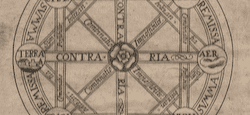
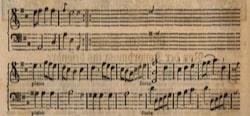
Gjerdingen argues that “the fluid mixing and matching of schemata would seem to exemplify perfectly the ars combinatoria [or ‘art of combinations’] … this was a philosophical tradition cited by Riepel and other eighteenth-century musicians” (Gjerdingen, 2007: 99 & 115). Select Bibliography Gjerdingen, Robert O. Music in the Galant Style (New York: Oxford University Press, […]

What Is Ars Combinatoria? Read More »
The Monte: The Basics

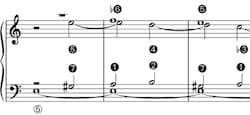
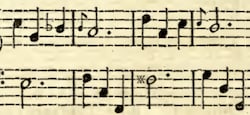
The Monte is a widely used schema in the 17th and 18th centuries and exists in many variants. In this essay, I will focus on the schema’s characteristics. Just as a Fonte, a Monte is a sequential schema in which each segment constitutes a cadence, often a ⑦–① cadence or clausula cantizans as well. However,

The Monte: The Basics Read More »

Variants of the Prinner (Part 4): The Stabat Mater Prinner

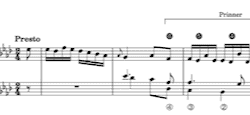
I have already explored the voice-leading pattern that Robert Gjerdingen calls a Prinner to some extend in four essays (The Traditional Prinner, Variants of the Prinner (Part 1), Variants of the Prinner (Part 2): Sequential Prinners and Variants of the Prinner (Part 3)). To that series I will add another essay, although from a structural

Variants of the Prinner (Part 4): The Stabat Mater Prinner Read More »

Extending the Fonte

In this essay, I will explore several techniques for extending a Fonte. While the Fonte is often composed of 2 segments, each of which consists of a ⑦–① cadence, this schema can be extended by adding an extra cadence to each segment, by equating a phrase containing multiple cadential gestures with one segment or by

Extending the Fonte Read More »

The Fonte: The Basics

The Fonte is a widely used schema in the 17th and 18th centuries and exists in many variants. In this essay, I will focus on the schema’s characteristics. The Fonte is essentially a descending sequential pattern with 2 segments, each segment constituting a ⑦–① cadence with a ➍–➌ melody. Segment 1 is written in the minor key

The Fonte: The Basics Read More »

Variants of the Prinner (Part 2): Sequential Prinners

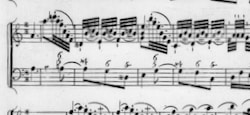
The two-part Prinner with its ➏–➎–➍–➌ melody and ④–③–②–① bass line holds great potential as a sequential progression thanks to its voice leading in parallel thirds. As can be seen in my essays The Traditional Prinner and Variants of the Prinner (Part 1), however, the presence of a third voice very often undermines that potential.

Variants of the Prinner (Part 2): Sequential Prinners Read More »