What Is Complementary Rhythm?
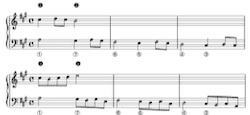
We speak of complementary rhythm (in a two-part setting) when two parts alternate a rhythmic motive so that a regular rhythmic pattern emerges.
What Is Complementary Rhythm? Read More »
We speak of complementary rhythm (in a two-part setting) when two parts alternate a rhythmic motive so that a regular rhythmic pattern emerges.
What Is Complementary Rhythm? Read More »
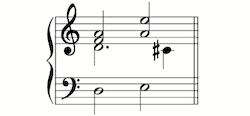
A direct octave occurs when two voices move in the same direction, the upper voice leaping, and produce a vertical octave. This voice leading is normally considered a (soft) error, although composers did accept it under certain conditions, for instance by including a suspension in an inner voice at the moment of the direct octave.
What Is a Direct Octave? Read More »
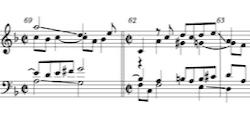
A direct fifth occurs when two voices move in the same direction, the upper voice leaping, and produce a vertical fifth. This voice leading is normally considered a (soft) error, although composers did accept it under certain conditions, for instance by including a suspension in an inner voice at the moment of the direct fifth.
What Is a Direct Fifth? Read More »
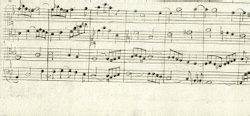
In his influencial Abhandlung von der Fuge (1753), Friedrich Wilhelm Marpurg (1718–1795) uses the expression per arsin et thesin “to refer to the entrance of a theme (usually a fugue subject) with displaced accents, former strong beats becoming weak and vice versa” (Walker, Arsis, thesis). (Marpurg was a German author, music critic, music theorist and
What Does Per Arsin Et Thesin Mean? Read More »
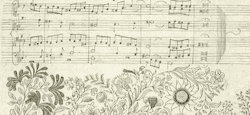
Sine pausa (without pause) refers to the fact that several voices, which are involved in canonic or stretto constructions, produce a simultaneous start of the same motif, theme or fugal subject, whether or not at different pitch levels, in inversion or including different rhythmic proportions. See also stretto. Select Bibliography Demeyere, Ewald. Johann Sebastian Bach’s
What Does Sine Pausa Mean? Read More »
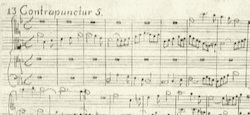
In music, stretto essentially means the overlapping of the same melodic idea/subject in two or more voices. Stretto can thus be considered a canonic technique, although it is usually applied only to a particular passage or passages within a piece that is not itself a canon. Stretto occurs typically in fugues. Paul Walker gives the
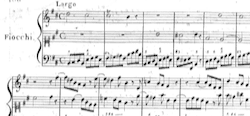
The term disposizione is used in the partimento tradition to refer to a fully written-out realization on as many staves as there are parts (in score) and in the Neapolitan counterpoint tradition to refer to a counterpoint exercise to be worked out in score. See also intavolatura. See also partimento. Select Bibliography Fenaroli, Fedele. METODO PER
What Is a Disposizione? Read More »
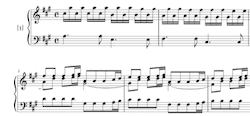
The term intavolatura is used in the partimento tradition to refer to a fully written-out keyboard realization (on two staves). An important collection of intavolature is the so-called Parma Manuscript. It contains 24 keyboard realizations from the third book of partimenti by Fedele Fenaroli (1730–1818). See also disposizione. See also partimento. Select Bibliography Fenaroli, Fedele. METODO
What Is an Intavolatura? Read More »
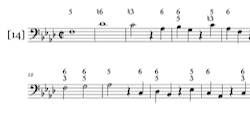
In his book The Art of Partimento, Giorgio Sanguinetti gives the following general definition: “a partimento is a sketch, written on a single staff, whose main purpose is to be a guide for improvisation of a composition at the keyboard”(Sanguinetti (2012), p. 14). It can be provided with or without thoroughbass figures. See also partimento
What Is a Partimento? Read More »
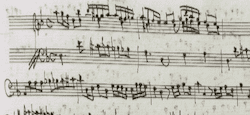
A partimento diminuito is a partimento for which the composer provided one or more models/suggestions of how it can be realized. Those models were incipits —and thus quite short— and not necessarily referring to the first bar(s). The term first appears in the pedagogical oeuvre of the Neapolitan maestro Francesco Durante (1684–1755). In turn, one
What Is a Partimento Diminuito? Read More »