This essay is the first in a series exploring Johann David Heinichen’s General-Bass in der Composition.
Heinichen’s General-Bass in der Composition (1728) is a monumental thoroughbass treatise in German-Italian style, covering not only technical topics such as dissonance treatment, the realization of quick bass notes and full-voice accompaniment, but also many aesthetic considerations.
In this essay, I provide historical background and context for Heinichen’s General-Bass in der Composition (henceforth GBC), and I also explain the rationale behind this series of essays. This series also takes George J. Buelow’s groundbreaking study of Heinichen’s treatise —Thorough-Bass Accompaniment according to Johann David Heinichen (third edition, 1992)— into account, while expanding on it and putting it into perspective.
Historical Background and Context
Albeit a lesser-known name today, Johann David Heinichen (1683–1729) was internationally hailed not only as a celebrated opera composer in both Germany and Italy and as Kapellmeister of what was then Europe’s most renowned orchestra, that of the court of Dresden, but also —and perhaps foremost— as the author of the GBC. In this monumental treatise, Heinichen extensively tackles —in an unprecedentedly thorough manner— many issues of both thoroughbass and composition. As George J. Buelow states, “it is the single most important resource on the thoroughbass written during the Baroque, and the most practical and inclusive tool for reconstructing the style and form of thoroughbass accompaniment for music written after 1700 in the German-Italian theatrical styles”.1
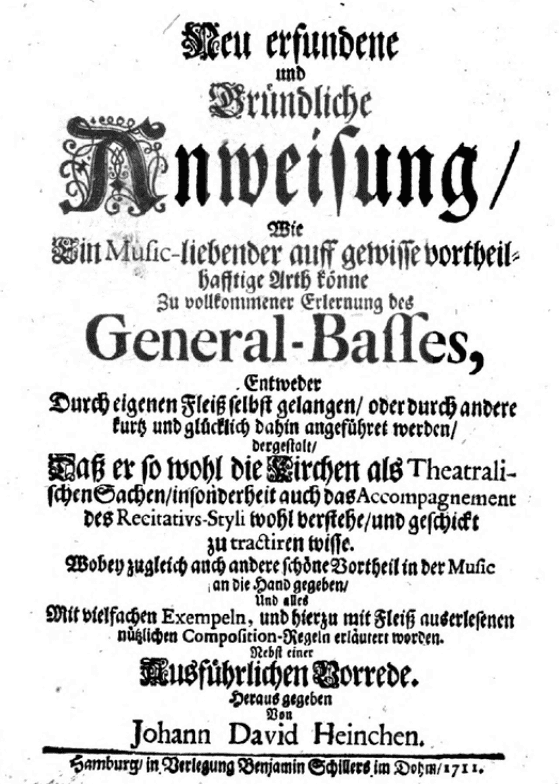
As early as 1711, a few years after Heinichen had completed his musical training as a composer with Leipzig Thomascantor Johann Kuhnau (1660–1722), he had already published a thoroughbass treatise, Neu erfundene und Gründliche Anweisung … zu vollkommener Erlernung des General-Basses (henceforth AGB), often considered the first edition of the GBC. However, the concepts of the two treatises differ considerably. Indeed, the GBC substantially alters the general concept and clearly intends to widen its scope. First, the number of pages is more than tripled, from 284 to 960, and it now includes a huge number of musical examples, both abstract and taken from an array of composers, many references to publications by other theorists, and many extensive footnotes, which offer the nuance typical of a great musician such as Heinichen and also deal with aesthetic issues. By contrast, the AGB contains only two references to other theorists: one to the foreword of Musicalische Vorstellung einiger Biblische Historien (1700) by his former teacher Kuhnau and another to Musurgia Universalis (1650) by Anthanasius Kircher (1601/02–1680). Second, whereas thoroughbass is the sole topic of the AGB, the GBC not only deals with thoroughbass as such, but also takes it as a starting point for composition. Third, and perhaps most importantly, while the AGB offers an excellent insight into thoroughbass principles of the German style from the early eighteenth century, the GBC extensively deals with a number of thoroughbass aspects typical of the Italian style from that period. The GBC can actually be seen as a testimony to everything Heinichen picked up and applied during the seven years he worked in Italy, from approximately 1710 to early 1717, most notably as a highly successful opera composer in Venice. During that period, it seems plausible that he encountered leading composers such as Francesco Gasparini (1668–1727) —whose thoroughbass treatise was of great influence on Heinichen—, Antonio Lotti (1667–1740) and Antonio Vivaldi (1678–1741).
Rationale for this Series
Heinichen’s GBC contains a wealth of practical information regarding numerous parameters of thoroughbass playing. However, the language of both Heinichen and Buelow is not always easy to understand, and Buelow mostly gives only English translations of Heinichen’s quotations. This series intends to disclose that information in clearly formulated and illustrated essays, also including the original quotations in German. In addition, certain assumptions by Buelow will be put into perspective.
Earlier Studies
Besides Buelow’s extensive study of the GBC, which also includes commentary on the AGB, the following publications are also worthwhile consulting for Heinichen’s views on thoroughbass playing:
- Franck Thomas Arnold’s book The Art of Accompaniment from a Thorough-Bass (originally 1931)
- Jesper Bøje Christensen’s workbook Die Grundlagen des Generalbaßspiels im 18. Jahrhundert — Ein Lehrbuch nach zeitgenössischen Quellen (1992), also available in English and French translations
- Buelow’s article The Italian Influence in Heinichen’s Der General-Bass in der Composition (1994)
- Siegbert Rampe’s book Generalbasspraxis 1600–1800 (2014)
Original Sources
- A digital version of the original edition of the AGB is available here:
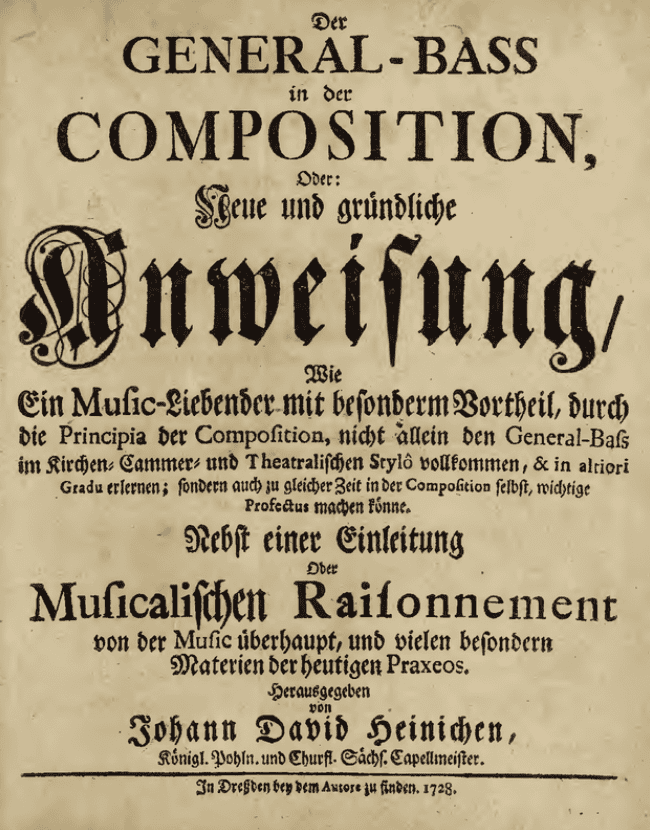
- A digital version of the original edition of the GBC is available here:
https://imslp.org/wiki/Der_General-Bass_in_der_Composition_(Heinichen%2C_Johann_David)
Notes
- Buelow, 1994: 47. ↩︎
Select Bibliography
Arnold, Franck Thomas. The Art of Accompaniment from a Thorough-Bass (2 volumes) (Oxford: Oxford University Press, 1931; unabridged and unaltered republication by Dover Publications in 1965 (with a new introduction) and 2003).
Buelow, George J. Thorough-Bass Accompaniment according to Johann David Heinichen (third edition, Lincoln and London: University of Nebraska Press, 1992).
⸻. The Italian Influence in Heinichen’s Der General-Bass in der Composition (1728), in: Basler Jahrbuch für Historische Musikpraxis XVIII, ed. Reidemeister, Peter (Winterthur: Amadeus Verlag, 1994), 47–65.
Christensen, Jesper Bøje. Die Grundlagen des Generalbaßspiels im 18. Jahrhundert: Ein Lehrbuch nach zeitgenössischen Quellen (Kassel: Bärenreiter, 1992).
⸻. Les Fondements de la Basse Continue au XVIIIe siècle : Une méthode basée sur les sources d’époques (Basel: Bärenreiter, 1995).
⸻. 18th Century Continuo Playing: A Historical Guide to the Basics (Kassel: Bärenreiter, 2002).
Forkel, Johann Nikolaus. Ueber Johann Sebastian Bachs Leven, Kunst und Kunstwerke (Leipzig, 1802).
Heinichen, Johann David. Der General-Bass in der Composition (Dresden, 1728).
Rampe, Siegbert. Generalbasspraxis 1600–1800 (Laaber: Laaber Verlag, 2014).
Williams, Peter. Johann Sebastian Bach and the Basso Continuo, in: Basler Jahrbuch für Historische Musikpraxis XVIII, ed. Reidemeister, Peter (Winterthur: Amadeus Verlag, 1994), 67–86.