In this essay, I discuss Telemann’s views on direct fifths and octaves.
Telemann takes a stricter stance on direct fifths and octaves than his 18th-century colleagues —recommending to avoid them also between the bass and an inner part— yet remains flexible, occasionally even producing outer-part progressions that are downright objectionable.
The musical examples are taken from Derek Remeš’s digital and freely available edition of the SSGBÜ, which can be downloaded at https://doi.org/10.17877/TUDODATA-2025-MC06WAYR.
Note further that
- the translations of Telemann’s quotes are mine
- “bar 1a” refers to the first half of bar 1, and “bar 1b” to the second half
- the term “Oberstimme” refers to the upper part of the thoroughbass realization
- I use Robert Gjerdingen’s black-circled figures to indicate scale steps in an upper part (e.g. ➍–➌) and white-circled figures to indicate scale steps in the bass (e.g. ⑦–①).
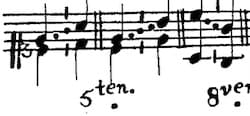
It would appear that the general consensus in eighteenth-century Germany was that direct fifths and octaves could cause issues only between the outer parts, as Friedrich Wilhelm Marpurg, for instance, discusses in the first volume of his Handbuch bey dem Generalbasse und der Composition from 1755.1 Telemann, however, was more conservative in this regard, judging that a direct fifth or octave could also cause an issue between the bass and any middle part. Commenting first on (a) in aria 3, then on (a) in aria 2, he explains the following:
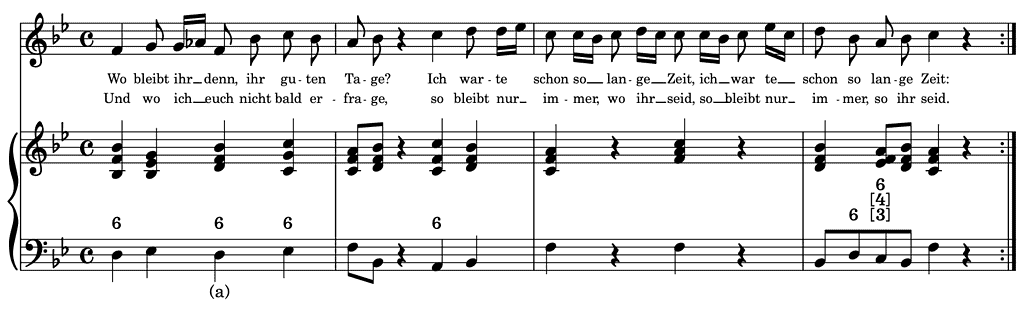
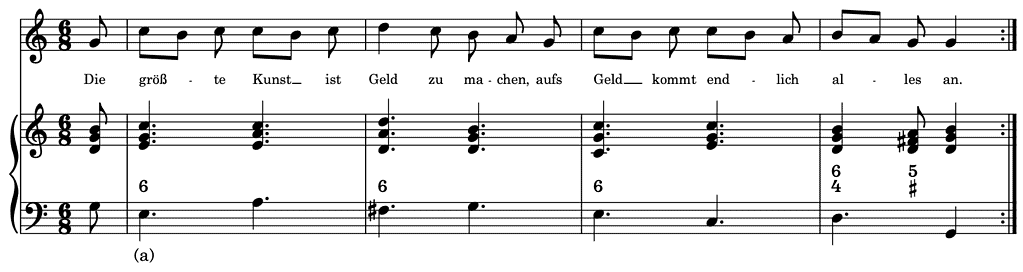
“[In aria 3 at] (a) Here the bass, and not the 6 is doubled, because otherwise octaves and fifths would have resulted at the following note, thus:
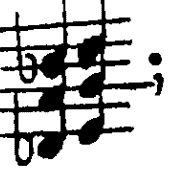
On the other side [in aria 2] at (a), this bass doubling took place in order to avoid a direct fifth [a–e1 in the bass and tenor part on beat 2]. Direct fifths and octaves occur when, counting in a straight line from the bass up to the upper note, or from the upper note down to the lower, a fifth or octave emerges among one of the last notes:”
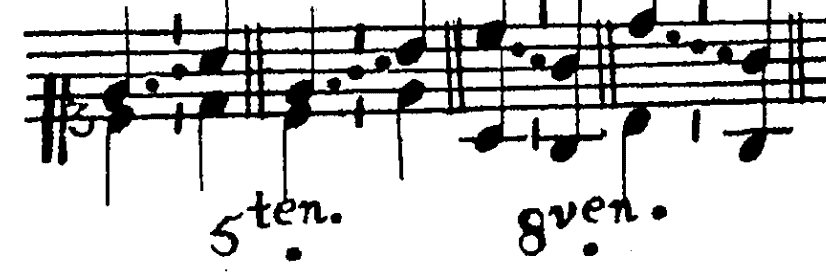
“(a) Hier wird der bass, und nicht die 6, darum verdoppelt, weil sonst beÿ der folgenden note 8 und 5 entstanden wären, also:
drüben beÿ (a) geschahe diese verdoppelung, um eine verdeckte 5 zu vermeiden. Verdeckte 5 und 8 sind, wann ich vom basse bis zur obern note, oder von der obern bis zur untern, in gerader linie forzehle, und alsdann in einigen der letzten noten sich 5 oder 8 hervorthun:”
From this description and the accompanying examples, it becomes clear that direct fifths and octaves are problematic when the two responsible parts move in the same direction and (at least) the upper part leaps. However, when the upper part moves stepwise or leaps within the same chord, Telemann finds a direct fifth —and octave, as his realizations illustrate— between the outer parts permissible. Still, even in those cases, he defends contrary motion, eliminating any discussion as to whether this type of direct fifth is permissible. See aria 4, and his comments and illustrations below.
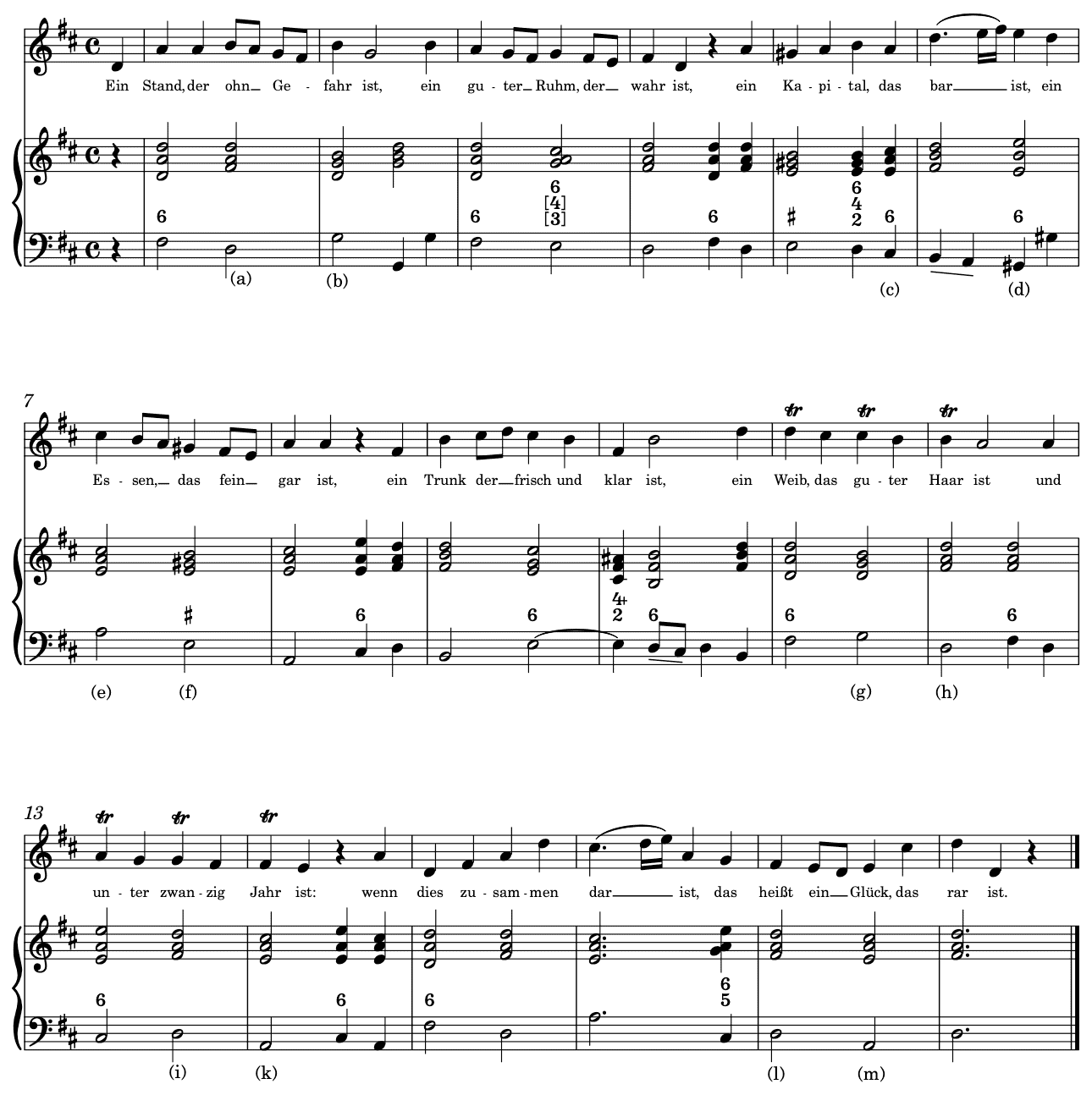
“Some of the direct fifths are considered permissible, as:

it will therefore be no cardinal offence to violate more of them when necessity demands it and one otherwise has reason to do so; just as all rules extend no further than possibility permits; yet possibility is capable of much, and order is always good.2 Contrary motion is a means of avoiding direct fifths and octaves, as (a b), (d e), and (g h) show; in (e f), (i k), and (l m), however, such fifths are present:

these could have been avoided by means of contrary motion. But we have expressed ourselves on this matter above; and moreover, they may be counted among the permissible ones.”
“Es werden einige der verdeckten 5. für erlaubt gehalten, als:
also wird es kein haupt-verbrechen seÿn, auch gegen mehrere zu sündigen, wenn es die noht erfodert, und man sonst uhrsache dazu hat; gleichwie alle reguln sich nicht weiter erstrecken, als sie die möglichkeit zulässt; diese aber vermag viel, und ordnung ist immer gut. Die entgegen-bewegung ist ein mittel, die verdeckten 5 und 8 zu vermeiden, wie (a b) (d e) (g h) zeigen; bey (e f) (i k) (l m) hingegen sind dergleichen 5:
diese hätten durch die entgegen-bewegung gehoben werden können. Aber wir haben uns oben darüber erkläret; und über dem kann man sie zu den erlaubten zehlen.”
According to Telemann, contrary motion is particularly suited for progressions where the bass leaps up a fourth and both bass notes of that rising fourth are set with a triad, a view he expresses in relation to aria 5:
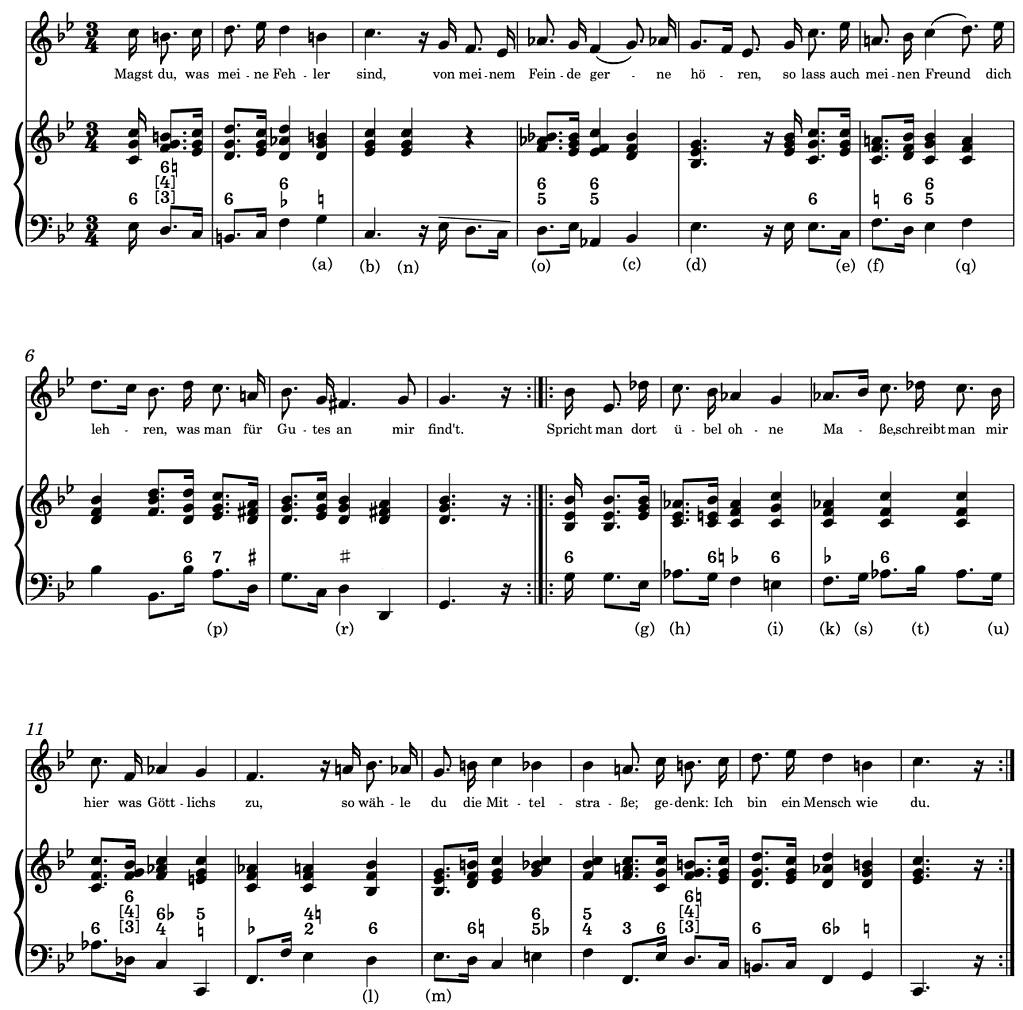
“In order to become acquainted with contrary motion —that is, when the right and left hands move towards or away from each other— one should observe (a b), (c d), (e f), (g h), (i k), and (l m). It is particularly to be employed when the bass ascends a fourth set with two triads, as in (c d), (e f), and (g h), or when a triad follows after a 6, as in (i k) and (l m).”
“Um mit der entgegen-bewegung, wann nemlich die rechte und linke hand sich gegen oder von einander bewegen, bekandt zu werden, so bemerke man (a b) (c d) (e f) (g h) (i k) (l m). Insonderheit ist sie anzubringen, wann der bass eine 4 in zween accorden aufwerts steiget, wie beÿ (c d) (e f) (g h), oder wann nach einer 6 ein accord folget, wie bey (i k) (l m).”
The fact that, in the case of a clausula basizans, this voice leading results in ➐ not rising stepwise to ➊ but leaping down to ➎ is clearly no problem for Telemann —a feature, for that matter, that he leaves unmentioned. In fact, throughout the SSGBÜ, a stepwise rising leading note is not at all a priority for Telemann when it occurs in a middle part of the thoroughbass realization, as he favours contrary motion.3 In aria 5 at (c d) for instance, d1 in the tenor part does not rise to e♭1 but leaps down to b♭ in E flat major, even if a voice-leading progression with a stationary b2 in the upper part and rising steps in the middle parts would have resulted in good voice leading.4 As a matter of fact, Telemann writes this very voice leading during the final cadence of aria 6:
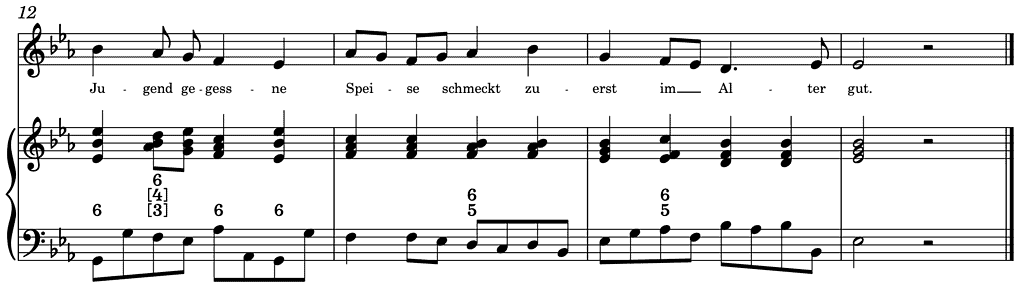
Despite this rather severe approach to direct fifths and his preference for contrary motion, Telemann is not rigid, as he mentions himself and the example above already illustrates. He occasionally even produces downright questionable voice leading, a telling example of which is beat 3 of bar 6 of this aria, where the outer parts —the Oberstimme doubling the vocal part— are engaged in a descending direct fifth with both parts leaping.
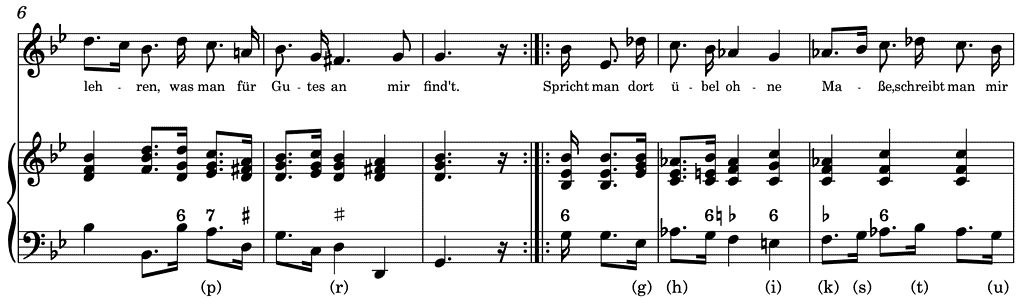
Many more direct fifths occur in the SSGBÜ, almost all
- descending with all four parts descending
- with ➐ leaping down to ➎
- in the context of a cadence.
Just two further examples suffice here. A first example of a descending direct fifth occurs between the outer parts from beat 4 of bar 12 to the downbeat of bar 13 of aria 36:
A striking example of a simultaneously rising direct fifth —albeit between the bass and tenor part— and a rising direct octave —albeit between the bass and alto part— occurs in bar 11b–12a of aria 29:
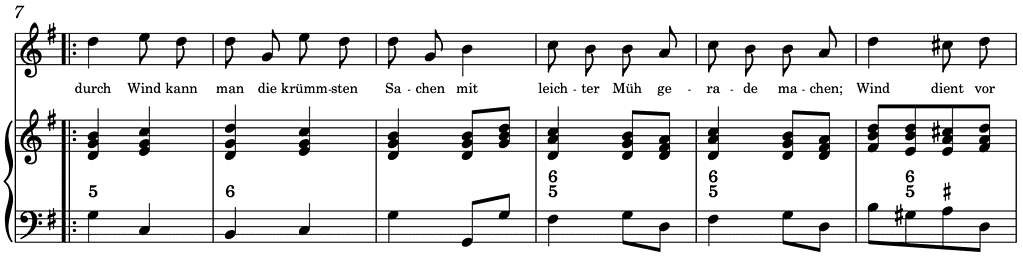
One could argue that the impact of this voice leading is somewhat softened because a new phrase starts on the downbeat of bar 12, yet the fact that all the parts —the Oberstimme again doubling the vocal part— leap up makes this voice leading quite audible anyway. Telemann is clearly not bothered by this, otherwise he would have written the chord on the last eighth note of bar 11 one position higher, with d2 in the Oberstimme. (In this case, he seems to have preferred reproducing the voice leading of the previous bar, whose Oberstimme yet again doubles the vocal part.)
(For Telemann’s take on the succession of a direct and a diminished fifth —they occur in the outer parts in the example above in bars 9b–10a and 10b–11a— see my essay Telemann’s SSGBÜ: On Parallel Fifths.)
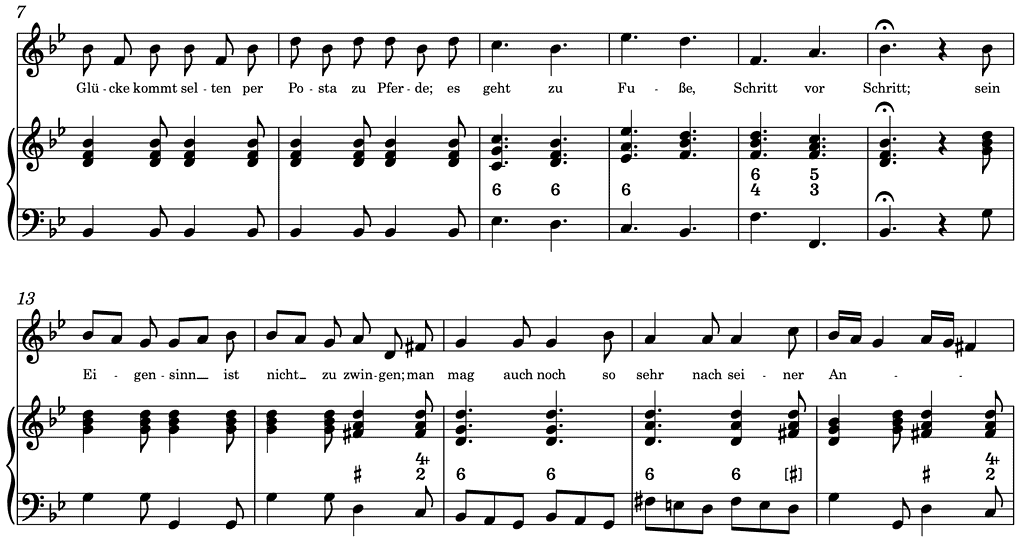
Contrary to direct fifths, direct octaves with a leap in the upper part are extremely rare in the SSGBÜ. In fact, there is only one example, between the bass and tenor part of bar 12 of aria 33, although its first note closes the A part while its second note opens the B part:
Consider bar 22 of aria 24 now. Telemann is clearly not bothered by a diminished seventh that resolves correctly in the upper part (here in the Oberstimme) but whose bass leaps down a third to create a vertical octave in a setting, moreover, in which all the parts descend:
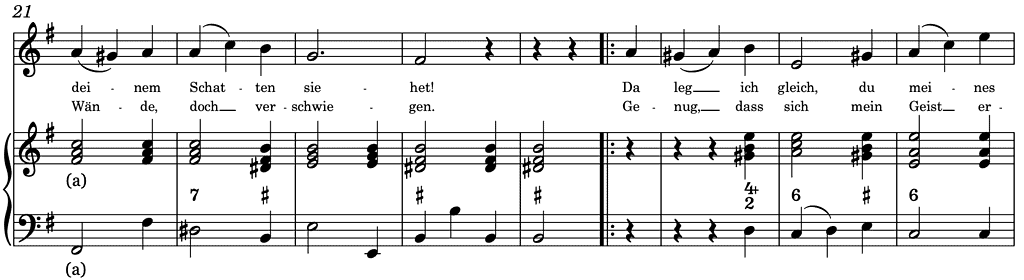
This is a type of voice leading that some eighteenth-century musicians did not consider unproblematic, despite the upper part moving down stepwise. Marpurg, for instance, in the second volume of his Handbuch bey dem Generalbasse und der Composition from 1757, expresses a reserved attitude to it. In the section devoted to the possible vertical intervals that can be used to accompany the resolution of the seventh, after having discussed the third, the fifth and the sixth, he writes the following: “We now continue with the resolutions of the seventh and consider how it takes place fourthly in the octave, when the bass descends a third. One therefore makes best use of it in full-voiced works, placing the interval of the seventh preferably in the middle voices rather than in the outer ones. The safest procedure for resolving the seventh to the octave is to fill in the space of a third in the bass beforehand with an accented passing note,5 as in Figure 13 (a), so as to forestall the opportunity of producing a faulty octave progression by means of a passing note, as in Fig. 13 (b).”
“Wirfahren anitzo in den Auflösungen der Septime fort, und sehen wie solche geschicht Viertens in die Octave, wenn der Baß eine Terz unter sich geht. Fig. 12. Dieses ist die lezte consonirende Resolution der Septime, aber die unsicherste, wegen der im Terzenraum des Basses dazwischen liegenden Octave. Man bedienet sich also selbiger am besten in vollstimmigen Sachen, und zwar bringet man das Intervall der Septime lieber in die Mitte, als in der äussersten Stimmen. Am sichersten verfährt man mit der Auflösung der Septime in die Octave, wenn man den Terzenraum im Bass zum voraus mit einer Wechselnote ausfüllt, so wie bey Figur 13. (a) damit der Gelegenheit vorgebeuget werden, vermittelst eines Durchgangs, so wie bey Fig. 13. (b) eine fehlerhafte Octavenfolge hören zu lassen.”6
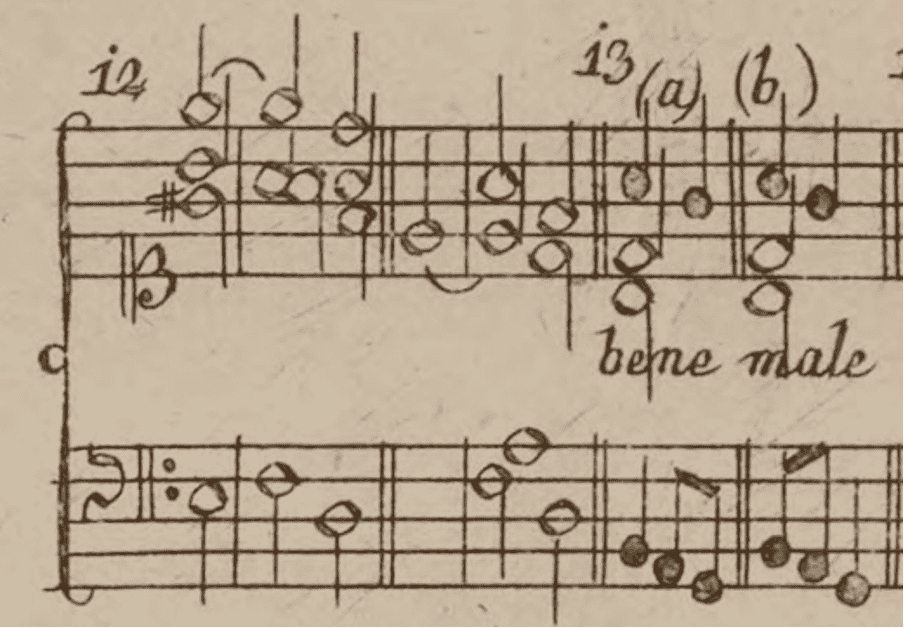
Tab. IV Fig. 12, 13a and 13b, public domain,
available on https://imslp.org
And someone like Johann Sebastian Bach seems to have been reluctant to use this voice leading in a four-part texture, even when the seventh appears in a middle voice. A telling example occurs in Contrapunctus 2 from The Art of Fugue BWV 1080, where he makes elaborate use of a motif combining two neighbouring subject tails, the first one introduced with a suspension.
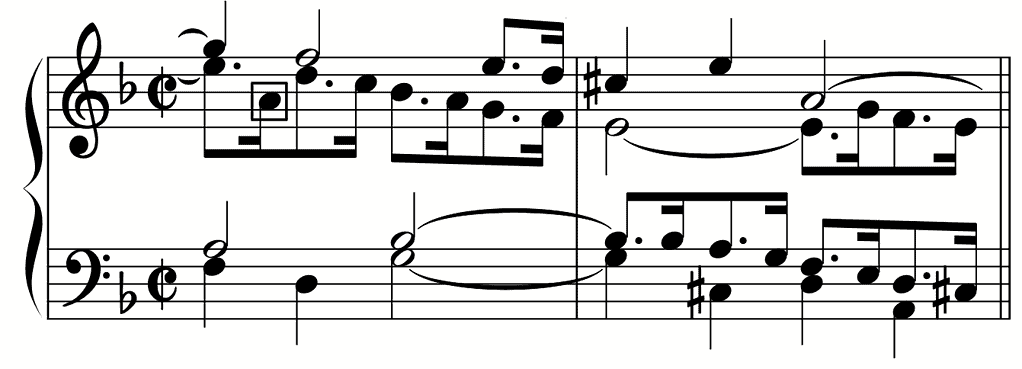
This double motif generally appears in its standard form —as in the tenor in bar 74— but in bar 73 the alto does not repeat the e2 immediately following the suspension but leaps down instead to a1. The most plausible explanation, I would argue, is that Bach was here deliberately sidestepping the descending direct octave between alto and bass that a repeated e2 would have produced.7
Notes
- Marpurg, 1755: 68. ↩︎
- Note that in his digital edition, Derek Remeš erroneously translates “diese aber vermag viel, und ordnung ist immer gut” as “the rules enable much and order is always good [?]”. After all, “diese” does not refer to “the rules” but to “the possibility” (“die möglichkeit”), and “vermag” is a singular rather than plural form of “vermögen” (“to be capable of”). His translation as it stands is indeed somewhat nonsensical, which is why he adds “[?]” to indicate that its precise meaning eludes him. Telemann’s formulation and intention, however, are clear: one mostly has several options to avoid voice-leading liberties or issues, while “order” —respect for the rules— remains something to strive for. ↩︎
- The SSGBÜ contain two examples in arias 3 and 36, where ➐ does occur in the Oberstimme and does not rise to ➊. Still, the harmonic context is different, not being a clausula basizans but a deceptive and a modal cadence, respectively, the Oberstimme in both cases descending stepwise from ➐ to ➏. See my essay Miscellaneous Voice-Leading Licences. ↩︎
- Two more instances of this type of voice leading on a rising ⑤–① progression in the bass occur in this aria:
• at (g h), where the local key is A flat major (note the d♭2 in the vocal part)
• during the transition from bar 11 to 12, where the local key is F minor (Telemann did not mark this spot, which must be an oversight). ↩︎ - Note that the term Wechselnote does not translate as neighbour note here; after all, this term was used in galant Germany usually for what we would call today an accented passing note. For more information, see my essays Indicating Accented Passing Notes in Thoroughbass and The Querstrich in Thoroughbass Figuring: What Can It Mean?. ↩︎
- Marpurg, 1757: 101–102. ↩︎
- For more information, see my book Johann Sebastian Bach’s Art of Fugue — Performance Practice Based on German Eighteenth-Century Theory (Leuven: Leuven University Press, 2013), p. 162–163. ↩︎
Select Bibliography
Arnold, Franck Thomas. The Art of Accompaniment from a Thorough-Bass (2 volumes) (Oxford: Oxford University Press, 1931; unabridged and unaltered republication by Dover Publications in 1965 (with a new introduction) and 2003).
Christensen, Jesper Bøje. Die Grundlagen des Generalbaßspiels im 18. Jahrhundert: Ein Lehrbuch nach zeitgenössischen Quellen (Kassel: Bärenreiter, 1992).
Christensen, Jesper Bøje. Les Fondements de la Basse Continue au XVIIIe siècle : Une méthode basée sur les sources d’époques (Basel: Bärenreiter, 1995).
Christensen, Jesper Bøje. 18th Century Continuo Playing: A Historical Guide to the Basics (Kassel: Bärenreiter, 2002).
Demeyere, Ewald. Johann Sebastian Bach’s Art of Fugue — Performance Practice Based on German Eighteenth-Century Theory (Leuven: Leuven University Press, 2013).
Heinichen, Johann David. Der General-Bass in der Composition (Dresden, 1728).
Marpurg, Friedrich Wilhelm. Handbuch bey dem Generalbasse und der Composition (Berlin, 1755 (vol. 1) and Berlin, 1757 (vol. 2)).
Mattheson, Johann. Kleine General-Bass-Schule (Hamburg, 1735).
Rampe, Siegbert. Generalbasspraxis 1600–1800 (Laaber: Laaber Verlag, 2014).
Telemann, Georg Philipp. Singe-, Spiel- und General-Bass-Übungen (Hamburg, 1733–34).
Telemann, Georg Philipp. Singe-, Spiel- und General-Bass-Übungen TWV 25:39-85 für Singstimme & Tasteninstrument — Revidierte Neuausgabe, ed. Wolf Hobohm (Magdeburg: Edition Walhall – Verlag Franz Biersack, 2003).
Zohn, Steven. Music for a Mixed Taste: Style, Genre, and Meaning in Telemann’s Instrumental Works (New York: Oxford University Press, 2008/2015 (revised paperback edition)).