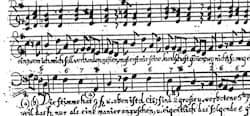
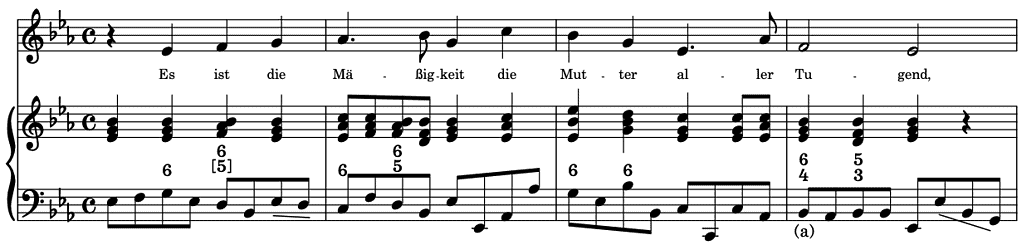
In this essay, I will discuss Telemann’s views on parallel fifths, both within the keyboard realization and between one of its parts and the vocal part. The SSGBÜ include rules and guidelines for the succession of two perfect fifths, of a perfect to a diminished fifth and vice versa.
Telemann forbids consecutive perfect fifths within a realization, but not between one of its parts and the vocal part. The succession of a perfect and a diminished fifth, or vice versa, can occur within a realization under certain conditions, and always between one of its parts and the vocal part.
The musical examples are taken from Derek Remeš’s digital and freely available edition of the SSGBÜ, which can be downloaded at https://doi.org/10.17877/TUDODATA-2025-MC06WAYR.
Note further that
- the translations of Telemann’s quotes are mine
- “bar 1a” refers to the first half of bar 1, and “bar 1b” to the second half
- the term “Oberstimme” refers to the upper part of the thoroughbass realization.
Parallel Fifths in the Keyboard Realization
Parallel perfect fifths are not permitted in a keyboard realization. Telemann illustrates this prohibition in aria 3 (not shown), aria 12 (see paragraph “6/5♭ Instead of 6 on ⑦” in my essay Telemann’s SSGBÜ: Chord Substitutions and Additions) and in aria 17 (see below). However, Telemann is more lenient regarding the succession of a perfect to a diminished fifth, and vice versa, and of two diminished fifths.
Referring to (a) in bar 3 of aria 16, Telemann writes the following:
“From this bass note to the following, the middle notes in the realization form two fifths; these are permitted when one of them, or both, are diminished.”
“Von dieser, bis zur folgenden, machen oben die mittelsten noten zwo 5.ten; solche werden erlaubt, wann eine davon, oder alle beÿde, klein sind.”1
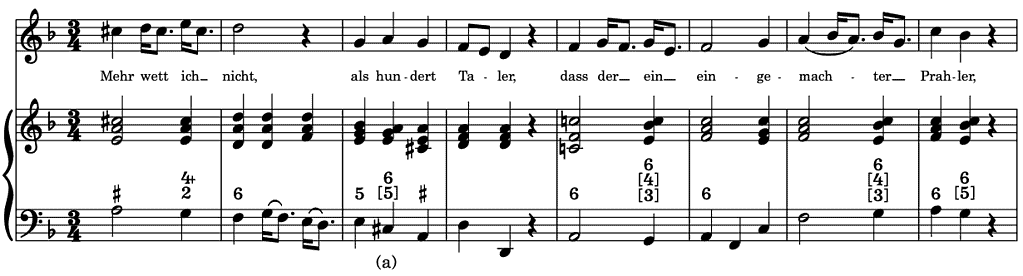
The specific voice leading at (a) in the example above —the descending succession of a diminished to a perfect fifth— will be dealt with in more detail below. As a matter of fact, on several other occasions in the SSGBÜ, Telemann elaborates on the succession of a diminished and a perfect fifth, of a perfect and a diminished fifth, as well as successive diminished fifths. Referring to (a) in bar 21 of aria 24, he states the following regarding rising parallel diminished fifths:
“Not everyone will allow rising diminished fifths. Recently I came across the following:
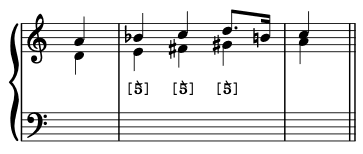
they were resolved as follows:”
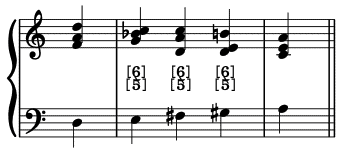
“Kleine 5.ten hinaufwerts will nicht ieglicher verstatten. Iüngst kamen mir folgende vor:
sie waren so aufgelöset:”
From this, we understand that consecutive rising diminished fifths are to be avoided in a keyboard realization; Telemann will return to this, further clarifying and emphasizing this point. Yet from his realization, we also learn something new: it becomes clear that Telemann approves of the rising succession of a perfect to a diminished fifth; after all, d/a1 in the bass and alto part of the realization during the upbeat is followed by e/b♭1 on the downbeat of the only complete bar in this example. Telemann will come back to this voice leading as well, approving it explicitly (see below).
As a matter of fact, the same type of voice leading occurs from bar 20 to 21 in aria 24, where the rising succession of a perfect to a diminished fifth occurs in the outer parts of the right hand.
Note that, despite Telemann mentioning an example containing several consecutive diminished fifths, that consideration does not apply to (a) in aria 24, where only one diminished fifth occurs, its upper part (in the Oberstimme) resolving correctly by descending stepwise motion, after having become a diminished seventh on beats 1 and 2 of bar 22.
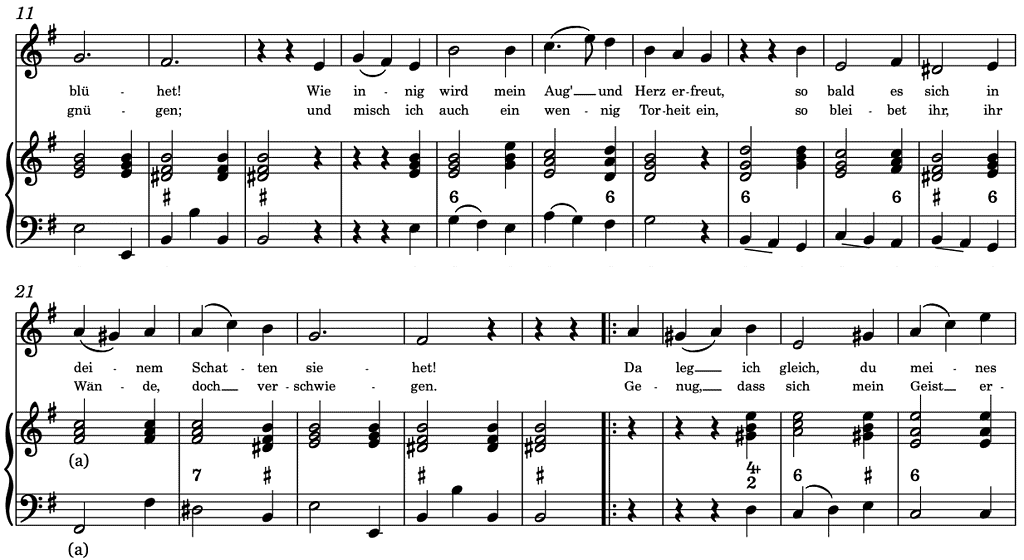
Further information on the succession of a perfect to a diminished fifth —and vice versa— especially between the bass and the Oberstimme is given by Telemann following aria 25:
“On account of what was just mentioned [regarding consecutive diminished fifths below aria 24], we believe that when a perfect fifth moves up to a diminished fifth (especially in the outer parts, namely in the bass and the Oberstimme), this is rather a beauty than a fault; whereas when the [rising] motion proceeds from a diminished fifth to a perfect fifth, the ear is offended thereby. In downward motion we reverse this voice leading. Several consecutive diminished fifths, as the example above [i.e., the one below aria 24] shows, are the composer’s responsibility; it is enough if the keyboard player resolves the figures there indicated properly.”
“Wegen des iüngst-gedachten vermeinen wir, dass, wenn eine grosse quinte in eine kleine hinauf trit, (insondern in den äussersten theilen, nemlich im basse und ganz oben) solches vielmehr eine schönheit, als ein fehler, seÿ, hingegen wann die bewegung von einer kleinen in die grosse geschicht, das ohr dadurch beleidiget werde. Im fortschreiten herunterwerts kehren wir diesen satz um. Mehrere auf einander folgende kleine quinten, wie drüben das exempel zeiget, kommen auf des componisten rechnung an; gnug, wenn der clavirist die figuren, die dort, rein auflöset.”
Let us go systematically through the first two sentences of this quote, relating them to realizations from the SSGBÜ, starting with the first phrase:2
“we believe that when a perfect fifth moves up to a diminished fifth (especially in the outer parts, namely in the bass and the Oberstimme), this is rather a beauty than a fault”
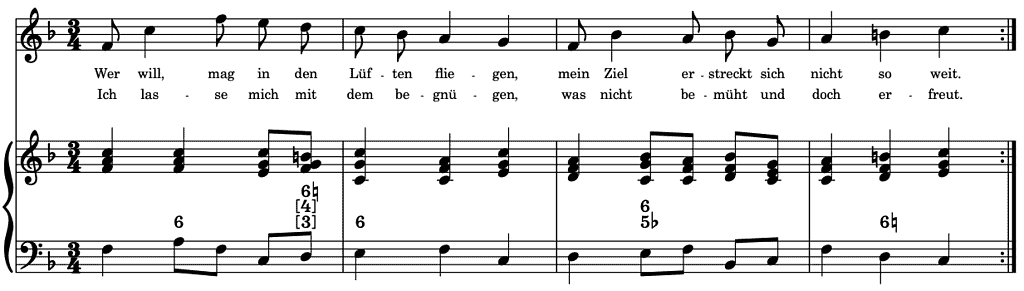
Two examples of a rising succession of a perfect to a diminished fifth between the bass and the Oberstimme occur in the SSGBÜ, the first moving stepwise, in bar 3 of aria 34:
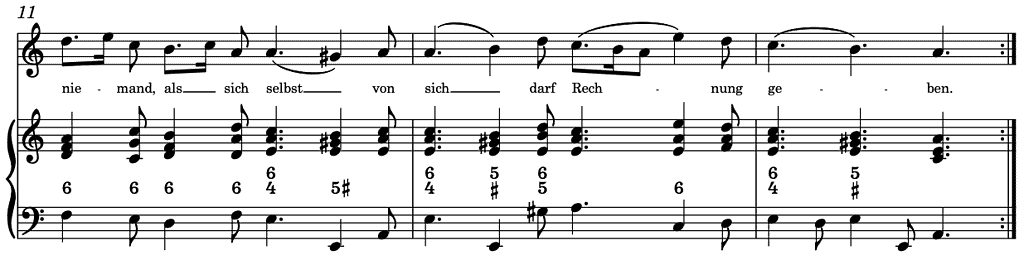
The other rising succession of a perfect to a diminished fifth between the bass and the Oberstimme occurs on beat 2 of bar 12 of aria 12 in leaping form, albeit in the context of what today would be called dominant triad and first-inversion dominant seventh chord:
If Telemann indeed considers the rising succession of a perfect to a diminished fifth between the bass and the Oberstimme “a beauty”, one could wonder why he did not write that voice leading in bar 12 of aria 11. Moreover, a G-minor chord with d 2 in the Oberstimme at that point would have avoided having all the parts of the realization rise towards bar 11b, those in the right hand all leaping.
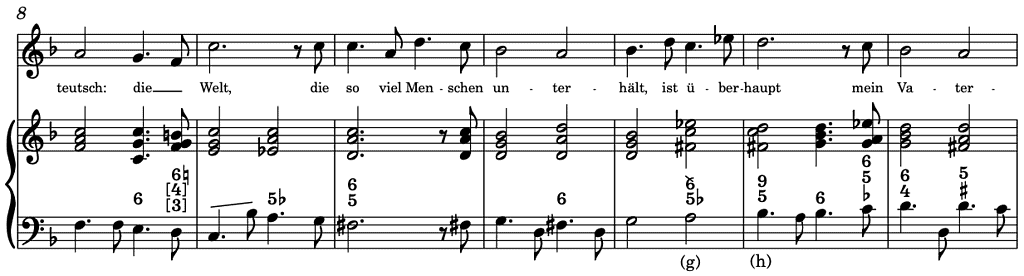
Yet it would appear that in this case he is favouring the voice leading where a vertical third —g–b♭1— is followed by a vertical sixth —f♯–d 2— indeed a standard contrapuntal procedure for a clausula cantizans.
The rising succession of a perfect to a diminished fifth also appears five times in the SSGBÜ between the bass and an inner part of the right-hand realization. The first two instances are found in aria 13:
- in bars 22b–23a, between the bass and the alto part, in stepwise form
- in bar 33, between the bass and the tenor part, in leaping form.
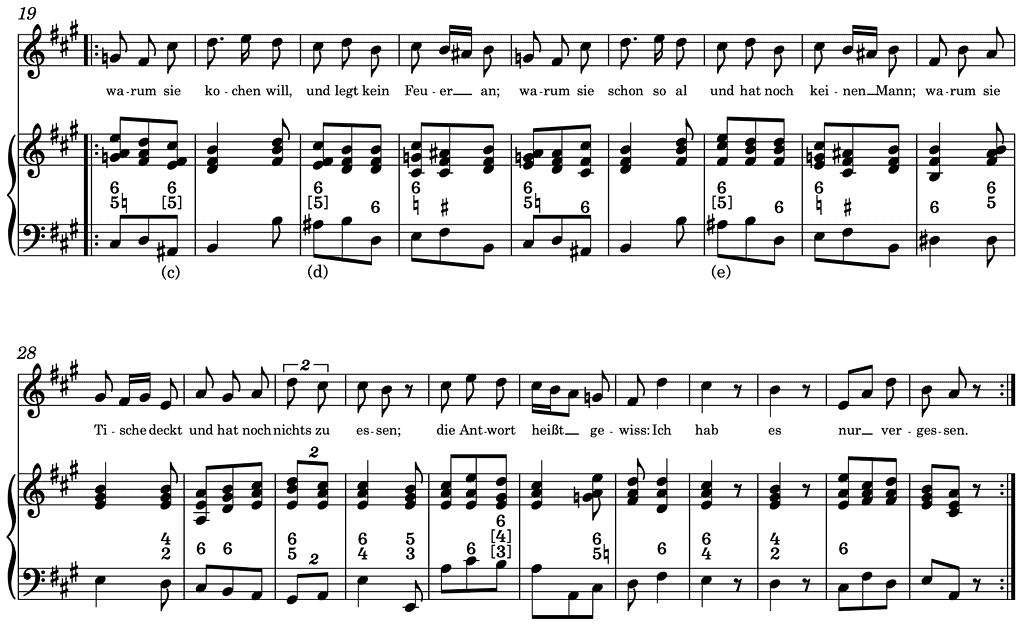
The same harmonic and contrapuntal setting of bar 33 occurs in bar 7 of aria 45 (not shown).
In bar 6 of aria 20, the second example of this voice leading in the SSGBÜ, it appears in stepwise motion between the bass and the tenor:
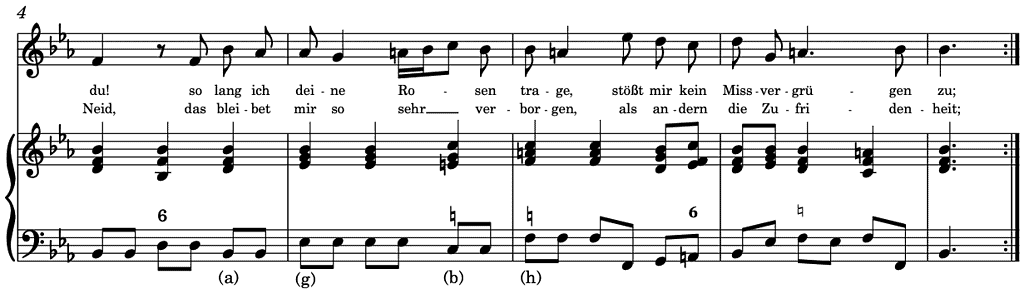
The same harmonic and contrapuntal setting occurs in bar 5 of aria 37 (not shown).
The rising succession of a perfect to a diminished fifth also occurs, albeit once, between the lowest and highest parts of the right-hand realization, in leaping form, in bar 19 of aria 42:
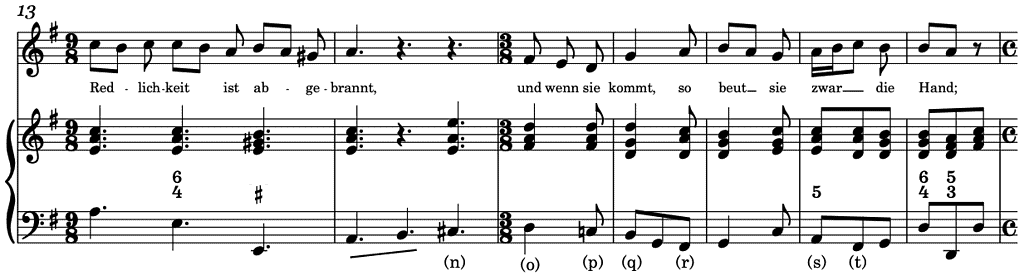
While these examples and guidelines implicitly make clear that Telemann approved of unprepared diminished fifths, he formulates this explicitly in a guideline accompanying aria 6. See my essay Telemann’s SSGBÜ: Miscellaneous Voice-Leading Licences.
Let us turn now to the second phrase of the first sentence:
“when the [rising] motion proceeds from a diminished fifth to a perfect fifth, the ear is offended thereby.” Telemann is consistent in his directive; no such examples of voice leading occur in the SSGBÜ, not between any two parts of the realization.
The second sentence of this quote is not the easiest to grasp, which is why I reproduce the original German version here as well:
“In descending motion we reverse this voice leading.”3
“Im fortschreiten herunterwerts kehren wir diesen satz um.”
I have opted to translate “Satz” in this case not as “movement” or “passage”, but as “setting”, another common meaning of this German word. In fact, the term “Satz” also refers to voice leading and the technicalities of musical composition. Consider for instance the title Johann Philipp Kirnberger gave his multivolume treatise from the 1770s —Die Kunst des reinen Satzes— translated by David Beach and Jurgen Thym as The Art of Strict Musical Composition. As such, one might paraphrase Telemann’s sentence as “In descending motion we change the direction of the parts”, even if this results in a reading that is somewhat tautological. Admittedly, at first sight, this sentence seems to indicate that, in the case of descending motion, the type of fifths mentioned in the first sentence need to be interchanged, which would result in the following hypothetical formulation:
“when a diminished fifth moves down to a perfect fifth (especially in the outer parts, namely in the bass and the Oberstimme), this is rather a beauty than a fault; whereas when the [descending] motion proceeds from a perfect fifth to a diminished fifth, the ear is offended thereby.”
However, the first argument is incomplete and unconvincing, the second downright wrong, both in themselves and with regard to possible examples from the SSGBÜ to illustrate them. First, not only a single example of a descending succession of a diminished to a perfect fifth between the bass and any upper part of the realization occurs in the SSGBÜ; moreover, the bottom note of a diminished fifth usually rises stepwise or descends a third rather than moving down by step. However, a descending succession of a diminished to a perfect fifth does occur twice between the bass and the alto of the right-hand realization, yet both times in the context of a succession that a modern theorist would call a first-inversion dominant seventh chord followed by a dominant triad, thus staying within the same type of chord and thereby ‘softening the blow’, so to speak. We already saw one example of this voice leading, in aria 16 at (a):
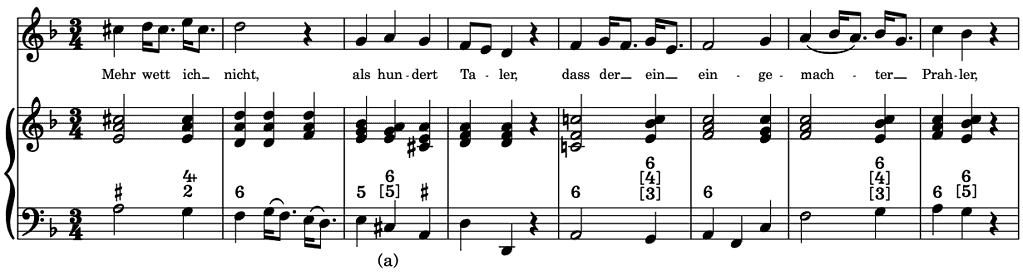
An identical example, yet in major instead of in minor, occurs on beat 2 of bar 2 of aria 36, again between the bass and the alto part of the realization:
Secondly, if the descending succession of a perfect to a diminished fifth between the bass and the Oberstimme were to offend the ear, it would obviously not occur four times in the SSGBÜ, as it does. The first example of this voice leading appears in beat 2 of bar 19 of aria 17:
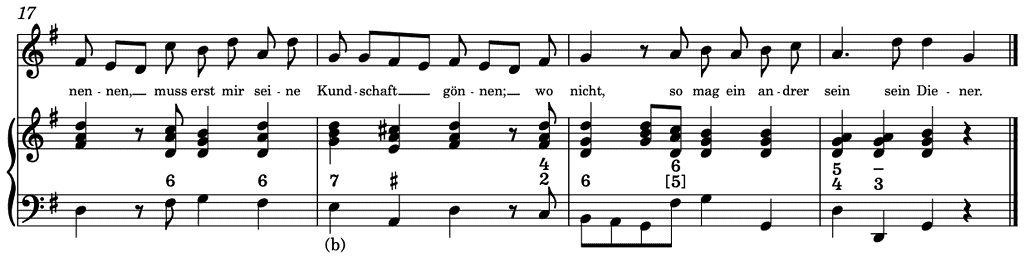
Note that an octave displacement occurs in the bass between the perfect and the diminished fifths.
The second example of a descending succession of a perfect to a diminished fifth between the bass and the Oberstimme appears in the transition from bar 9 to 10 in aria 29, where this voice leading is emphasized arguably due to
- the absence of an octave displacement in the bass
- the change of position, all voices leaping up to the G-major triad with d2 in the Oberstimme on the last eighth note in bar 9
- the fact that the vertical diminished fifth occurs on the strong beat of bar 10:
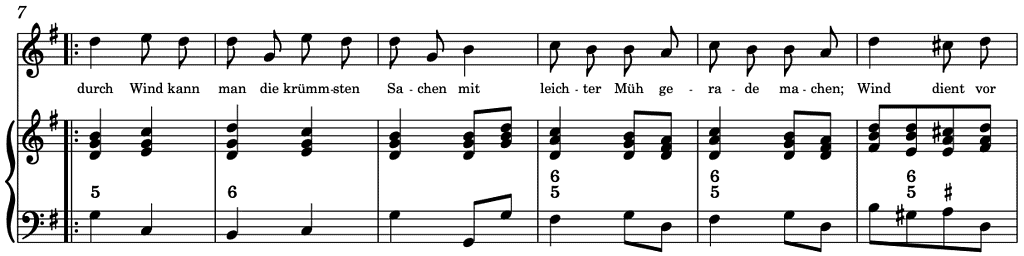
The two other examples of this type of voice leading between the bass and the Oberstimme occur in bar 16 of aria 42 and in bar 8a of aria 43 (not shown).
Parallel Fifths Between the Vocal Part and the Oberstimme
Referring to (a) and (b) in aria 17, Telemann states the following:
“The vocal part has g1 and f♯1, the Oberstimme above d2 and c♯2; they are two perfect and forbidden fifths; they may slip through because the f♯1 is to be regarded merely as an ornament, and in fact the following e1 counts.”
“Die stimme hat g fis u. oben ist d cis; sind 2 grosse und verbotene 5ten; sie mögen durchwischen weil das fis nur als eine manier anzusehen, u. eigentlich das folgende e gilt.”
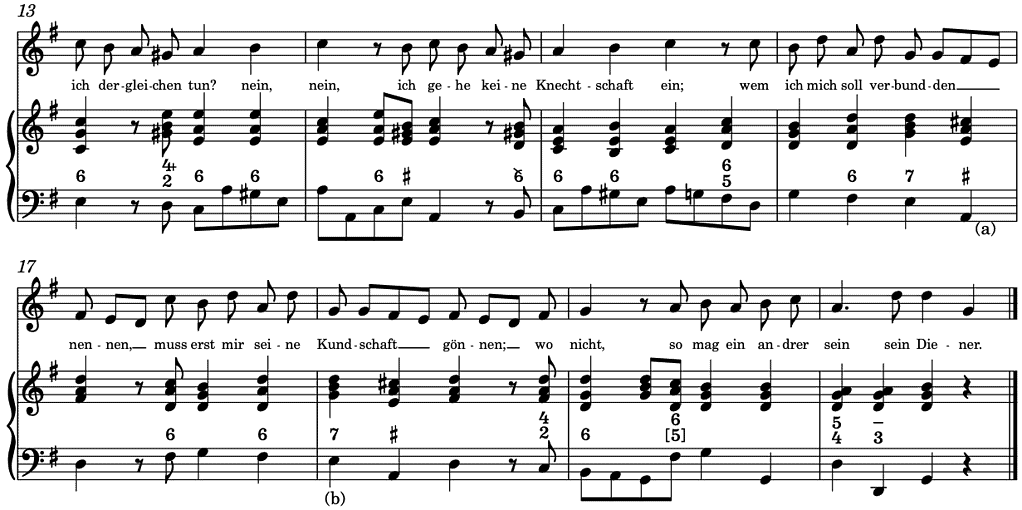
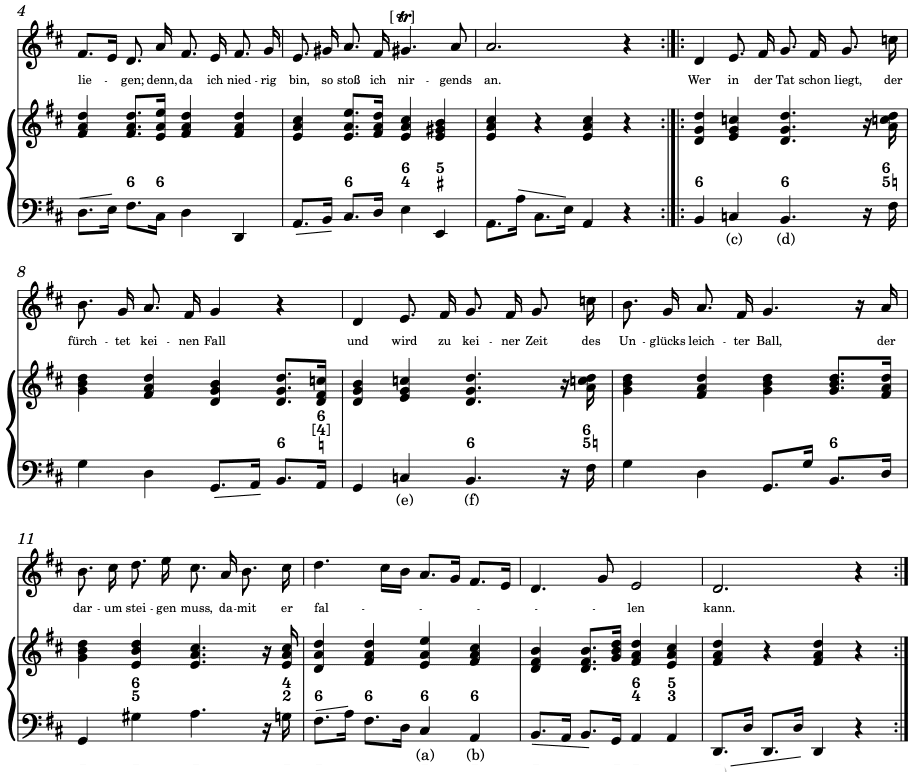
From this directive, one might conclude that, when the vocal part did not include f♯1 but progressed directly from g1 to e1, these fifths between the vocal part and the Oberstimme would not be acceptable for Telemann. Still, referring to three progressions in aria 23, he basically argues that the keyboard realization has its own voice-leading logic, not necessarily having to take the voice leading of the vocal part into account:
“Here the notes in the Oberstimme at (a b) make two perfect fifths with the vocal part:
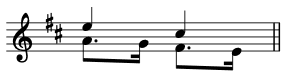
In these cases, and even more so with the two diminished fifths at (c d) and (e f), it is something to be overlooked. For if the player were to proceed solely according to the figures, without score, he would play it in exactly the same way, and yet not be culpable.”
“Hier machen die obersten noten beÿ (a b) mit der singe-stimme zwo grosse quinte:
Es ist beÿ diesen, noch mehr aber beÿ den zwo kleinen beÿ (c d) u. (e f) durch die finger zu sehen. Denn wenn der spieler bloss nach den ziefern, ohne partitur, verführe, so würde er eben so greifen, u. doch nicht strafbar seÿn.”
Notes
- Telemann calls a diminished fifth a kleine quinte, a perfect fifth a grosse quinte. ↩︎
- I will not discuss its third sentence since I have sufficiently covered it above. ↩︎
- While translating this sentence as “In ascending motion we invert this passage” in his digital edition, erroneously rendering “herunterwerts” as “ascending” instead of “descending”, Derek Remeš adds “[?]” after it to indicate that its precise meaning eludes him. ↩︎
Select Bibliography
Arnold, Franck Thomas. The Art of Accompaniment from a Thorough-Bass (2 volumes) (Oxford: Oxford University Press, 1931; unabridged and unaltered republication by Dover Publications in 1965 (with a new introduction) and 2003).
Christensen, Jesper Bøje. Die Grundlagen des Generalbaßspiels im 18. Jahrhundert: Ein Lehrbuch nach zeitgenössischen Quellen (Kassel: Bärenreiter, 1992).
Christensen, Jesper Bøje. Les Fondements de la Basse Continue au XVIIIe siècle : Une méthode basée sur les sources d’époques (Basel: Bärenreiter, 1995).
Christensen, Jesper Bøje. 18th Century Continuo Playing: A Historical Guide to the Basics (Kassel: Bärenreiter, 2002).
Heinichen, Johann David. Der General-Bass in der Composition (Dresden, 1728).
Mattheson, Johann. Kleine General-Bass-Schule (Hamburg, 1735).
Rampe, Siegbert. Generalbasspraxis 1600–1800 (Laaber: Laaber Verlag, 2014).
Telemann, Georg Philipp. Singe-, Spiel- und General-Bass-Übungen (Hamburg, 1733–34).
Telemann, Georg Philipp. Singe-, Spiel- und General-Bass-Übungen TWV 25:39-85 für Singstimme & Tasteninstrument — Revidierte Neuausgabe, ed. Wolf Hobohm (Magdeburg: Edition Walhall – Verlag Franz Biersack, 2003). Zohn, Steven. Music for a Mixed Taste: Style, Genre, and Meaning in Telemann’s Instrumental Works (New York: Oxford University Press, 2008/2015 (revised paperback edition)).