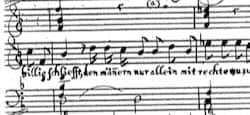
This essay explores Telemann’s views on the number of parts of a thoroughbass realization, as presented in his Singe-, Spiel- und General-Bass-Übungen.
In the SSGBÜ, chords are typically four-part (bass plus three upper parts). For consecutive sixth chords, Telemann recommends three-part chords. In specific cases, five-part and full-voiced chords may be used. Additionally, when necessary, the right hand can simply double the bass in octaves.
This essay concludes with a brief assessment of Telemann’s approach to the number of parts of a thoroughbass realization in comparison with that of some of his contemporaries.
All musical examples are taken from Derek Remeš’s digital and freely available edition of the SSGBÜ, which can be downloaded at https://doi.org/10.17877/TUDODATA-2025-MC06WAYR. Note further that
- the translations of Telemann’s quotes are mine
- “bar 1a” refers to the first half of bar 1, and “bar 1b” to the second half
- the term “Oberstimme” refers to the upper part of the thoroughbass realization
- I use Robert Gjerdingen’s black-circled figures to indicate scale steps in the melody (e.g. ➍–➌) and white-circled figures to indicate scale steps in the bass (e.g. ⑦–①).
Standard Four-Part Realization Without the Use of Unisons
Telemann advocates a standard four-part thoroughbass realization, a texture that is indeed omnipresent in the SSGBÜ. In his discussion on consonances and dissonances below aria 9, Telemann provides the following guideline:
“We have given no place to the unison, which is otherwise also a consonance, because using it would cost us one of the four parts we employ here:”
“Dem Unisono, der sonst auch eine Consonanz ist, haben wir keinen platz eingeräumet, weil uns durch ihn eine von den 4. stimmen, deren wir uns hier bedienen, verloren ginge:”
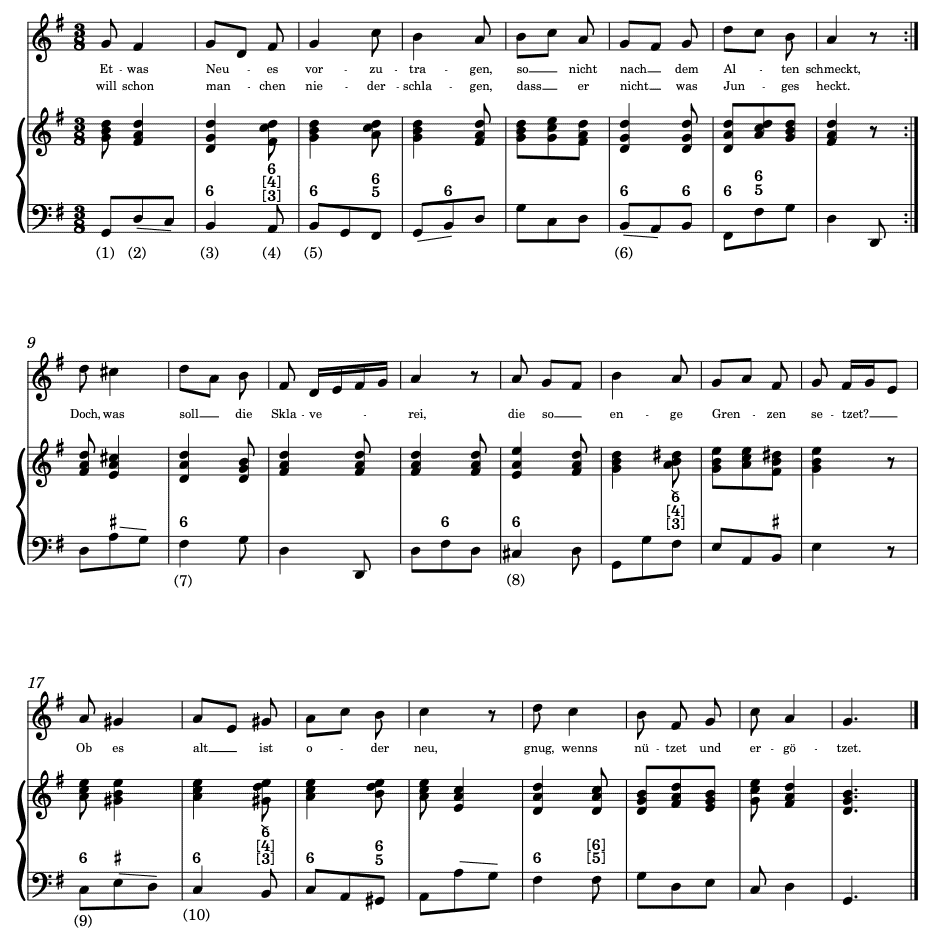
Telemann’s thoroughbass realization of the first aria, for instance, is consistently four-part throughout:
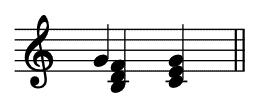
Despite Telemann’s prohibition of three-part settings due to unisons, he does not always follow his own rule, as beat 2 of the final bar of aria 34 illustrates:
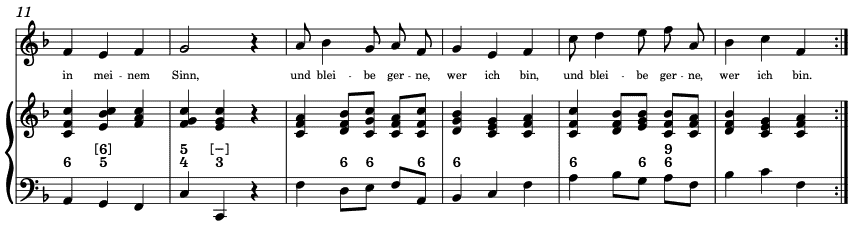
While Telemann recommends a standard four-part realization, he does at times prescribe —or allow— realizations with a different number of parts, usually in response to a specific context. Accordingly, I will discuss below four alternatives he provides, in turn: three-part, five-part, vollstimmige (full-voiced) and two-part thoroughbass realizations.
Three-Part Realization of Consecutive Sixth Chords
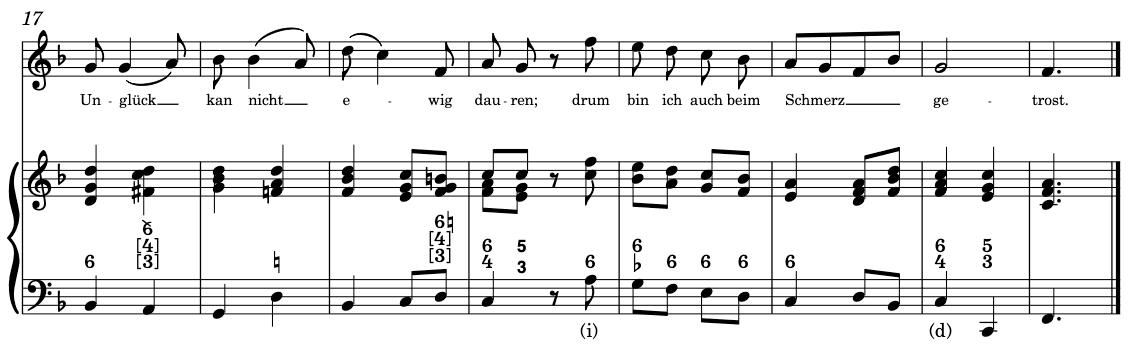
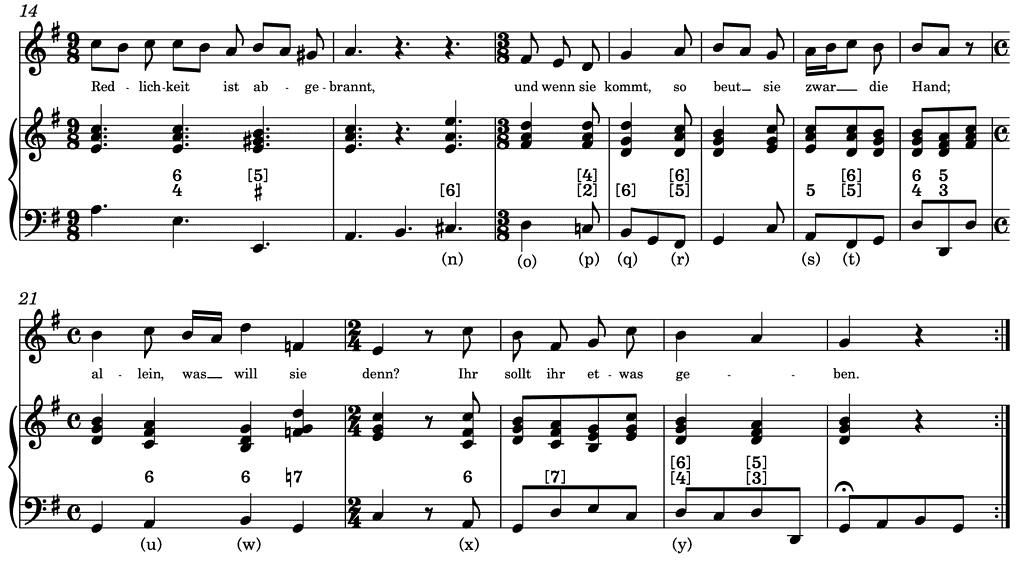
When realizing consecutive sixth chords, Telemann states that they should —or may— be realized in three parts rather than four. Referring to bars 20b–22a of aria 6, he provides the following guideline:
“(i) By many consecutive 6s, where the bass moves stepwise up or down, one omits the fourth voice.”
“(i) Beÿ vielen auf einander folgende 6, wobeÿ der bass stufen-weise hinauf oder hinunter gehet, lasse man die 4.te Stimme fahre.”
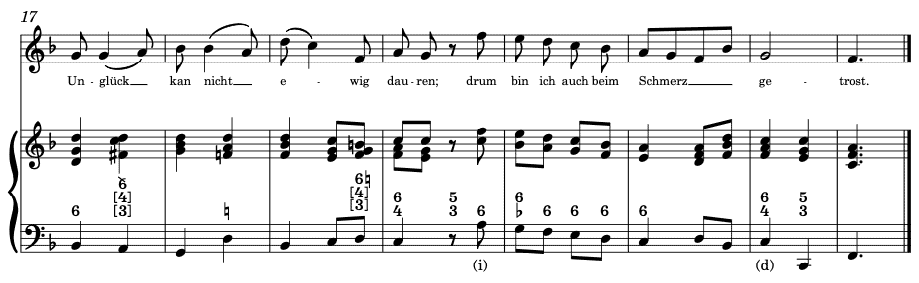
Note that
- this guideline again implies a standard four-part realization
- a three-part realization of consecutive sixth chords appears to be mandatory rather than optional
- in a progression of consecutive sixth chords, the sixth is always in the Oberstimme, thereby avoiding parallel fifths between the upper and middle parts.
Telemann provides a similar, albeit more flexible, guideline with regard to the realization of consecutive sixth chords, referring to bars 10b–11a and 13 of aria 20:
“that one may employ three parts in the case of many sixths is illustrated in (e) and (f).”
“dass man beÿ vielen 6.ten dreÿ stimmen nehmen möge, zeigen (e) u. (f).”
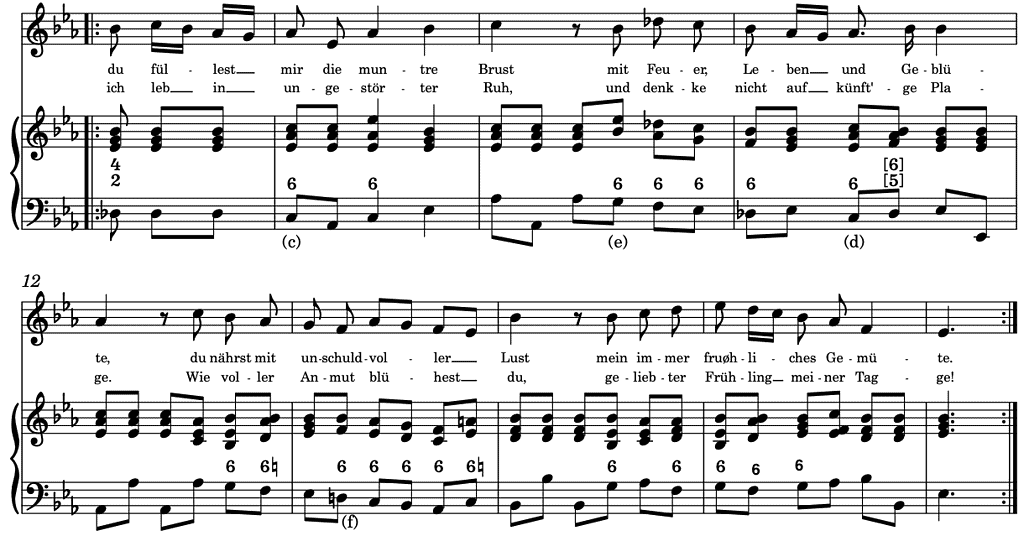
Thus, while a three-part realization is probably the preferred option, Telemann does not exclude a four-part realization for consecutive sixth chords. Consider again the example above, in particular bars 14b–15a: as you can see, four consecutive six chords follow one another there, each set in four parts.
(It is interesting to note that Johann Sebastian Bach, for instance, did not advocate a three-part realization of consecutive sixth chords in his thoroughbass instruction. His students were expected to realize such progressions in four parts, with the fourth voice alternating between doubling the bass note and doubling the sixth. I will return to this in a later essay.)
With regard to the register in which three-part realizations of consecutive sixth chords should be played, Telemann adds a further directive. Continuing the quote referring to bars 20b–22a of aria 6, he states:
“If a tenor is singing here, the right hand should play an octave lower.”
“Sünge hier ein Tenor, so spielte die rechte eine 8 tiefer.”
I find this quite remarkable since it
- implies that the Oberstimme descends as low as f, that is, an octave plus a tritone below the standard lower limit of b1 that Telemann gives (see my essay Telemann’s SSGBÜ: Range and Doubling)
- is one of the rare instances in the SSGBÜ where the right hand/Oberstimme explicitly takes into account what the singing voice is doing.
One might argue that Telemann gives this directive in order to avoid the thoroughbass realization sounding an octave higher than the tenor. Yet, although not regularly, Telemann does at times propose a realization an octave above the vocal line. See, for example, the opening of aria 23:
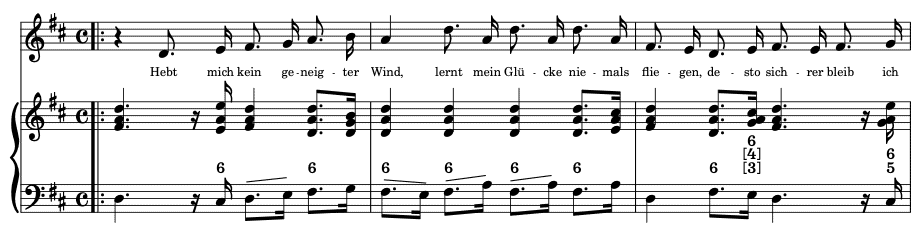
At the same time, and as is the case in the example above, the ‘regular’ instances in which the Oberstimme of a thoroughbass realization lies an octave above the vocal line are rather brief:
- most often they last for only a single chord
- on three occasions they span two consecutive chords, thereby producing parallel octaves between the vocal line and the Oberstimme
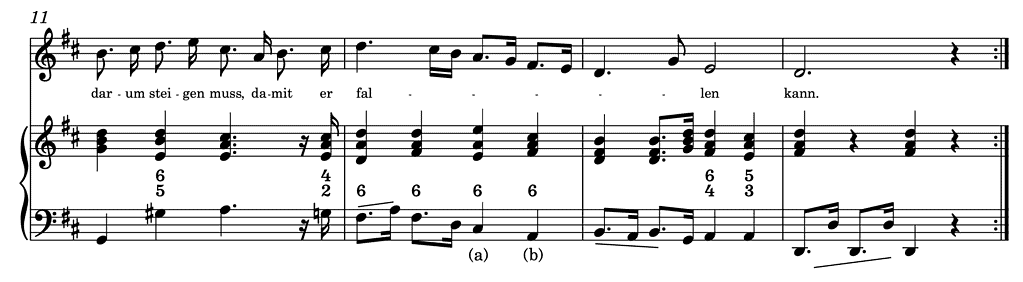
- and only once do they extend over three consecutive chords (again producing parallel octaves), namely in the three final bars of aria 24:
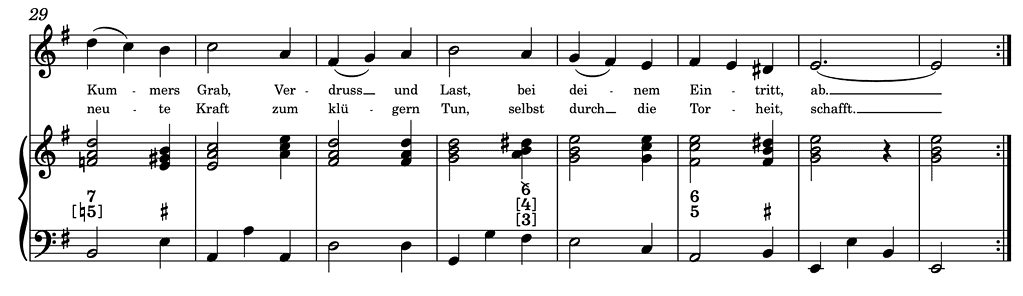
In the two examples we have seen with three-part realizations of consecutive sixth chords, however, the sequences are notably longer, comprising four, five or even six consecutive chords.
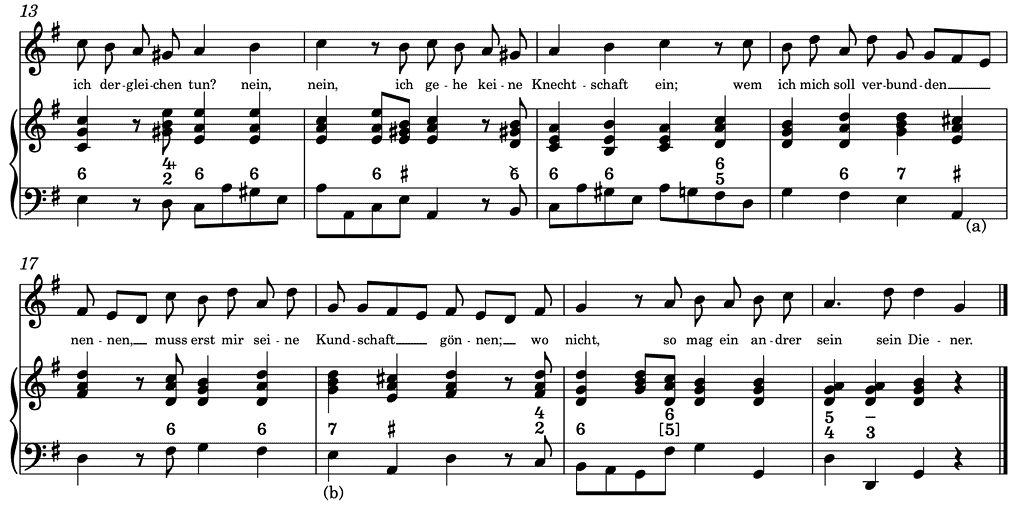
One might argue that Telemann’s directive is intended to avoid not only parallel octaves between the tenor and the Oberstimme (even though the above discussion shows that this poses no problem for Telemann), but also parallel fifths between the tenor and the middle part of the realization. Yet in two occasions in the SSGBÜ Telemann explicitly states that parallel fifths between the vocal line and the Oberstimme are permissible. Referring to bars 16b and 18a of aria 17, Telemann provides the following guideline:
“(a) (b) The singing voice has g–f♯, and above it [in the Oberstimme] d–c♯: these are two perfect and forbidden fifths; they may be passed over, because the f♯ is to be regarded merely as an ornament, and the following e is what actually counts.”
“(a) (b) Die stimme hat g fis u. oben ist d cis; sind 2 grosse und verbotene 5ten; sie mögen durchwischen weil das fis nur als eine manier anzusehen, u. eigentlich das folgende e gilt.”
A similar situation, accompanied by an analogous guideline, appears in bar 12b of aria 23:
“Here the upper notes … form two perfect fifths with the singing voice:
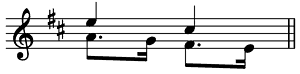
In such a case …, it is to be seen through the fingers. For if the player were to proceed merely according to the figures, without score, he would play exactly the same and yet would not be at fault.”
“Hier machen die obersten noten … mit der singe-stimme zwo grosse quinte:
Es ist beÿ diesen … durch die finger zu sehen. Denn wenn der spieler bloss nach den ziefern, ohne partitur, verführe, so würde er eben so greifen, u. doch nicht strafbar seÿn.”
It would thus seem that, for Telemann, the thoroughbass generally follows its own logic and remains largely ‘independent’.
Note that Telemann does not instruct the player to take the right hand an octave lower whenever a tenor is singing; he gives this directive only in the context of three-part realizations of consecutive sixth chords.
Also note that he does not explain how one should handle voice leading when entering or leaving such a low right-hand passage, how one transitions into it and back out of it. Judging from bar 20 of aria 6, voice leading between the end of the four-part realization and the beginning of the three-part one does not appear to be a priority, regardless of whether this aria is sung by a soprano or a tenor. This raises the question whether Telemann would simply leap back up an octave from the quarter note a in the Oberstimme (bar 22a) to the eighth note a1 (bar 22b), or whether he would smooth voice leading by subdividing the quarter note e/a into two eighth notes e/a–e1/a1 (bar 22a)…
Five-Part Realization
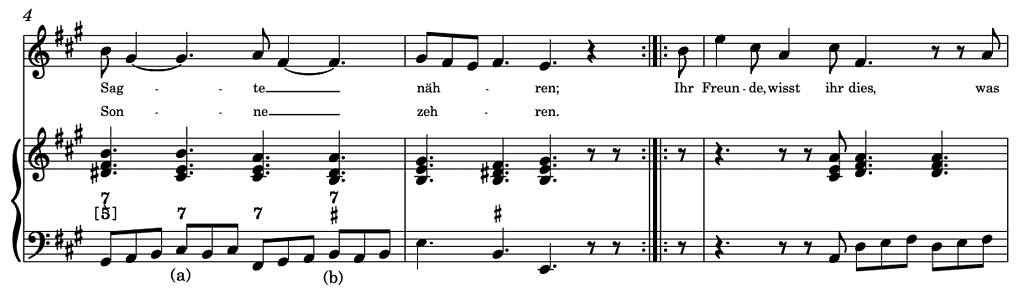
Referring to beats 2 and 4 of bar 4 of aria 10, Telemann explains that
- these seventh chords, being part of a ‘circle-of-fifths progression with seventh chords’, are incomplete —the fifth is absent while the bass is doubled instead— in order to ensure good voice leading in a four-part texture.
- a four-part ‘circle-of-fifths progression with seventh chords’ is therefore realized by alternating complete seventh chords (on beats 1 and 3) with incomplete ones (on beats 2 and 4).
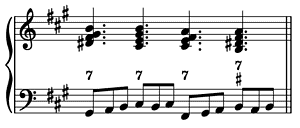
He then goes on to state that, in a five-part setting, every seventh chord is complete:
“But if one wishes to use five parts, which in such cases is not prohibited, then everything is present:”
“Will man aber 5 stimmen nehmen, welches in solchen fällen unverwehret, so ist alles da:”
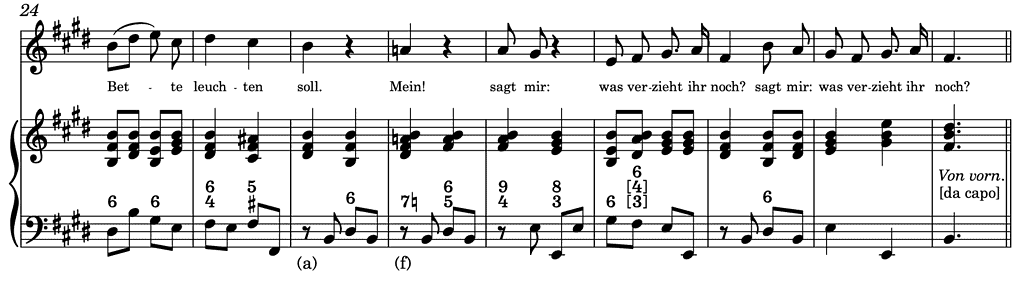
An isolated (dominant) seventh chord can also be realized in five parts, so that the chord is complete. (However, only one such five-part dominant seventh chord occurs in the SSGBÜ.) Referring to bar 27 of aria 21, Telemann states:
“When we add the fifth voice at (f), this produces the seventh chord, which must necessarily be heard; and if we had left out the d♯ or f♯, the harmony would have been incomplete.”
“Wann wir beÿ (f) die fünfte stimme hinzufügen, so veruhrsachet solches die 7, welche notwendig gehört werden muss; u. hätten wir dis oder fis weggeworfen, so wäre die harmonie unvollkommen gewesen.”
This remark seems to imply that, apart from ‘circle-of-fifths progressions with seventh chords’, Telemann generally requires dominant seventh chords to be complete, even in a four-part texture. Nevertheless, in the SSGBÜ there are three four-part incomplete dominant seventh chords outside the context of such progressions in which the third, rather than the fifth, is absent: they occur on
- beat 4 of bar 2 of aria 19 Gemüts-Ruhe (Peace of Mind)
- beat 2 of bar 5 of aria 38 Beherzter Freÿer (Courageous Suitor)
- beat 4 of bar 21 of aria 42 Freundschaft (Friendship):
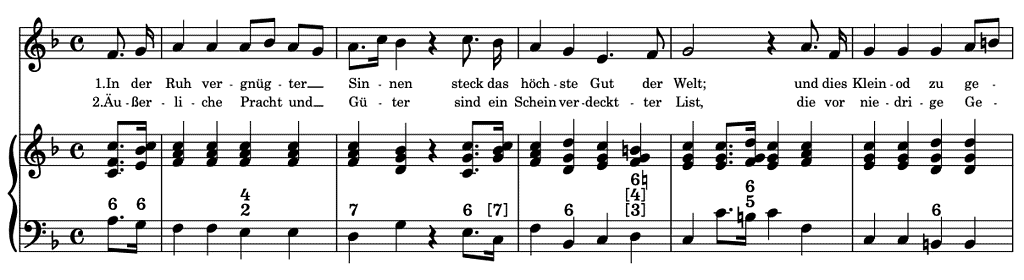
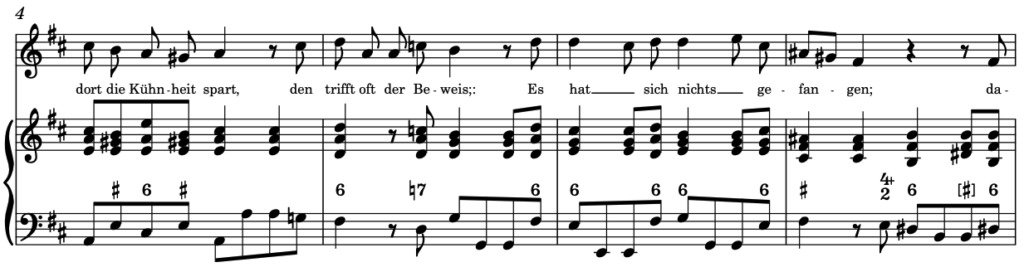
It is worth considering whether these incomplete dominant seventh chords contain an error. In the case of the dominant seventh chords in aria 19, one might consider adding e1, resulting in a five-part dominant seventh chord such as the one in bar 27 of aria 21. As for the dominant seventh chord in aria 42, a five-part version of that chord is likewise conceivable; nevertheless, one might wonder whether the doubled g1 was perhaps intended to be a b1. After all, Telemann more often than not has ➐ descend to ➎ when the Oberstimme moves from ➋ to ➊ over a ⑤–① bass progression. (I will elaborate in future essays on Telemann’s apparent disregard for having ➐ rise to ➊ in an inner part, as well as his guideline regarding the potential addition of the seventh on ⑤ in the context of a ⑤–① bass progression when it is not indicated in the figures.)
Vollstimmiges Accompagnement (Full-Voiced Accompaniment)
In the context of recitative playing (no. 40), Telemann writes that one may also use a vollstimmiges Accompagnement (full-voiced accompaniment):
“Both hands may also play full chords, as shown from (b) onwards to the end.”
“Es mögen auch beÿde hände voll genomen werden, wie von (b) an, bis zu ende, gewiesen wird.”
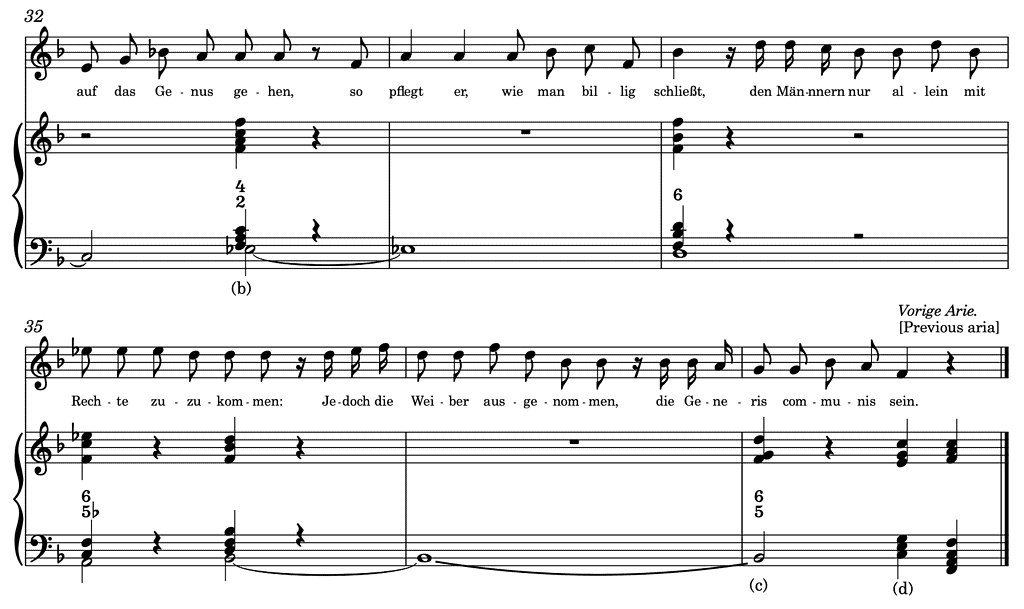
While it is obvious that a full-voiced accompaniment implies chords to be played also in the left hand, Telemann —contrary to Johann David Heinichen, for instance— provides no rules or guidelines on what should or should not be done. From his example it becomes clear that
- the right hand mostly preserves three parts, the exception being the first chord of the fragment with full-voiced accompaniment, which has four parts (bar 32, beat 3)
- the diminished fifth on beat 1 of bar 35 occurs only in the right hand (Heinichen, by contrast, allows this note to be doubled by the left hand, even if this results in parallel octaves).
Note that Telemann, unlike many of his contemporaries, does not mention full-voiced accompaniment for ‘normal’ thoroughbass playing.
(I will elaborate on Telemann’s rules for realizing the thoroughbass of a recitative, taking the type of keyboard instrument into account, as well as on Heinichen’s rules for full-voiced playing, in separate essays.)
Two-Part Realization: The Oberstimme Doubling the Bass in Octaves
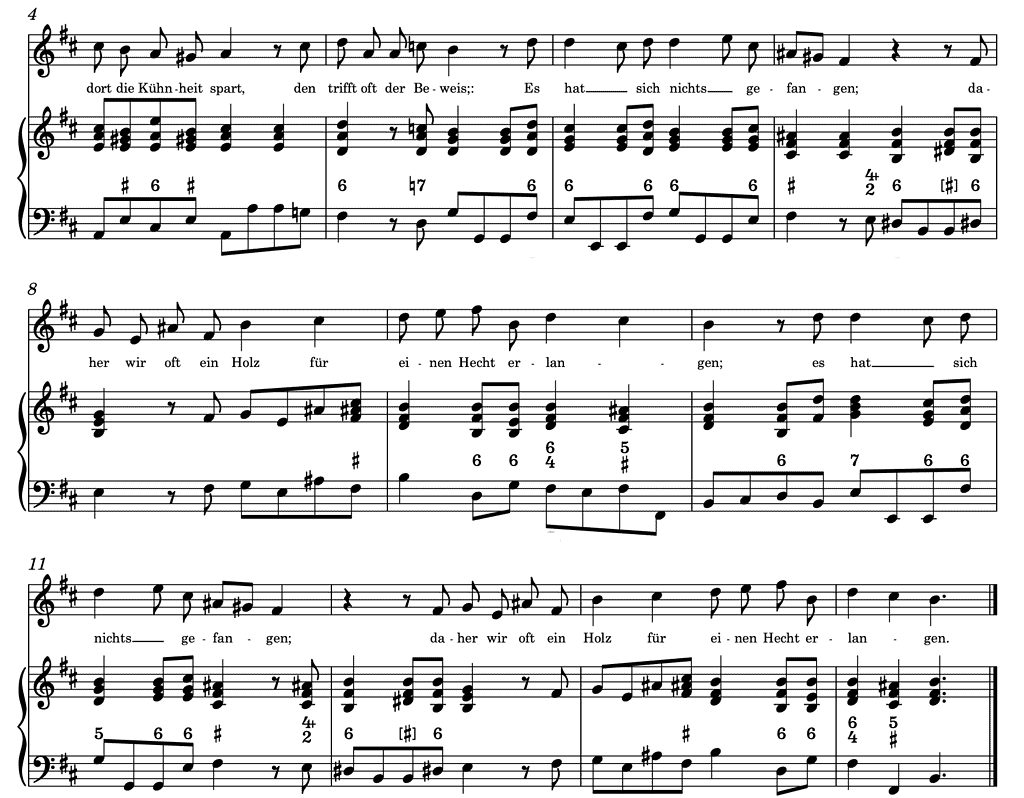
Although Telemann provides no explicit rule or guideline regarding if or when the Oberstimme can or should simply double the bass in octaves, he gives this type of realization twice in aria 38, in bars 8 and 12b–13a. In this context, the vocal line presents the motive f♯1–g1–e1–a♯1–f♯1–b1 (bars 7b–8 and 12–13a), which the continuo imitates in octaves in stretto during the first four notes, half a bar later.
One-Part Realization or Tasto Solo
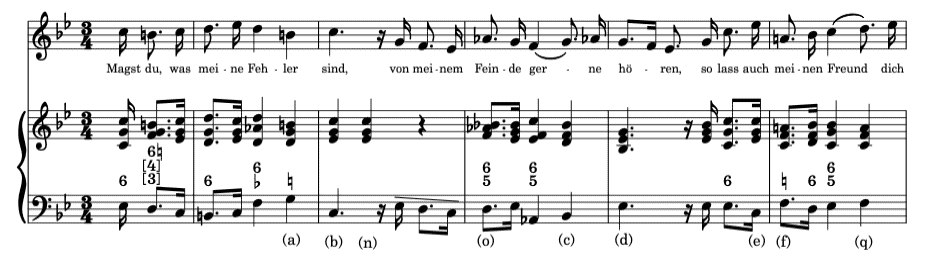
Bass notes representing the fundament of a new, independent chord yet realized tasto solo are rather exceptional in the SSGBÜ, the few that do occur functioning as passing or neighbour notes. Compare, for instance, the triple upbeat of aria 5 with bar 2b. While the second note of this aria is set as a 6/4/3 chord —one of the common realizations of ② when involved in stepwise motion— the same note within the same melodic snippet is treated two bars later simply as a passing note, as indicated by the presence of the Querstrich, even though an identical setting would there have been perfectly possible. (The vocal line merely presents a different counterpoint to this progression.)
Yet perhaps the most striking example of ignoring a new, individual and seemingly requisite chord occurs in relation to the f on beat 2 of bar 7 of aria 14:
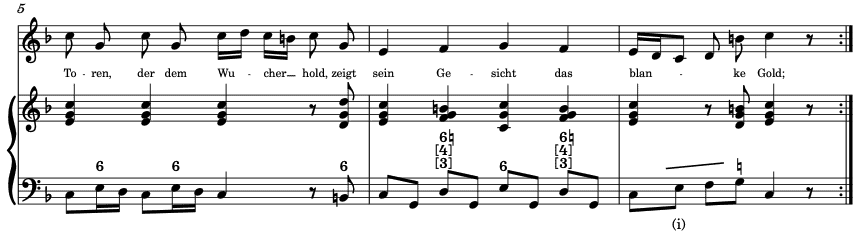
Instead of setting ④ as a sixth or 6/5 chord in C major —the obvious choice in the context of a ③–④–⑤ clausula basizans— Telemann writes a Querstrich above the e and the f. He offers the following comment as a rationale for this decision:
“(i) The right hand rests here in order to make the singer’s low notes more audible.”
“(i) Die rechte ruhet hier darum, um die tiefen tone des sängers hörbarer zu machen.”
A somewhat more frequent use of tasto solo in the SSGBÜ occurs when one or more new, metrically weak bass notes merely prolong the harmony of the strong beat and are left without chordal realization. This typically happens during the final chord of a phrase or sentence, whether or not these metrically weak bass notes function as a transition. See, for instance, bars 8 and 16 of aria 1:
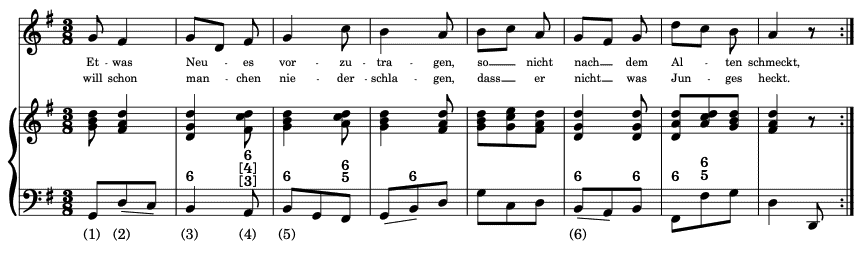
(Note that Telemann writes the two phrases out in full; the repeat in Remeš’s edition is editorial.)
For an example of a transition played tasto solo, see bar 4 of aria 43:
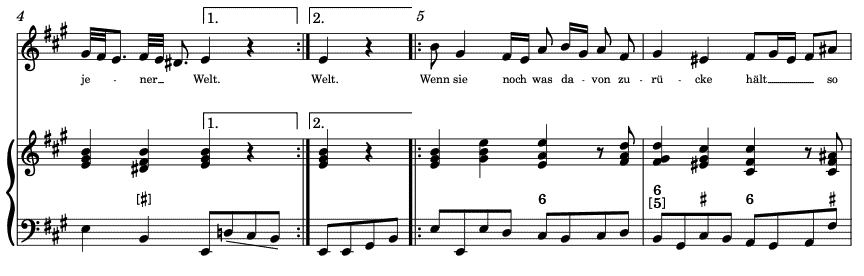
(Interestingly, Telemann appears consistently to prefer that transitions be played tasto solo, a topic that will be discussed in greater detail in a subsequent essay.)
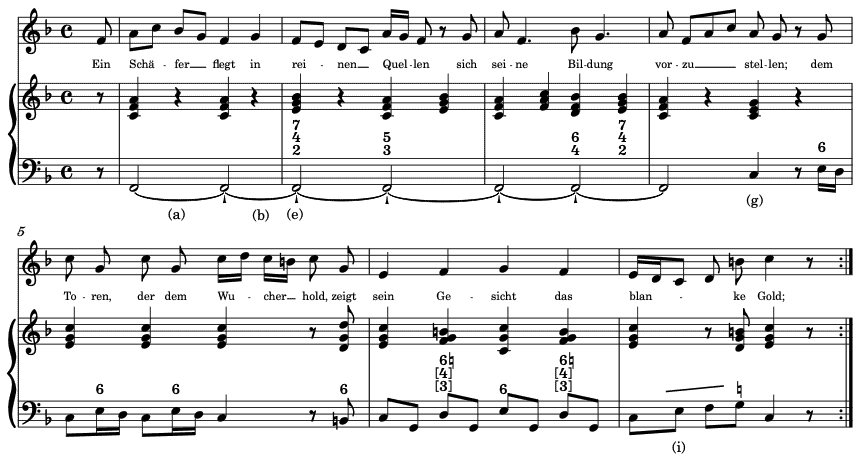
A tasto solo bass note may also occur at the beginning of a phrase when the right hand merely prolongs the chord concluding the previous phrase, even if the new phrase’s first note is figured. For an example, see bar 4b of aria 14:
Assessing Telemann’s Guidelines for the Number of Parts in a Realization: For Kenner or Liebhaber?
A strict four-part texture with three continuo voices in the right hand dominates in the SSGBÜ. Since Telemann explicitly designed these pieces primarily for amateurs, one might be tempted to conclude that the very concept of continuo playing here is also ‘amateurish’. Yet although Telemann never spells out what distinguishes amateur from professional thoroughbass realization, he does address the technique of full-voiced accompaniment, a technique his contemporaries generally regarded as professional. Granted, he mentions it only in the specific context of recitative realization rather than as a general continuo style, but he nevertheless brings it up. If his aim were to keep his rules and guidelines purely within the amateur sphere, why would he introduce a technique that clearly demands greater skill and agility? Moreover, he presents full-voiced accompaniment in recitatives neutrally, as an alternative, without attaching any value judgement or sense of a ‘higher’ level to it. This raises the question of why he does not also offer full-voiced accompaniment as another option for regular continuo playing, as Heinichen and Mattheson, for instance, do. Does Telemann’s absence of a general description of full-voiced accompaniment point to an ‘amateur-oriented’ approach? Or does it instead reflect an aesthetic vision, that full-voiced accompaniment simply did not belong to ordinary continuo playing for him? On the other hand, Telemann adds the following remark at the end of aria 48 Jeder sein eigner Richter (Each His Own Judge):
“We acknowledge that much remains to be covered that pertains to the teaching of thoroughbass.”
“Wir gestehen, dass noch manches übrig ist, so zur lehre von general-basse gehöret.”
Could one of the topics he left aside indeed have been the general practice of full-voiced accompaniment…?
Select Bibliography
Arnold, Franck Thomas. The Art of Accompaniment from a Thorough-Bass (2 volumes) (Oxford: Oxford University Press, 1931; unabridged and unaltered republication by Dover Publications in 1965 (with a new introduction) and 2003).
Christensen, Jesper Bøje. Die Grundlagen des Generalbaßspiels im 18. Jahrhundert: Ein Lehrbuch nach zeitgenössischen Quellen (Kassel: Bärenreiter, 1992).
Christensen, Jesper Bøje. Les Fondements de la Basse Continue au XVIIIe siècle : Une méthode basée sur les sources d’époques (Basel: Bärenreiter, 1995).
Christensen, Jesper Bøje. 18th Century Continuo Playing: A Historical Guide to the Basics (Kassel: Bärenreiter, 2002).
Heinichen, Johann David. Der General-Bass in der Composition (Dresden, 1728).
Mattheson, Johann. Kleine General-Bass-Schule (Hamburg, 1735).
Rampe, Siegbert. Generalbasspraxis 1600–1800 (Laaber: Laaber Verlag, 2014).
Telemann, Georg Philipp. Singe-, Spiel- und General-Bass-Übungen (Hamburg, 1733–34).
Telemann, Georg Philipp. Singe-, Spiel- und General-Bass-Übungen TWV 25:39-85 für Singstimme & Tasteninstrument — Revidierte Neuausgabe, ed. Wolf Hobohm (Magdeburg: Edition Walhall – Verlag Franz Biersack, 2003).
Zohn, Steven. Music for a Mixed Taste: Style, Genre, and Meaning in Telemann’s Instrumental Works (New York: Oxford University Press, 2008/2015 (revised paperback edition)).