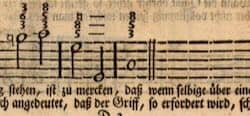
In this essay, I discuss what a continuist should or can do when a Querstrich (literally “cross-stroke”, a horizontal or slightly oblique stroke used in thoroughbass notation) appears in thoroughbass figuring.
A Querstrich in thoroughbass figuring can imply that a chord is to be held for all of its span or for part of it only, the right hand then resting for the remainder. It can also mean that the same chord in the same position must be restruck on each associated bass note.
To avoid cluttering the text with full titles, I refer to the sources by author and publication year only, with abridged references provided in the footnotes. Full bibliographical details are given in the Select Bibliography.
Note further that
- all translations are mine
- eighteenth-century sources vary in spelling between “Querstrich” and “Queerstrich”
- throughout this essay, I use the term “Querstrich” in the corpus text, even when the original source does not
- the term “Oberstimme” refers to the upper part of the thoroughbass realization
- I discuss the oblique stroke to indicate an accented passing note in my essay Indicating Accented Passing Notes in Thoroughbass.
Telemann (1733)
Georg Philipp Telemann gives the following definition of the Querstrich:
“(2) The stroke ⟍ indicates that the right hand rests there.”
“(2) Der Strich ⟍ bedeutet, dass die rechte hand daselbst ruhe.”1
While this formulation is somewhat ambiguous —does it mean actual resting in the right hand, thus implying silence, or that the right-hand chord is held?— the passage in the aria to which this remark refers, as with all similar passages, makes clear that a Querstrich implies the chord at its outset is to be held down.
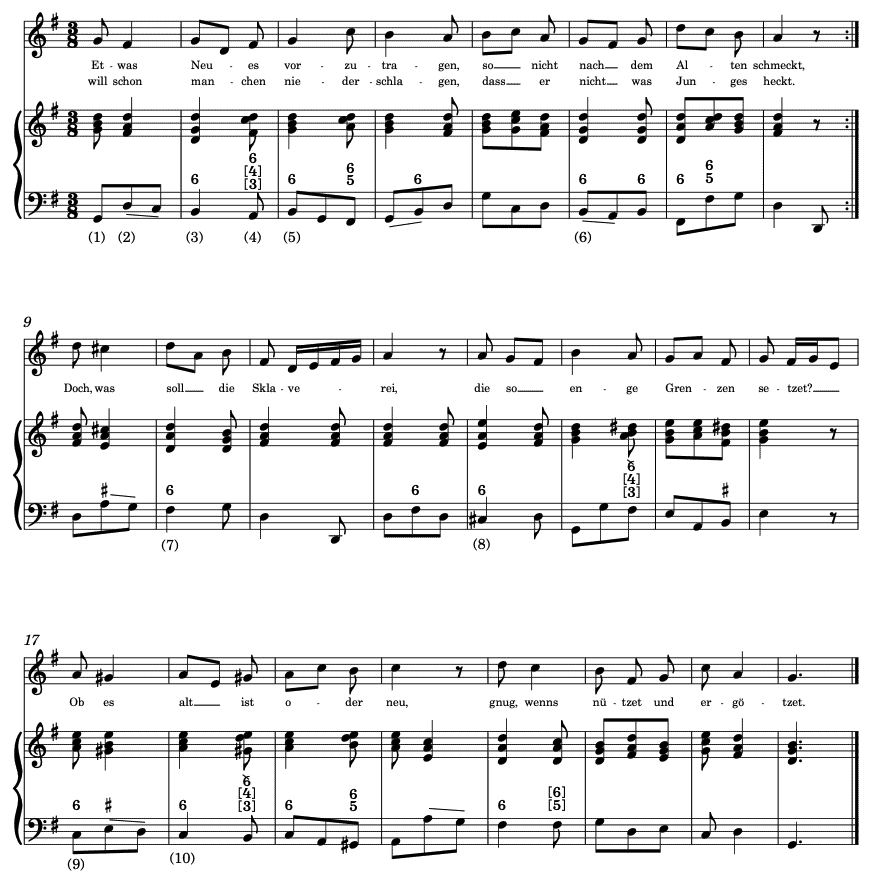
Aria 1 Neues (Newness).
Still, in the penultimate bar of aria 23, the right-hand chord is repeated during a Querstrich, while in the final bar a quarter-note rest occurs:
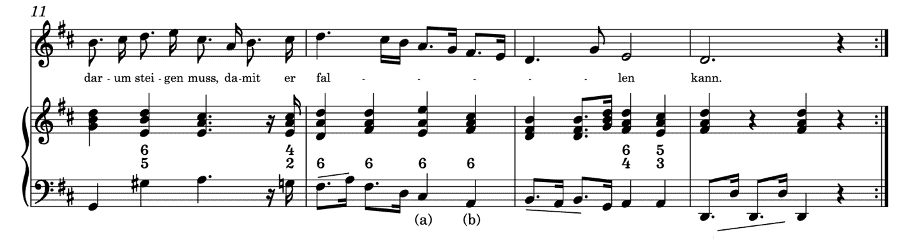
Aria 23 Beglückte Niedrigkeit (Blessed Lowliness).
Kellner (1737 & 1743)
Interestingly, in the second edition of his thoroughbass treatise (1737), David Kellner seems to associate the Querstrich exclusively with restriking the same chord on each of the bass notes it covers:
“The first example is figured, but in the second one there is a stroke at that point, which indicates that all the notes pass through. This is much better and clearer.”
“Das erste Exempel ist beziffert, das zweyte aber hat an der Stelle einen Strich, der da bedeutet, daß alle Noten durchgehen; Solches ist viel besser und deutlicher.”2
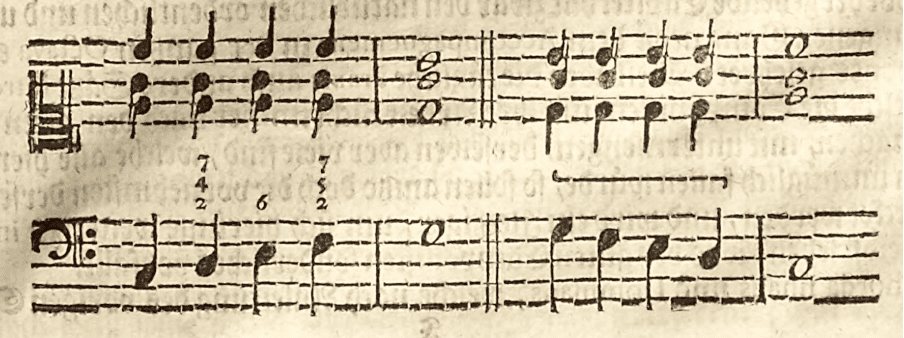
While the formulation “daß alle Noten durchgehen” in itself does not clarify whether the same right-hand chord is to be repeated or rather held over all the bass notes under the Querstrich, the musical example illustrates the former:
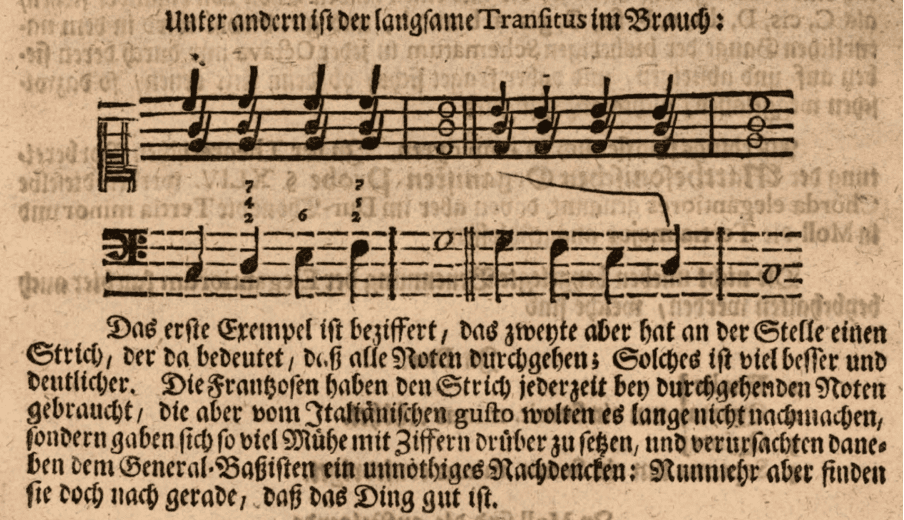
In fact, at least in this case, a whole-note chord in the right hand would have been unusual. German thoroughbass treatises from this period indicate that, apart from the final bar of a phrase or sentence, marking each beat —including in the right hand— is the norm. (For Telemann’s views on the number of chords to be played in a thoroughbass in 4/4, see Telemann’s SSGBÜ: Number of Parts.)
Note the particular shape of the stroke in the musical example above: it descends slightly until the last quarter note, when it drops more sharply. I have not seen such a stroke elsewhere, and Kellner uses a Querstrich nowhere else in the treatise. To determine whether this stroke might carry an additional meaning, I also consulted the newly set 1743 edition of Kellner’s treatise. In that edition, the stroke has been replaced by a more conventional exemplar, though it begins and ends with a tiny flourish, presumably for visual clarity, while the accompanying text remains unchanged.
Reinhard (1744)
Leonhard Reinhard may suggest that a Querstrich signals the previous chord should be held rather than repeated, although his formulation remains open to interpretation:
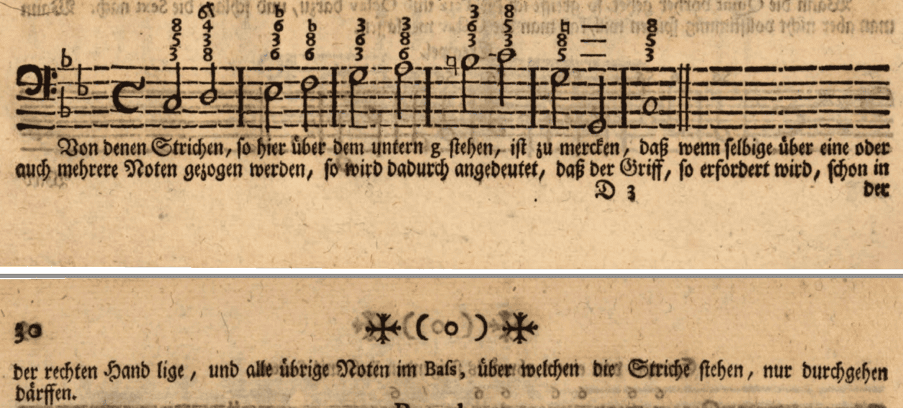
“Concerning the strokes that appear here above G, it is to be noted that when they are drawn over one or several notes, this indicates that the chord required is already in the right hand, and that all the remaining notes in the bass, over which the strokes are drawn, may merely pass through.”
“Von denen Strichen, so hier über dem untern g stehen, ist zu merken, daß wenn selbige über eine oder auch mehrere Noten gezogen werden, so wird dadurch angedeutet, daß der Griff, so erfordert wird, schon in der rechten Hand lige, und alle übrige Note im Bass, über welchen die Striche stehen, nur durchgehen därffen.”3
Adlung (1758)
Jakob Adlung associates the Querstrich with both performance possibilities —that is, either holding the previous chord or repeating it in the same position:
“A Querstrich above a note —or a longer one above several notes at once— is very convenient both for the copyist and for the player, since it indicates that the preceding chord is to be retained or struck again. For it is, after all, far easier to retain and repeat what one already has than to be alarmed by a profusion of figures, by which nothing further is gained. Accordingly, the example in Fig. 25 on the fourth plate may appear difficult to many, yet by means of such a sign it can be written and played more easily, as may be seen in Fig. 26. For in this way it becomes more immediately apparent that the chord of C is to be struck with each of the first five notes. The curved sign above the tenth note has the same meaning. One will, however, find that such signs for holding a chord are not written as diligently as they might be, since some do not think of them, while others indeed wish to attract attention with their multicoloured thoroughbasses.”
“Ein Queerstrich über einer Note — oder ein längerer über etlichen zugleich ist sehr bequem vor den Schreiber und vor den Spieler; denn dadurch wird angezeigt, daß der vorhergehende Griff solle behalten, oder abermal angeschlagen werden. Nun ist ja viel leichter, was man hat, zu behalten, und zu wiederholen, als durch viel Ziefern sich schrecken zu lassen, durch welche man auch nichts mehr erhält; folglich wird das Exempel Fig. 25 auf der 4ten Tabelle manchen schwer scheinen; welches aber durch solch Zeichen leichter geschrieben und gespielt wird, wie Fig. 26 zu sehen. Denn also fällt es geschwinder in die Augen, daß der Accord C zu allen den fünf ersten Noten solle angeschlagen werden. Das krumme Zeichen über der 10ten Note gilt gleich viel. Man wird aber finden, daß solch Behaltungszeichen nicht so fleißig geschrieben wird, als es geschehen könnte, weil einige nicht daran gedenken, einige auch wohl mit ihren buntschäckigten Generalbässen Aufsehen machen wollen.”4
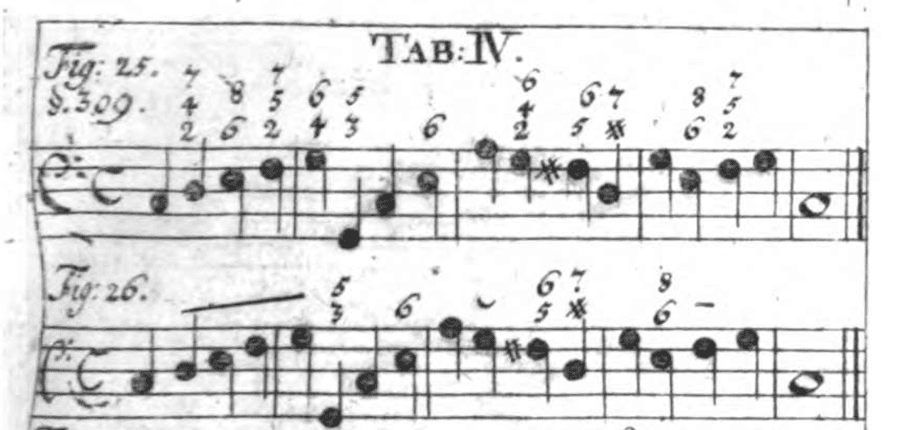
Note how the bass and figurings of the first bar in figure 25 are almost identical to those in Kellner’s musical example. It seems plausible to assume that Adlung was familiar with Kellner’s thoroughbass treatise. (The only difference in the figuring occurs on the third beat, where Adlung adds an “8” above the “6”, possibly indicating e2 in the Oberstimme in this bar, while Kellner gives c2.)
Marpurg (1761)
As does Kellner, Marpurg seems to associate the Querstrich exclusively with repeated right-hand chords:
“When the very same chord is to be struck on several successive notes, one generally makes use of a stroke to indicate the harmony that remains, instead of repeating it by means of altered figures.”
“Wenn eben derselbe Griff zu verschiedenen Noten hintereinander angeschlagen werden soll: so bedient man sich genre eines Striches, um die verbleibende Harmonie zu bezeichnen, anstatt dieselbe durch veränderte Ziffern zu wiederhohlen.”5
C.P.E. Bach (1762)
Carl Philipp Emanuel Bach associates the use of Querstriche (plural for Querstrich) with what he calls durchgehende Noten. It should be noted, however, that this term cannot simply be translated as passing notes, since it denotes a related but broader concept. After all, a durchgehende Note may correspond not only to what we would call today a passing note, but also to a neighbour note and to a consonant leap,6 hence my decision to retain the original German term in the translation below.
Ҥ. 68. Among the rapid notes, it is rare for each one to have its own accompaniment. Of the notes that are struck without accompaniment, one says: they pass through.
§. 69. Single durchgehende Noten are not indicated; but when many occur in succession, one places a Querstrich above them, which extends as far as the right hand is to remain at rest. They occur in all kinds of tempos and time signatures, and in all sorts of figures. Sometimes half of the notes pass through (a); at times fewer than half (b); sometimes, in a rapid tempo and when the notes are short, by far the greater number pass through (c).”
Ҥ. 68. Unter den geschwinden Noten hat selten eine jede ihr eignes Accompagnement. Von den Noten, welche ohne Accompagnement angeschlagen werden, sagt man: Sie gehen durch.
§. 69. Einzelne durchgehende Noten werden nicht angedeutet; wenn aber viele hintereinander vorkommen, so setzt man einen Queerstrich darüber, welcher so weit reicht, als die rechte Hand ruhen soll. Sie kommen bey allerley Zeitmaaße und Tactarten in allerhand Figuren vor. Bisweilen geht die Hälfte von den Noten durch (a); zuweilen weniger als die Hälfte (b); manchmal gehen bey geschwindem Zeitmaaße, und wenn die Noten kurz sind, die allermeisten durch (c):”7
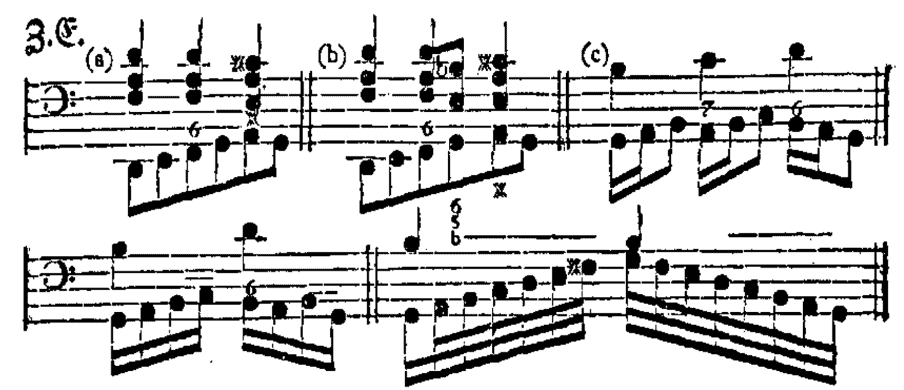
The following short paragraph and its accompanying musical example are revealing in two respects: one explicitly articulated in both text and example, the other implied solely by the musical example:
“§. 70. When durchgehende Noten continue for a long duration, the most recently used accompaniment [chord] may be repeated.”
“§. 70. Bey einer langen Dauer durchgehender Noten kann das zuletzt da gewesene Accompagnement wiederholt werden:”8
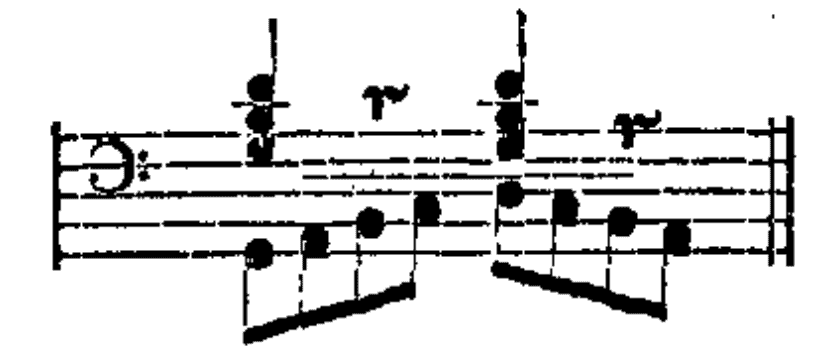
First, both §. 70 and its musical example clarify that C.P.E. Bach permits the same chord to be replayed when durchgehende Noten extend over a long span, despite the Querstrich remaining continuous within the bar. Second, the musical example illustrates that the presence of a Querstrich in itself does not imply that the chords must be held for their full length; rather, they may be shortened and followed by a rest.
J.M. Bach (1780)
Like Carl Philipp Emanuel Bach, Johann Michael Bach associates the use of Querstriche with durchgehenden Noten, employing the latter term in the same sense as Carl Philipp Emanuel:
“Durchgehende Noten are either those that fill in the space between one consonance and another, or they are harmonic, when they break up/arpeggiate the chord; and, according to their nature, the weak parts of the bar —2, 4, 6 and 8— are called durchgehende Noten. (—) is the sign.”
“Durchgehende Noten sind entweder diejenigen, welche den Zwischenraum von einer Consonanz zur andern ausfüllen, oder sie sind harmonisch, wenn sie den Accord zergliedern; und werden nach der Beschaffenheit, die schlimmen Tactglieder, 2—4—6—8 durchgehende Noten genennet. (—) ist das Zeichen.”9
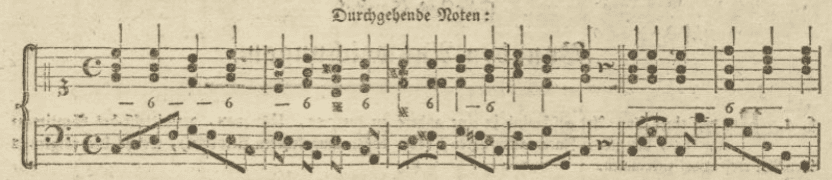
As the example makes clear, die schlimmen Tactglieder here refer to the second, fourth, sixth and eighth eighth notes in a 4/4 time signature.
Kirnberger (1781)
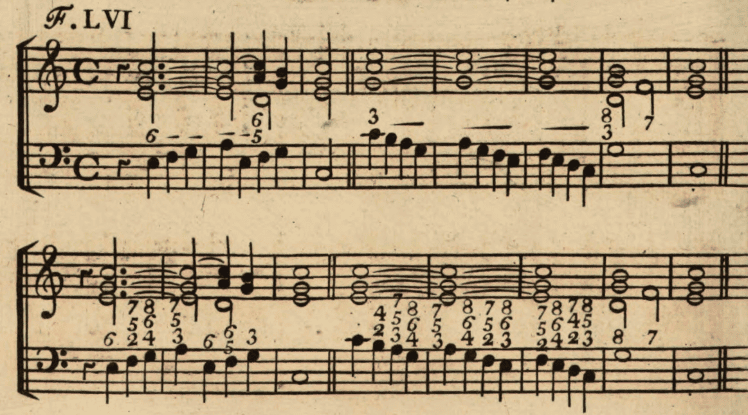
The argument Kirnberger gives for using Querstriche instead of figuring each bass note individually is one of practical facility in playing:
“When the chord of the second occurs in passing [i.e., as the realization of a passing note] and is prepared by the Oberstimme, it requires no special designation, and one may then place only this sign — instead of the otherwise customary figures above it, by which, in all cases (and thus also in this one), it is indicated that the harmony remains from the preceding tone. This also facilitates the playing itself, as has been demonstrated in Example Fig. LVI.” “Wenn der Secunden-Accord im Durchgange durch die Oberstimme präpariret, vorkömmt, so bedarf er keiner besondern Bezeichnung, und man darf alsdenn blos dieses Zeichen — statt der sonst gewöhnlichen Signatur mit Zahlen über ihn setzen, wodurch in allen Fällen, also auch in diesem angedeutet wird, daß die Harmonie vom vorhergehenden Tone liegen bleibt, wie es denn auch das Spielen selbst erleichtert, wie im Exampel Fig. LVI. nachgewiesen worden.”10
Notes
- Telemann, 1733: 1. ↩︎
- Kellner, 1737: 43. ↩︎
- Reinhard, 1744: 29–30. ↩︎
- Adlung, 1758: 642. ↩︎
- Marpurg, 1761: 34. ↩︎
- A passing note in its present-day meaning is termed Durchgang or transitus by C.P.E. Bach, not durchgehende Note (C.P.E. Bach, 1762: 30). Toward the end of his treatise on thoroughbass, he provides further clarification of durchgehende Noten: “§3. Durchgehende Noten occur in stepwise motion and in leaps, and are for the most part somewhat swift.” (“§.3. Die durchgehenden Noten kommen im Gange, und im Sprunge vor, und sind mehrentheils etwas geschwinde.” C.P.E Bach, 1762: 302.) ↩︎
- C.P.E. Bach, 1762: 28. ↩︎
- C.P.E. Bach, 1762: 29. ↩︎
- J.M. Bach, 1780: 19. ↩︎
- Kirnberger, 1781: 60. ↩︎
Select Bibliography
Adlung, Jakob. Anleitung zu der musikalischen Gelahrtheit (Erfurt, 1758).
Arnold, Franck Thomas. The Art of Accompaniment from a Thorough-Bass (2 volumes) (Oxford: Oxford University Press, 1931; unabridged and unaltered republication by Dover Publications in 1965 (with a new introduction) and 2003).
Bach, Carl Philipp Emanuel. Versuch über die wahre Art das Clavier zu spielen — Zweyter Theil, in welchem die Lehre von dem Accompagnement und der freye Fantasie abgehandelt wird (Berlin, 1762).
Bach, Johann Michael. Kurze und systematische Anleitung zum General-Baß, und der Tonkunst überhaupt, mit Exempeln erläutert (Kassel, 1780).
Kellner, David. Treulicher Unterricht im General-Bass … Zweyte und vermehrte Auflage. Nebst einer Vorrede Hn. G. P. Telemanns (Hamburg, 1737).
—. Treulicher Unterricht im General-Bass … Dritte Auflage. Mit einer Vorrede des Herrn Daniel Solanders (Hamburg, 1743).
Kirnberger, Johann Philipp. Grundsätze des Generalbasses als erste Linien zur Composition (Berlin, 1781).
Marpurg, Friedrich Wilhelm. Die Kunst das Clavier zu spielen — Zweyter Theil, worinnen die Lehre vom Accompagnement abgehandelt wird (Berlin, 1761).
Reinhard, Leonhard. Kurtzer und deutlicher Unterricht von dem General-Bass (Augsburg, 1744).
Telemann, Georg Philipp. Singe-, Spiel- und General-Bass-Übungen (Hamburg, 1733–34).