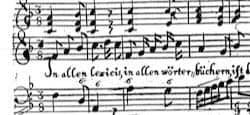
This essay is the fourth in a series examining Telemann’s views on chordal rhythm in a thoroughbass realization. Here, I discuss chordal rhythm in a 3/8 time signature, as presented in his Singe-, Spiel- und General-Bass-Übungen.
Telemann often writes a single chord above each bass note in arias in 3/8 when the note lasts a beat or longer. When the same right-hand chord applies to two successive bass notes, it may be held instead of repeated. Off-beat sixteenths are never realized.
All musical examples are taken from Derek Remeš’s digital and freely available edition of the SSGBÜ, which can be downloaded at https://doi.org/10.17877/TUDODATA-2025-MC06WAYR. Note further that
- the translations of Telemann’s quotes are mine
- “bar 1a” refers to the first half of bar 1, and “bar 1b” to the second half.
Of the 48 arias in the SSGBÜ, seven are entirely written in 3/8 (nos. 1, 8, 13, 22, 27, 28 and 39), while aria 42 contains two 3/8 passages in bars 6–9 and 15–19 (this aria also contains passages in 2/4, 3/4, 9/8 and 4/4).
Rule of Thumb: A Single Chord on Each Bass Note
As with chordal rhythm in 2/4 and 3/4, a good starting point for realizing a bass in 3/8 according to Telemann’s views is to play a single chord on each bass note. (For more information on chordal rhythm in 2/4 and 3/4, see Telemann’s SSGBÜ: Chordal Rhythm in 2/4 and Telemann’s SSGBÜ: Chordal Rhythm in 3/4.) See, for example, aria 8 Wechsel (Change):
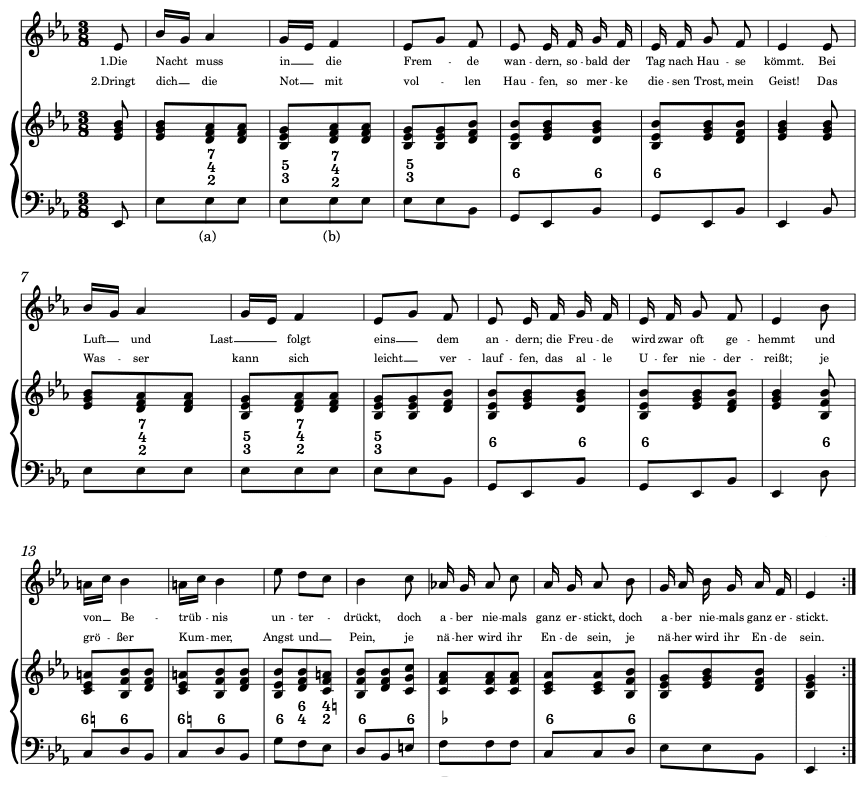
Apart from the final note of each phrase, each eighth-note beat is marked not only in the left hand but also in the right, even when this entails repeating both the bass note and the right-hand chord. Aria 1 Neues (Newness), however, shows that a single quarter-note chord may also accompany two different eighth notes in the bass:
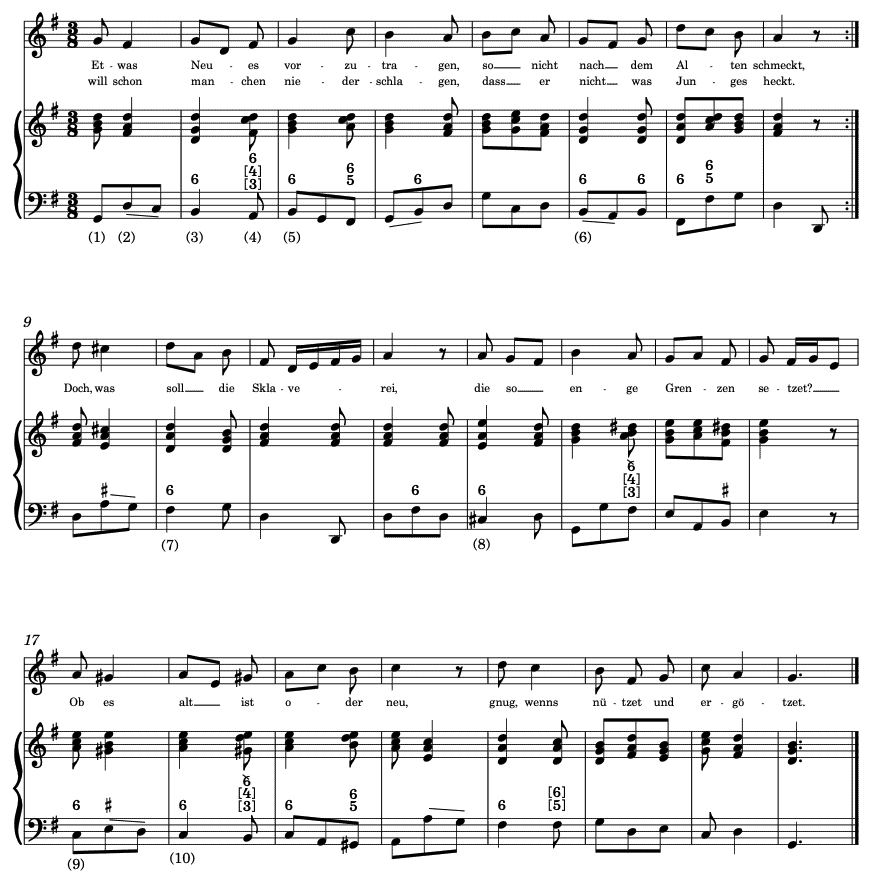
To prevent a chord from being repeated or played in a different position above the following bass note, Telemann often places a Querstrich close to the bass notes concerned, a considerable number of which appear in this aria. Still, although a Querstrich is absent in bars 3, 12, 14 and 19, each of these bars contains a quarter-note chord on beats 1 and 2 instead of two eighth-note chords.
(Note that a Querstrich does not invariably mean that nothing may be (re)struck during its duration. For more information, see The Querstrich in Thoroughbass Figuring: What Can It Mean?.)
Not To Restrike
While Telemann commonly restrikes every note of a new chord —not only in fully consonant chords but also when a resolution takes place (for more information, see my essay Telemann’s SSGBÜ: Chordal Rhythm in 2/4)— he does not do so in bar 13 of aria 22 Alterthum des geschlechts (Antiquity of the Species), where the common notes between the E-flat triad on beat 1 and the sixth chord above e♭ on beat 2 are held:
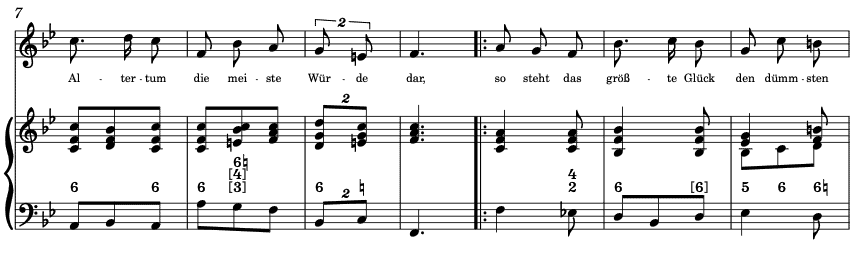
Note that this is exceptional in the SSGBÜ.
Chord on a Rest
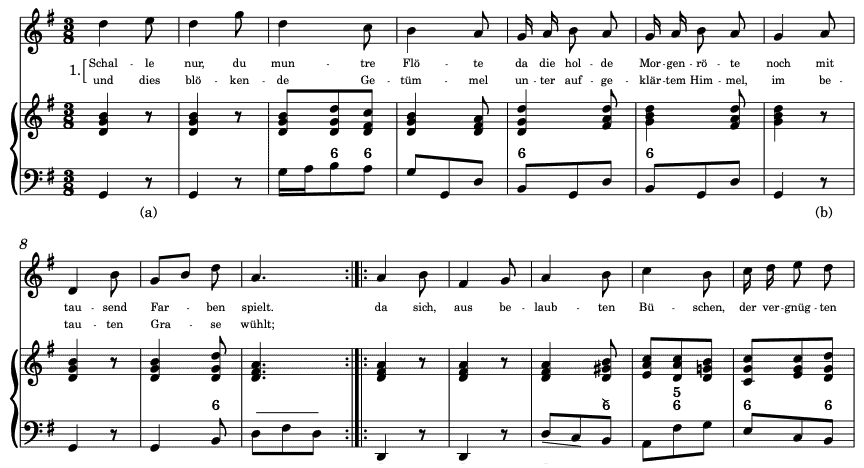
Even when his realization does not include it, Telemann allows for the possibility of playing a chord on a rest of one beat (an eighth note) in 3/8. This is how he formulates it with reference to (a) and (b) in aria 28 Pastorell (Pastorale):
“When one plays from a score, the harmonic figurings that occur during rests in the bass and are prompted by the vocal part may be realized in the right hand: accordingly, at (a) one may take a 6/4, and at (b) a 7/4/2.”
“Wenn man aus einer partitur spielet, so können die harmonischen figuren, welche, beÿ vorkommenden pausen im basse die singe-stimme an die hand giebt, oben angeschlagen werden: solchem nach mag man beÿ (a) 6/4 und beÿ (b) 7/4/2 nehmen.”
(Telemann also discusses playing chords on rests in the context of 3/4. For more information, see my essay Telemann’s SSGBÜ: Chordal Rhythm in 3/4.)
Not Realizing Off-Beat Sixteenth Notes
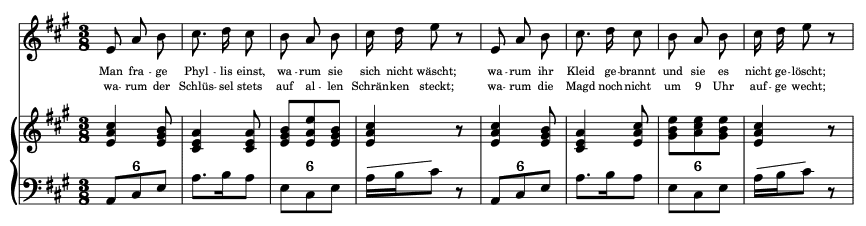
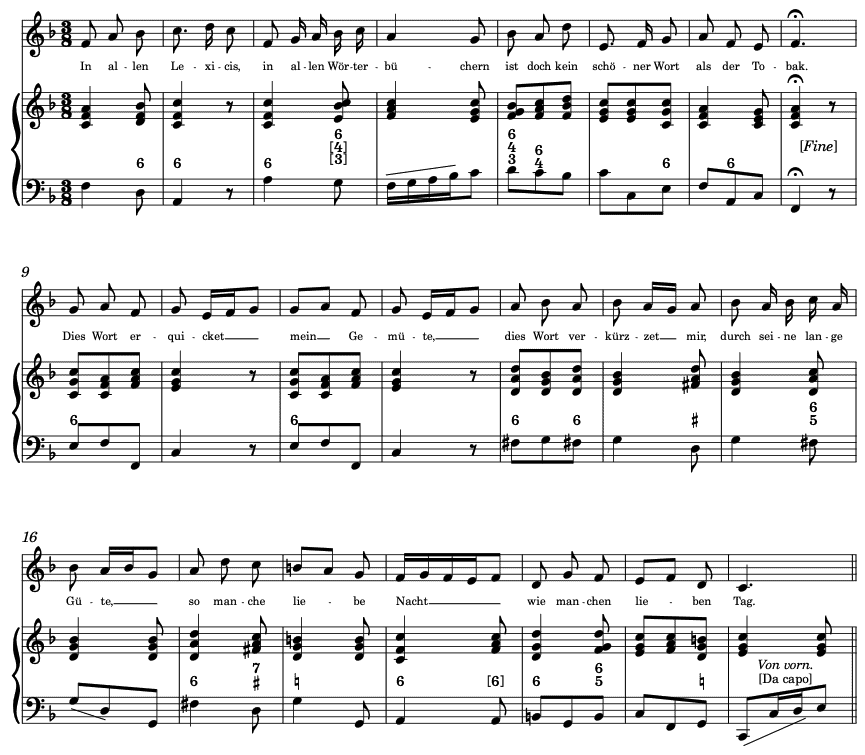
Regardless of whether a Querstrich is present, Telemann never realizes off-beat sixteenth notes, thereby treating them as mere passing or neighbour notes and disregarding the contrapuntal possibility of an accompanying part in parallel thirds. See, for instance,
- bars 2, 4, 6 and 8 in aria 13 Die vergesserne Phillis (The Forgetful Phylis); note that the vocal part does produce parallel thirds with the bass in those bars
- bar 3 in aria 28 Pastorell (Pastorale); see example above
- bars 4 and 22 of aria 39 Toback (Tobacco).
Select Bibliography
Arnold, Franck Thomas. The Art of Accompaniment from a Thorough-Bass (2 volumes) (Oxford: Oxford University Press, 1931; unabridged and unaltered republication by Dover Publications in 1965 (with a new introduction) and 2003).
Christensen, Jesper Bøje. Die Grundlagen des Generalbaßspiels im 18. Jahrhundert: Ein Lehrbuch nach zeitgenössischen Quellen (Kassel: Bärenreiter, 1992).
Christensen, Jesper Bøje. Les Fondements de la Basse Continue au XVIIIe siècle : Une méthode basée sur les sources d’époques (Basel: Bärenreiter, 1995).
Christensen, Jesper Bøje. 18th Century Continuo Playing: A Historical Guide to the Basics (Kassel: Bärenreiter, 2002).
Heinichen, Johann David. Der General-Bass in der Composition (Dresden, 1728).
Mattheson, Johann. Kleine General-Bass-Schule (Hamburg, 1735).
Rampe, Siegbert. Generalbasspraxis 1600–1800 (Laaber: Laaber Verlag, 2014).
Telemann, Georg Philipp. Singe-, Spiel- und General-Bass-Übungen (Hamburg, 1733–34).
Telemann, Georg Philipp. Singe-, Spiel- und General-Bass-Übungen TWV 25:39-85 für Singstimme & Tasteninstrument — Revidierte Neuausgabe, ed. Wolf Hobohm (Magdeburg: Edition Walhall – Verlag Franz Biersack, 2003). Zohn, Steven. Music for a Mixed Taste: Style, Genre, and Meaning in Telemann’s Instrumental Works (New York: Oxford University Press, 2008/2015 (revised paperback edition)).