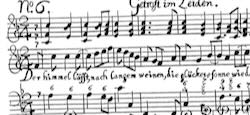
This essay is the first in a series examining Telemann’s views on chordal rhythm in a thoroughbass realization. Because chordal rhythm depends largely on the specific time signature employed, I will discuss each time signature in a separate essay. Here, I discuss chordal rhythm in a 2/4 time signature, as presented in his Singe-, Spiel- und General-Bass-Übungen.
In the SSGBÜ, Telemann often writes one chord above each bass note in arias in 2/4, whether that note is shorter than, equal to or longer than a beat. Yet, at least in certain cases, he also underlines the perception of every beat, which may result in fewer chords than one might expect.
All musical examples are taken from Derek Remeš’s digital and freely available edition of the SSGBÜ, which can be downloaded at https://doi.org/10.17877/TUDODATA-2025-MC06WAYR. Note further that
- the translations of Telemann’s quotes are mine
- “bar 1a” refers to the first half of bar 1, and “bar 1b” to the second half
- the term “Oberstimme” refers to the upper part of the thoroughbass realization.
Of the 48 arias in the SSGBÜ, seven are entirely written in 2/4 (nos. 6, 15, 21, 26, 29, 37 and 41), while the following two arias contain 2/4 passages:
- aria 9: the second section, from the upbeat to bar 13 onward (the first section is in 3/4)
- aria 42: bars 3–5 and 21–24 (this aria also contains passages in 3/4, 3/8, 9/8 and 4/4).
Ignoring Chords on the Weak Eighth Note of a Beat
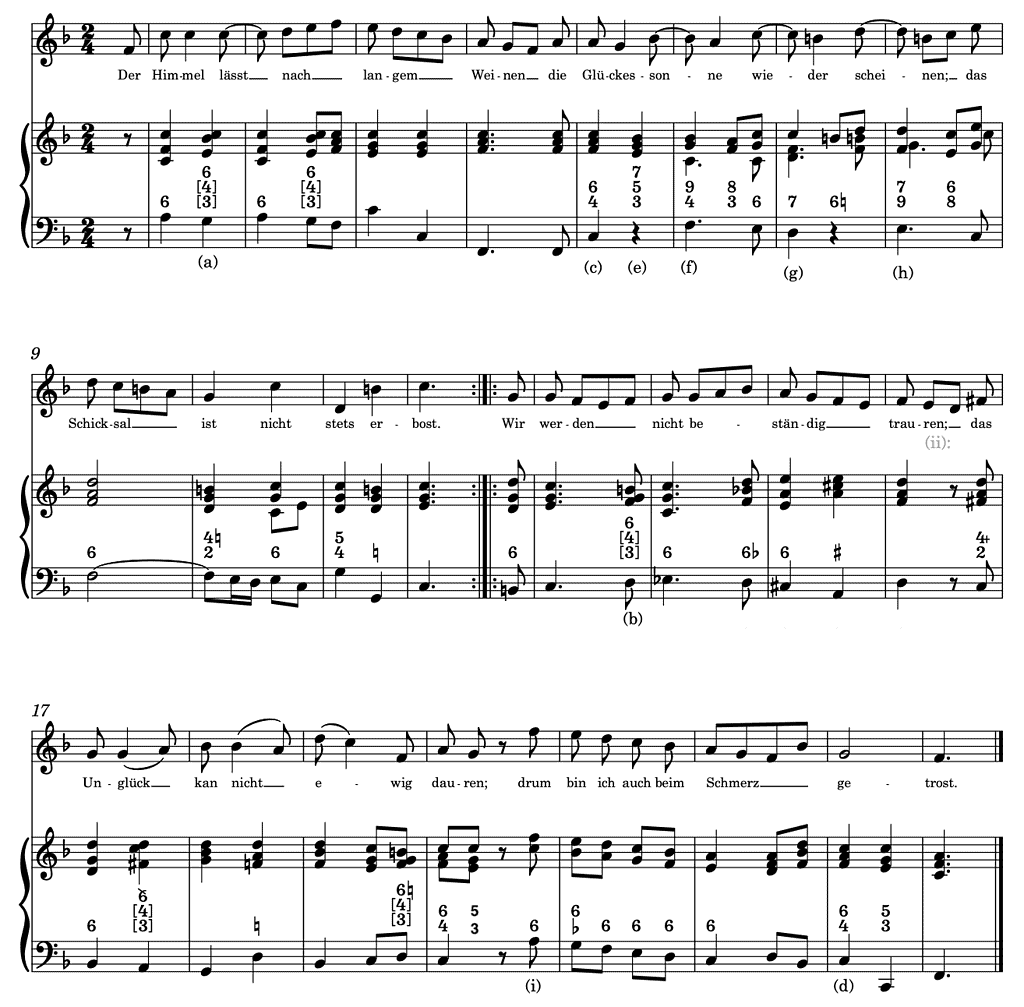
The only specific guideline Telemann gives for realizing basses in 2/4 concerns bars 2 and 14 of aria 15 Mutter-Söhne (Mother’s Sons), where he advises playing fewer chords than expected or suggested:
“The chords that are omitted in all cases marked (a) are based on the need to maintain the weight of the bar and to allow the singer to be heard more clearly. Thus, a player does well, in such situations where the harmony does not extend far—even if the passing tones are figured— to listen more than to rumble.”
“Die griffe, so beÿ allen (a) weggelassen werden, haben das tact-gewicht u. deutlichere vernehmen des sängers zum grunde: also thut ein spieler wohl, wann er in solchen fällen, da die harmonie sich nicht weit ausbreitet, ob auch schon die durchgehenden tone beziefert wären, mehr höret, als rumpelt.”
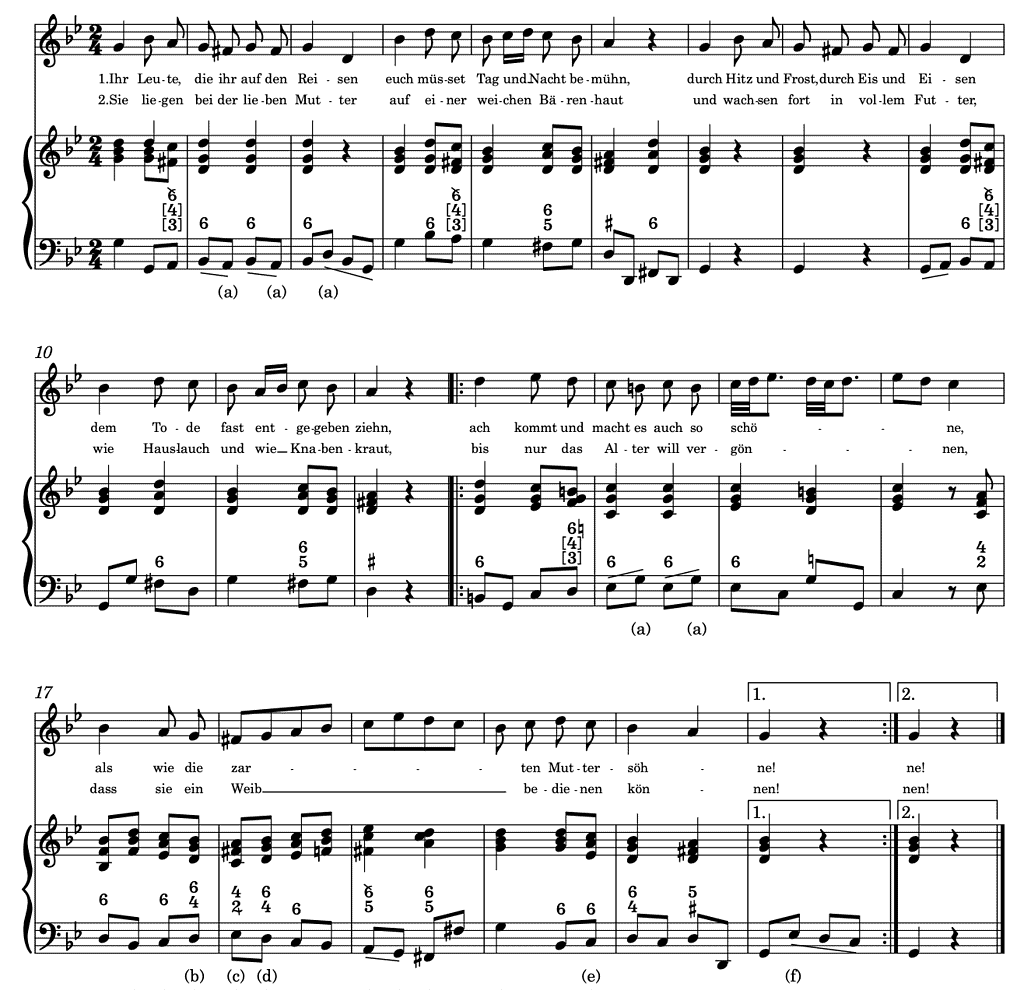
(Note that Telemann writes a 6/4/3 chord on the last eighth note of bars 1, 4, 9 and 13 while indicating only a sixth chord. I will elaborate on this possibility of expanding a sixth chord into a 6/4/3 chord in a future essay.)
In contrast to bars 1b, 4b, 9b and 13b, Telemann twice ignores the ‘extra’ sixth —or 6/4/3— chord in bar 2, a chord that would evidently arise from the f♯1 in the vocal line sounding over the A in the bass. In bar 14, he likewise ignores twice the implied G-major triad in bar 14, resulting from the alignment of the gs in the bass and the b♮1s in the vocal line.
These realizations illustrate how Telemann, aiming to preserve a clear perception of the (beats of a) time signature, does not always consider it appropriate to play more than one chord per beat, even when the vocal line and the bass strongly suggest, or even seem to demand, a faster chordal rhythm.
Further Illustrations of Quarter-Note Chordal Rhythm
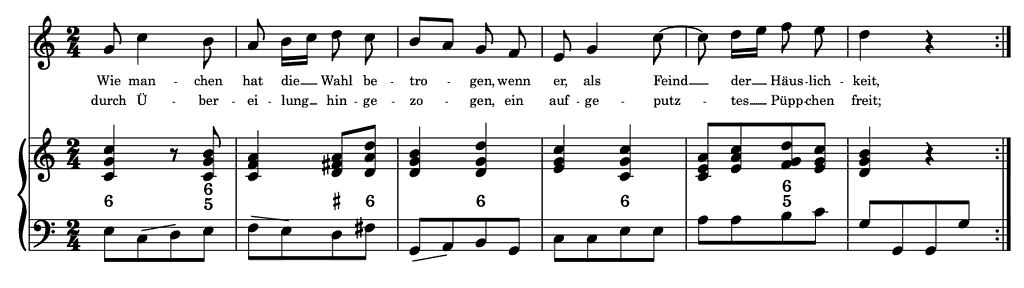
While aria 37 Geputzte Frau (Well-Dressed Woman) includes many passages with eighth-note chords (see below for more on eighth-note chordal rhythm), Telemann opts for quarter-note chords on the bass’s eighth notes in bars 3 and 4, where repeated eighth-note chords —especially from bar 3b— would have been equally possible.
Eighth-Note Chordal Rhythm
In fact, this type of repeated eighth-note chords in 2/4 occurs, for example, at the beginning of the second section of aria 9 Über das niedersächsische Versapen (On Lower Saxon Whining), in bars 13 and 14, where it even results in four consecutive identical eighth-note chords.
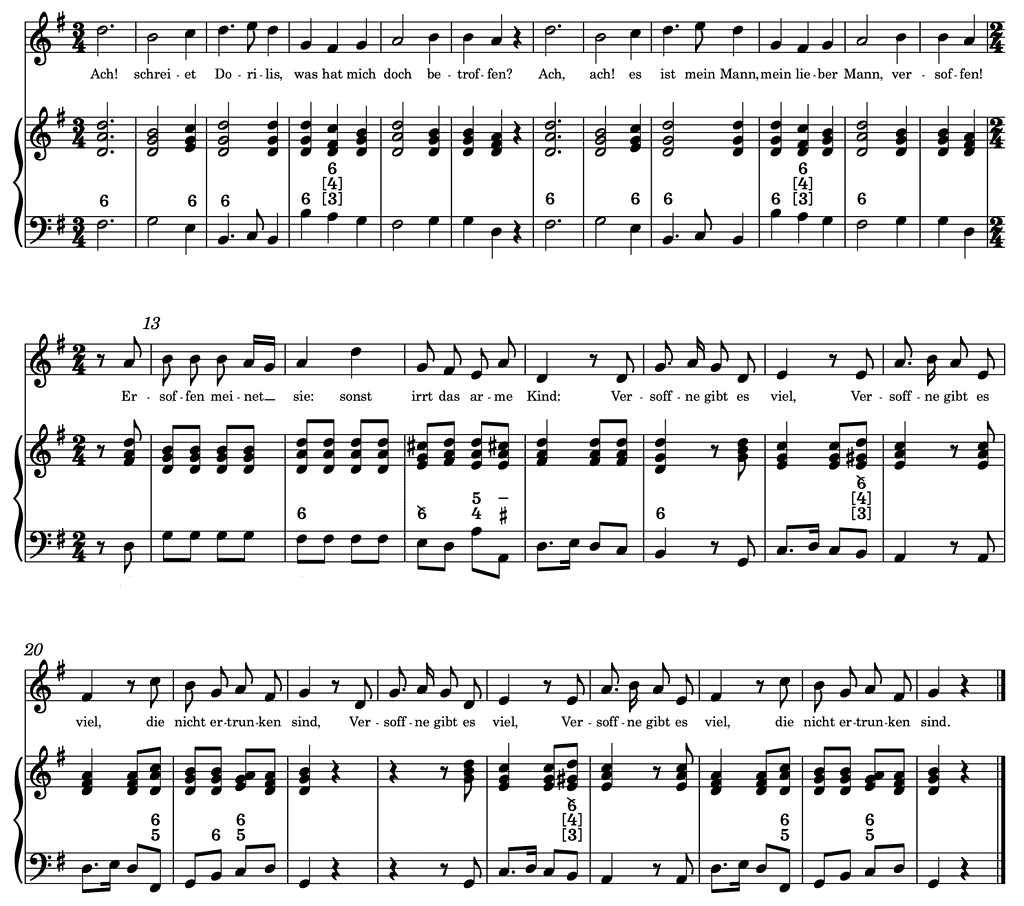
Note also how nearly every individual bass note receives its own chord in this aria (including in the opening section set in 3/4, a time signature I will discuss in the next essay). Bars 21 and 27, for example, each contain four successive different eighth-note chords. (Only the shorter note in a dotted rhythm does not receive its own chord.)
To Restrike or Not To Restrike — That Is the Question
In the context of a cadenza composta, whether set as 5/4–5/3 or 6/4–5/3, the common notes are systematically restruck at the moment of resolution in the SSGBÜ. This may be somewhat surprising, as common notes accompanying the resolution of a dissonance are usually not restruck. (I will elaborate on this in a later essay.)
Examples of a cadenza composta set as either 5/4–5/3 or 6/4–5/3 occur, for instance, in:
- bar 15b of the example above (5/4–5/3 at the level of eighth notes)
- bar 11 of the following example, aria 6 Getrost im Leiden (Consoled in Suffering) (5/4–5/3 at the level of quarter notes)
- bar 23 of the following example, aria 6 Getrost im Leiden (Consoled in Suffering) (6/4–5/3 at the level of quarter notes).
Telemann’s handling of common notes during other types of dissonance-consonance motion, however, is less uniform, regardless of time signature. In aria 6 Getrost im Leiden (Consoled in Suffering), for example —written in 3/4— the common notes accompanying the 9/4–8/3, 7–6 and 7/9–6/8 motions in bars 6, 7 and 8 are not restruck.
(Note that, unlike bar 6, the order of the figurings in bar 8 reflects the actual voice leading, with 9 below 7 and 8 below 6 —a practice common in the eighteenth century.)
Similarly, the common notes accompanying the 9–8 motion that ornaments the sixth chord in bar 19 of aria 46 Greiser Trinker (Old Drinker) are not restruck:
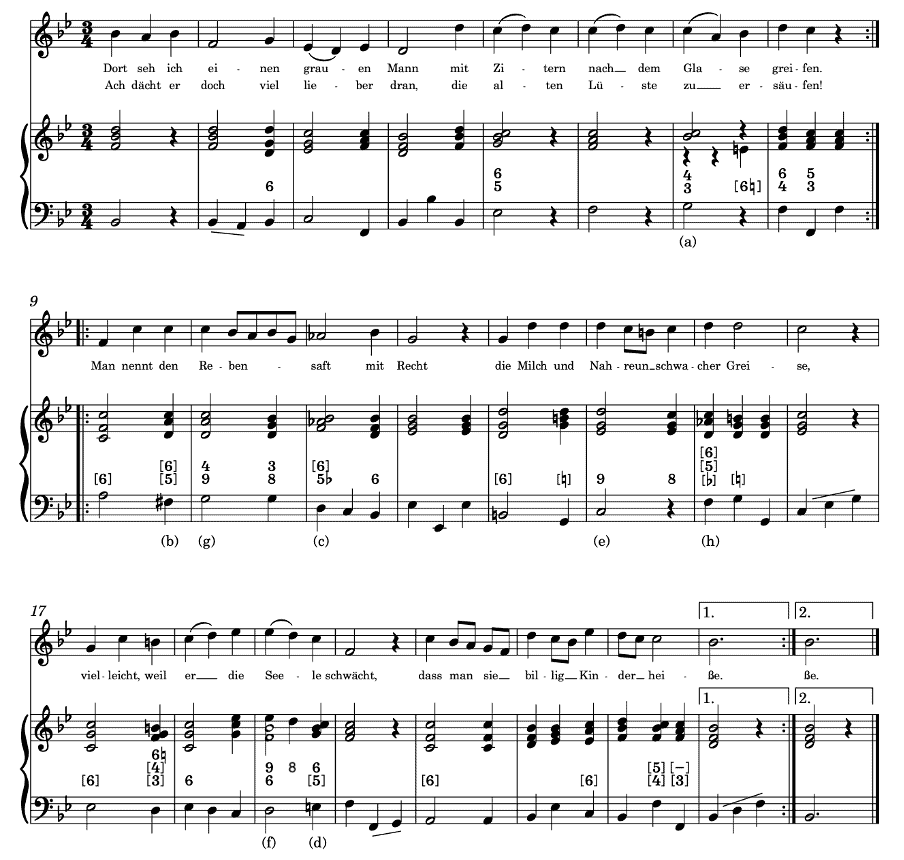
On the other hand, in bar 10 of the same aria, the 4/9–3/8 motion is accompanied by a restriking of the common note, whereas —as we saw— this very dissonance-consonance motion is accompanied by a not-articulated common note in bar 6 of aria 6 Getrost im Leiden (Consoled in Suffering). (Note that, unlike bar 6 in aria 6, the order of these figurings reflects the actual voice leading, with 9 below 4 and 8 below 3.)
Likewise, the common note during the 4/9–3/8 motion in bar 28 of aria 21 Ohnesorge (Without Worries) is restruck:
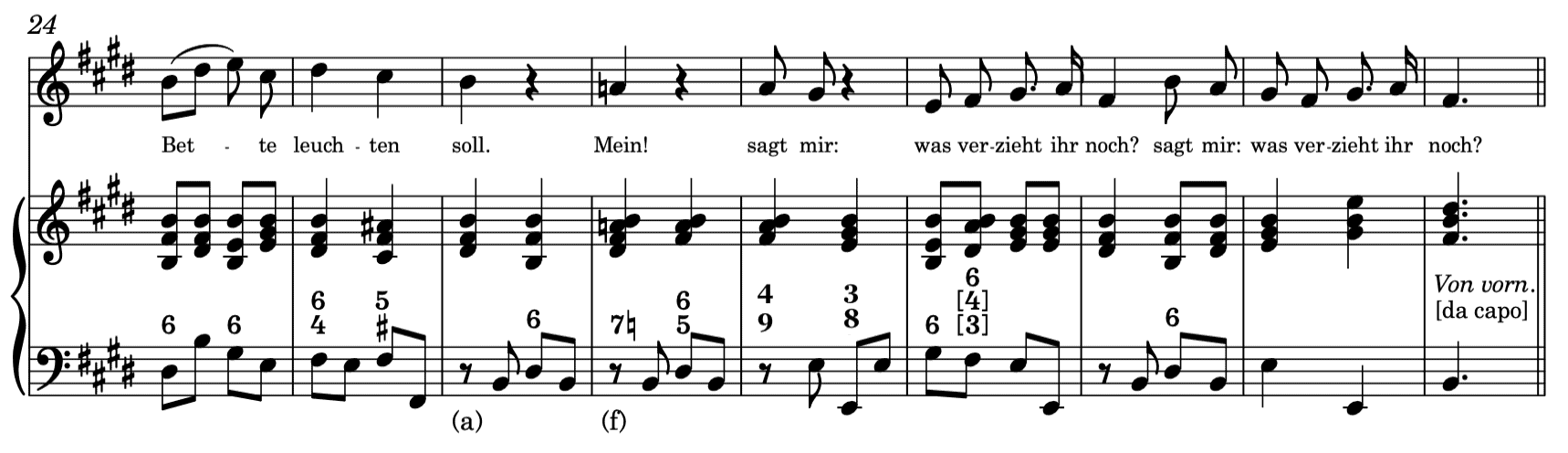
Note how Telemann continues to mark the beats with quarter-note chords in the right hand up to bar 28, despite the running eighth notes and rests in the bass, resulting in a different timing of the resolution in the vocal line and in the right hand. A similar situation occurs in bars 6–8 of aria 6 Getrost im Leiden (Consoled in Suffering).
A Chord on a Rest
With regard to the practice of playing chords in the right hand on rests in the bass, as illustrated in the example above, Telemann writes the following:
“In the first part of this aria, during the rests, one finds in the right hand a movement identical to that of the bass; at (a), however, a different movement appears. The latter is the best for tender expression and for maintaining the metre.”
“Durch den ersten theil dieser aria findet man oben beÿ den pausen eine gleiche bewegung mit dem basse, beÿ (a) hingegen eine andere; die letztere ist beÿ zärtlichen ausdrückung u. zu unterhaltung des tactes die beste.”
A More Nuanced Approach to Chordal Rhythm
Notice how, in bar 10b in aria 6 Getrost im Leiden (Consoled in Suffering), Telemann offers a solution that lies somewhat between an eighth-note and a quarter-note chordal rhythm, neither writing two eighth-note chords nor a single quarter-note chord. Instead, he proposes a slightly more nuanced realization —a type of voice leading that appears only once in the SSGBÜ, even though it could have been applied in many similar occasions.
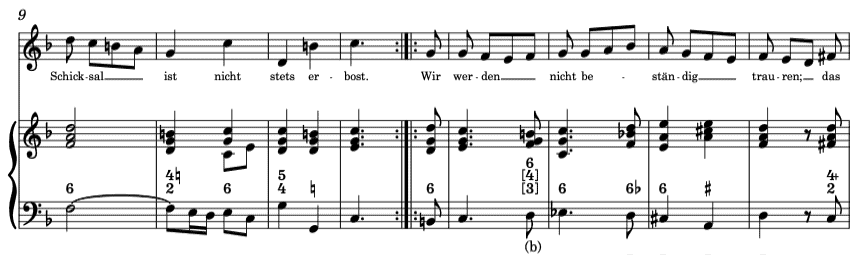
While the bass plays two eight notes, e–c, the common notes between the sixth chord and the ensuing triad are sustained (written as quarter notes in the Oberstimme and alto part), while the tenor part carries out an exchange with the bass, c1–e1.
Slower Chordal Rhythm
Take another look at aria 6 Getrost im Leiden (Consoled in Suffering). Here, not only do eighth-note chords —note, for instance, the six consecutive three-part sixth chords in bars 20b–22a— and quarter-note chords appear, but also dotted-quarter-note chords and even a half-note chord (bar 9).
(For more on the consecutive three-part sixth chords in bars 20b–22a, see my essay Telemann’s SSGBÜ: Number of Parts.)
Rule of Thumb
Despite some examples in which Telemann ignores the obvious ‘extra’ chord on an off-beat eighth note in the bass and vocal line, he generally provides it when the bass and vocal line clearly suggest it. Conversely, when a bass note extends beyond a single beat, Telemann does not feel obliged to mark every beat in the right hand; instead, he provides a chord that matches the length of the longer bass note. From these observations, one might formulate the following rule of thumb, which Telemann himself, however, nowhere explicitly articulates: as a starting point, play a single chord on each bass note.
Select Bibliography
Arnold, Franck Thomas. The Art of Accompaniment from a Thorough-Bass (2 volumes) (Oxford: Oxford University Press, 1931; unabridged and unaltered republication by Dover Publications in 1965 (with a new introduction) and 2003).
Christensen, Jesper Bøje. Die Grundlagen des Generalbaßspiels im 18. Jahrhundert: Ein Lehrbuch nach zeitgenössischen Quellen (Kassel: Bärenreiter, 1992).
Christensen, Jesper Bøje. Les Fondements de la Basse Continue au XVIIIe siècle : Une méthode basée sur les sources d’époques (Basel: Bärenreiter, 1995).
Christensen, Jesper Bøje. 18th Century Continuo Playing: A Historical Guide to the Basics (Kassel: Bärenreiter, 2002).
Heinichen, Johann David. Der General-Bass in der Composition (Dresden, 1728).
Mattheson, Johann. Kleine General-Bass-Schule (Hamburg, 1735).
Rampe, Siegbert. Generalbasspraxis 1600–1800 (Laaber: Laaber Verlag, 2014).
Telemann, Georg Philipp. Singe-, Spiel- und General-Bass-Übungen (Hamburg, 1733–34).
Telemann, Georg Philipp. Singe-, Spiel- und General-Bass-Übungen TWV 25:39-85 für Singstimme & Tasteninstrument — Revidierte Neuausgabe, ed. Wolf Hobohm (Magdeburg: Edition Walhall – Verlag Franz Biersack, 2003).
Zohn, Steven. Music for a Mixed Taste: Style, Genre, and Meaning in Telemann’s Instrumental Works (New York: Oxford University Press, 2008/2015 (revised paperback edition)).