
This essay is the first in a series exploring Georg Philipp Telemann’s Singe-, Spiel- und General-Bass-Übungen.
Telemann’s Singe-, Spiel- und General-Bass-Übungen (1733–1734) comprise 48 songs that include not only written-out continuo realizations but also instructions on how to create them. This collection is therefore an invaluable source for understanding German continuo practice of that time.
In this essay, I provide historical background and context for the Singe-, Spiel- und General-Bass-Übungen (henceforth SSGBÜ), and I also explain the rationale behind this series of essays. Note further that the translations of Telemann’s quotes are mine.
Historical Background and Context
On 28 October 1733, an advertisement written by Telemann himself was published in Hamburgische Berichte von neuen Gelehrten Sachen:
“MUSICALIA.
Hamburg. Our widely renowned Kapellmeister Mr. Telemann intends to publish an amusing and at the same time instructive musical journal under the title Singe-, Spiel- und General-Baß-Uebung. A sheet of it will appear weekly, namely on Thursdays, each containing an aria together with the figured bass. The arias will be composed particularly in the English, French and Polish style, and will be so easy that even an inexperienced person in music, after having heard them several times, will be able to sing them and make use of them even without accompaniment; but if one does not wish or is unable to sing them, they may be played on the keyboard or other instruments. Furthermore, above the figured bass there are five lines in which the notation shows what the right hand, by virtue of the figures, should grasp cleanly and comfortably. Moreover, at the end of each sheet, one or several occasional rules or remarks will be added, aimed at the thoroughbass, or providing some other explanation. The poems will consist of moral and other reflections by good poets. Each sheet costs 2 schillings or 1 groschen, and whoever wishes to pay in advance will also receive the dozen for half a reichsthaler, which, when complete, will be worth 2 marks or one gulden, all according to Hamburg currency. The edition is issued at the music shop under the Emperor’s Court, opposite the Town Hall; there can also be obtained six new quartets by Mr. Kapellmeister Telemann, at 2 reichsthalers, and his third dozen of clavier fantasias at 2 marks. The first number of the journal will be available on the Thursday after Martinmas.*) Hamburg, 28 October 1733.
*) 400 copies are printed on printing paper.”
“MUSICALIA.
Hamburg. Unser weit-berühmter Herr Capellmeister Telemann ist gesonnen, ein belustigend und zugleich unterrichtendes musicalisches Journal heraus zu geben, unter dem Titul: Singe-, Spiel- und General-Baß-Uebung. Es wird wöchentlich, und zwar Donnerstags, ein Blat davon zum Vorschein kommen, welches eine Arie, nebst dem bezieferten Basse, enthält. Die Arien werden insbesondere nach dem englischen, frantzösischen und polnischen Styl abgefasset, und dermassen leicht seyn, daß sie auch ein Unerfahrner in der Music, nachdem er sie etliche mal gehöret, wird nachsingen, und sich derselben, auch ohne Accompagnement, bedienen können; da man sie aber nicht singen wolte, noch könte, so mögen sie auf dem Claviere, oder andern Instrumenten, gespielet werden. Ferner befinden sich über dem bezieferten Basse 5 Linien, worin man durch Noten zeiget, was die rechte Hand, vermöge der Ziffern, reinlich und bequem zu greifen habe. Annoch wird man jedes mal am Ende eine, oder etliche, zufällige Reguln oder Anmerkungen hinzufügen, so auf den General-Baß abzielen, oder sonst einige Erläuterung geben. Die Poesien werden aus moralisch- und andern Gedanken guter Fichter bestehen. Jedes Blatt kostet 2 ß. oder 1 Gr., und wer voraus bezahlen will, der bekommt ebenfalls das Dutzend für einen halben Rthlr., welches aber, wenn es fertig, 2 Mk. oder einen Gulden, alles nach Hamburger Werth, gilt. Die Ausgabe geschieht im Music-Laden unterm Kaysers-Hofe, gegen dem Rath-Hause über; woselbst auch 6 neue Quatuors von Hn. Cap. Telemann, à 2 Rthlr., und dessen drittes Dutzend der Clavier-Fantasien à 2 Mk., zu bekommen sind. Das erste Stück des Journals ist am Donnerstag nach Martini zu haben.*) Hamburg den 28. October, 1733.
*) 400. Exemplarien kommen auf Druck-Papier.”
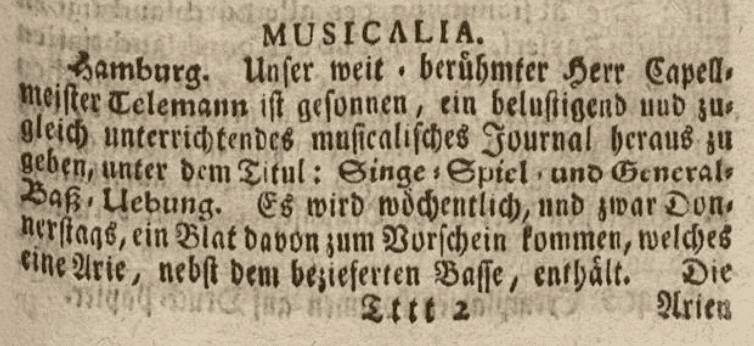
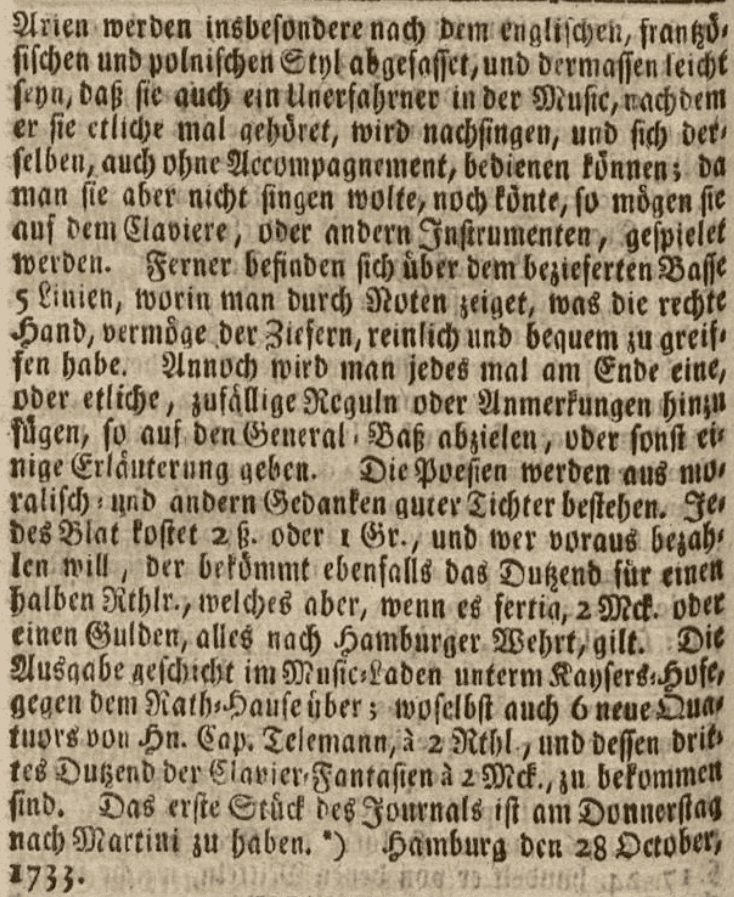
(28 October 1733), p. 739–740, public domain, available on https://gdz.sub.uni-goettingen.de.
This advertisement makes Telemann’s goals with his 48 SSGBÜ quite clear, explaining each term in the title:
- They are exercises (Übungen).
- They are easy.
- They can be sung with or without accompaniment (Singe).
- They can be played on the keyboard or another instrument without singing (Spiel).
- They include thoroughbass realizations (General-Bass).
- They provide rules and guidelines for creating thoroughbass realizations (General-Bass).
On 20 November of the same year, a second advertisement for the SSGBÜ appeared, again written by Telemann himself, further emphasizing some of its goals while also clarifying what it was not intended to be:
“Hamburg. The first and second pieces of the Singe-, Spiel- und General-Baß-Uebung, which our Kapellmeister Mr. Telemann has undertaken to publish weekly, namely every Thursday, in the manner of a journal, have now actually appeared. And since, like all his previous works, it meets with universal approval, both on account of its very easy instruction in thoroughbass and of the lively aria appearing each time, as well as the poetry set beneath it, composed by excellent masters, the famous author will be all the more encouraged to continue this fine work, which is also extremely convenient for learning to sing, in accordance with his promise, every week. It becomes clear from the appended remarks that his intention is not to show how a bass should be figured, which properly belongs to composition, but rather how one should play the figures, which is demonstrated with the utmost clarity in the accompanying scale with its threefold positions.”
“Hamburg. Das erste und zweyte Stück der Singe-, Spiel-, und General-Baß-Uebung, so unser Herr Capellmeister Telemann wöchentlich, und zwar alle Donnerstag, nach Art eines Journals, herauszugeben unternommen: ist nun wüklich heraus. Und da es so wie alle seine bisherige Arbeiten, sowohl der gar leichten Anweisung zum General-Baß, als der jedesmahl erscheinenden lebhaften Arie, und der darunter gelegten, von lauter Meistern verfertigten, Poesie wegen, durchgehends Beyfall findet: so wird der berühmte Hr. Verfasser um so mehr aufgemuntert werden, diese schöne, und auch zum singen lernen überaus bequeme Arbeit, seinem Versprechen nach, alle Woche fortzusetzen. Es erhellet aus den hinzugefügten Anmerkungen, daß seine Absicht nicht sey, zu zeigen, wie man einen Baß bezieffern soll, als welches eigentlich zur Composition gehöret, sondern wie man die Zieffern spielen müsse, welches denn in der dabey befindlichen Scala mit dreyfachen Griffen aufs deutlichste gewiesen wird.”
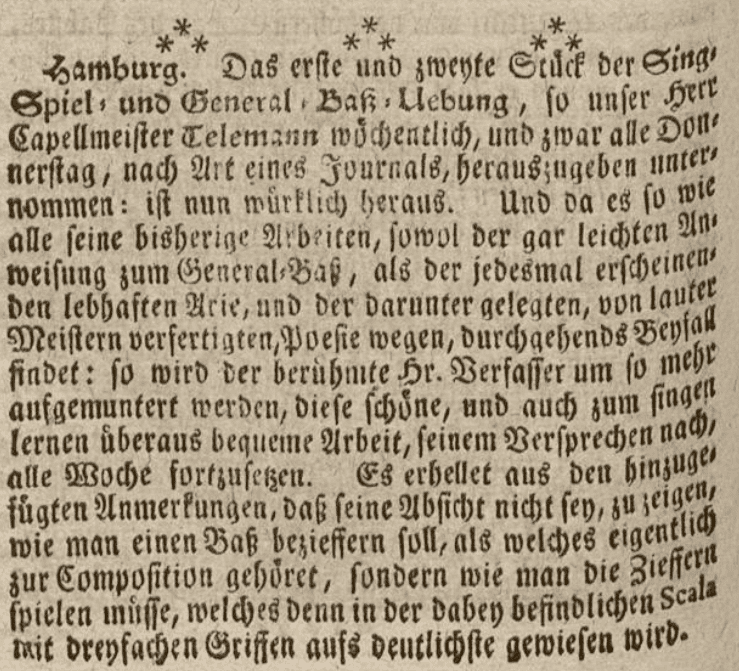
(20 November 1733), p. 784, public domain, available on https://gdz.sub.uni-goettingen.de.
Rationale for this Series
While the SSGBÜ contain a wealth of information on thoroughbass realization, this material is far from systematically organised. In fact, Telemann never intended to create a coherent method or manual on thoroughbass with a carefully structured design. As he stated in his first advertisement, his aim was rather to publish “an amusing and at the same time instructive musical journal”. This series of essays seeks
- to organize Telemann’s rules and guidelines into thematic topics, gathering the information scattered across the 48 arias into coherent essays richly illustrated with examples from the arias themselves
- to comment on Telemann’s rules and guidelines, especially those that are incomplete or raise questions
- to contextualize Telemann’s rules and guidelines with those of his contemporaries, thereby not only highlighting similarities but also showing where their approaches and concepts diverge.
Earlier Studies
Telemann’s SSGBÜ have already been discussed, at least in part, in several earlier studies, three of which are notable:
- Franck Thomas Arnold’s The Art of Accompaniment from a Thorough-Bass (originally 1931)
- Jesper Bøje Christensen’s Die Grundlagen des Generalbaßspiels im 18. Jahrhundert — Ein Lehrbuch nach zeitgenössischen Quellen (1992), also available in English and French translations
- Siegbert Rampe’s Generalbasspraxis 1600–1800 (2014).
Some Editions
- A digital version of the original edition of the SSGBÜ is available here: https://imslp.org/wiki/Singe-%2C_Spiel-_und_Generalbass%C3%BCbungen%2C_TWV_25:39-85_(Telemann%2C_Georg_Philipp).
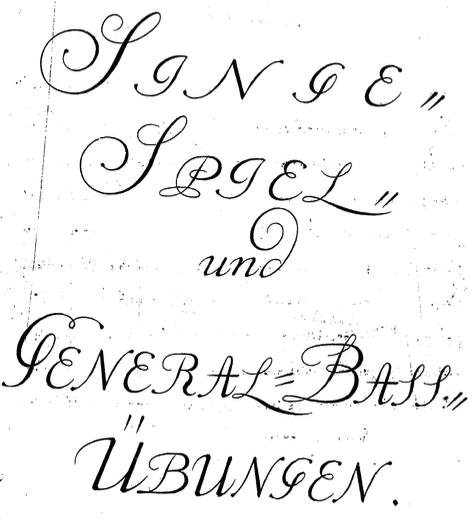
available on https://imslp.org.
- In 2003, Wolf Hobohm published a (paper) edition of the SSGBÜ for Edition Walhall (Magdeburger Telemann Edition), including an extensive preface and a modernized rendering of Telemann’s formulation of his rules and guidelines. However, I do not always find his interpretations entirely convincing. And note that the scores of the arias contain some errors.
- Derek Remeš has produced a free digital edition of the SSGBÜ, which
- can be accessed at https://doi.org/10.17877/TUDODATA-2025-MC06WAYR
- includes an often rather free English translation of Telemann’s rules and guidelines, the reason why all translations in this series are mine (note that some errors crept into the transcription of the original German)
- will be used in my essays to illustrate Telemann’s approach to thoroughbass realization
- is also available in a version without thoroughbass realizations.
Select Bibliography
Arnold, Franck Thomas. The Art of Accompaniment from a Thorough-Bass (2 volumes) (Oxford: Oxford University Press, 1931; unabridged and unaltered republication by Dover Publications in 1965 (with a new introduction) and 2003).
Christensen, Jesper Bøje. Die Grundlagen des Generalbaßspiels im 18. Jahrhundert: Ein Lehrbuch nach zeitgenössischen Quellen (Kassel: Bärenreiter, 1992).
Christensen, Jesper Bøje. Les Fondements de la Basse Continue au XVIIIe siècle : Une méthode basée sur les sources d’époques (Basel: Bärenreiter, 1995).
Christensen, Jesper Bøje. 18th Century Continuo Playing: A Historical Guide to the Basics (Kassel: Bärenreiter, 2002).
Rampe, Siegbert. Generalbasspraxis 1600–1800 (Laaber: Laaber Verlag, 2014).
Telemann, Georg Philipp. Singe-, Spiel- und General-Bass-Übungen (Hamburg, 1733–34).
Telemann, Georg Philipp. Singe-, Spiel- und General-Bass-Übungen TWV 25:39-85 für Singstimme & Tasteninstrument — Revidierte Neuausgabe, ed. Wolf Hobohm (Magdeburg: Edition Walhall – Verlag Franz Biersack, 2003).
Telemann, Georg Philipp. Singe-, Spiel- und General-Bass-Übungen (Hamburg, 1733–34).
Telemann, Georg Philipp. Singe-, Spiel- und General-Bass-Übungen TWV 25:39-85 für Singstimme & Tasteninstrument — Revidierte Neuausgabe, ed. Wolf Hobohm (Magdeburg: Edition Walhall – Verlag Franz Biersack, 2003).
Zohn, Steven. Music for a Mixed Taste: Style, Genre, and Meaning in Telemann’s Instrumental Works (New York: Oxford University Press, 2008/2015 (revised paperback edition)).