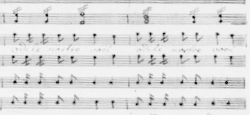
Telemann’s SSGBÜ: Number of Parts

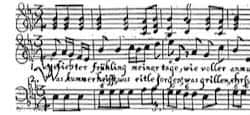
This essay explores Telemann’s views on the number of parts of a thoroughbass realization, as presented in his Singe-, Spiel- und General-Bass-Übungen. In the SSGBÜ, chords are typically four-part (bass plus three upper parts). For consecutive sixth chords, Telemann recommends three-part chords. In specific cases, five-part and full-voiced chords may be used. Additionally, when necessary,

Telemann’s SSGBÜ: Number of Parts Read More »

Telemann’s Singe-, Spiel- und General-Bass-Übungen: Context

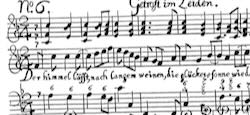
This essay is the first in a series exploring Georg Philipp Telemann’s Singe-, Spiel- und General-Bass-Übungen. Telemann’s Singe-, Spiel- und General-Bass-Übungen (1733–1734) comprise 48 songs that include not only written-out continuo realizations but also instructions on how to create them. This collection is therefore an invaluable source for understanding German continuo practice of that time.

Telemann’s Singe-, Spiel- und General-Bass-Übungen: Context Read More »

The Folia

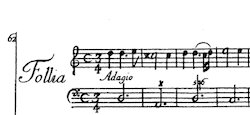
The Folia originated in late 15th-century Portugal and Spain, and by the 17th and 18th centuries had become a widely used framework all over Europe with a number of guises. In this essay, I focus on the so-called ‘late Folia’, which I will refer to simply as ‘the Folia’. The Folia is a minor-mode schema

The Folia Read More »

The Jupiter

This essay is the fourth and last of a series devoted to changing-note schemata, a type of dichotomous schema with a treble and/or a bass whose melodic shape look like a gruppetto or a musical turn (~). In this essay, I will discuss the schema that Robert O. Gjerdingen has labelled the Jupiter. A Jupiter

The Jupiter Read More »

The Pastorella

This essay is the third of a series devoted to changing-note schemata, a type of dichotomous schema with a treble and/or a bass whose melodic shape look like a gruppetto or a musical turn (~). In this essay, I will discuss the schema that Robert O. Gjerdingen has labelled the Pastorella. A Pastorella is a

The Pastorella Read More »

The Aprile

This essay is the second of a series devoted to changing-note schemata, a type of dichotomous schema with a treble and/or a bass whose melodic shape look like a gruppetto or a musical turn (~). In this essay, I will discuss the schema that Robert O. Gjerdingen has labelled the Aprile, after the Neapolitan-trained soprano

The Aprile Read More »