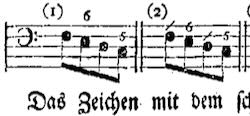
In this essay, I discuss various ways in which accented passing notes were indicated in eighteenth-century German thoroughbass figuring.
An accented passing note may be figured either literally or indirectly. In the latter case, the composer may omit figures over it or place an oblique line above it; only the following consonant note is figured, and its chord is to be played on the accented passing note.
To avoid cluttering the text with full titles, I refer to the sources by author and publication year only, with abridged references provided in the footnotes. Full bibliographical details are given in the Select Bibliography.
Note further that
- all translations are mine unless otherwise stated
- I use the term “Querstrich” throughout and avoid the modern paraphrase “horizontal line”.
Composers such as Johann Sebastian Bach prefer figuring as literally as possible, even when this produces complex figures, as with chords on accented passing notes. Several eighteenth-century treatises, however, aim to simplify this complex notation, referring to such notes often as Wechselnoten or transitus irregulares (singular: transitus irregularis). To distinguish the frequently used sign for durchgehende Noten —the horizontal Querstrich— these treatises often, though not exclusively, introduce an oblique line above Wechselnoten, which Carl Philipp Emanuel, among others, calls a Seitenstrich or schräger Strich (literally “oblique line”). (For more information on the Querstrich, see The Querstrich in Thoroughbass Figuring: What Can It Mean?.)
J.S. Bach
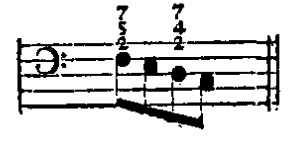
An example of ‘old-school’, complex notation appears on beat 3 of bar 3 of the Vivace from Johann Sebastian Bach’s Sonata in G major for Violin and Thoroughbass BWV 1021. (While the manuscript copied by Bach’s second wife Anna Magdalena dates from around 1730–1734, the exact date of the sonata’s composition remains unknown.)
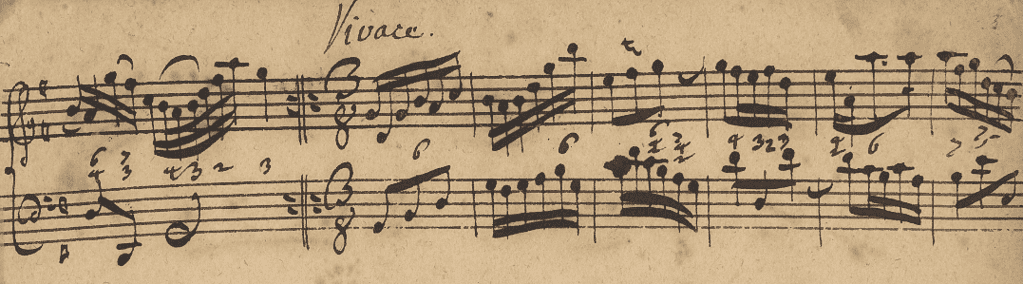
Bach notates exactly which intervals he wants above the a in the bass: 7/4/2, or —‘translated’— g2–d2–b1, that is, simply a G-major triad derived from the following bass note g.
Heinichen (1728)
Contrary to J.S. Bach, Johann David Heinichen favours a notational method in which the transitus irregularis remains unfigured, while the figures appear above the following consonant bass note —a method that, as Heinichen states, requires experience to execute correctly.
In his chapter On Rapid Notes and Various Time Signatures (Von geschwinden Noten, und mancherley Tacten), Heinichen first explains the transitus, a key concept for understanding how to realize basses containing rapid notes:
“§. 3. Transitus means in sensu proprio —or in its real sense— a free passing up or down to the third in which, namely, the middle note does not have its own harmony but passes through freely. To which it should be noted: that just as is well known with notes of the same value, the first, third, fifth, etc., are called Notae virtualiter longae or long notes (according to their inner value) while, in contrast, the second, fourth, sixth, etc., are called Notae virtualiter breves or short notes (according to their inner value), so too the same occurs with the transitus; and the first and third notes of like duration are always inherently [virtualiter] long, the middle one, however, inherently short. In the following examples, the long notes from which the transitus to the third begins each time are marked with small strokes:”
“§. 3. Transitus heisset in sensu proprio oder in seinen eigentlichen Verstande, ein freyer Durchgang in die 3e auff oder niederwerts, da nehmlich die mittlere Note keine eigene Harmonie hat, sondern frey durch passiret. Wobey anzumercken, daß gleichwie bekandter massen, bey allen Noten von gleicher Geltung die erste, 3te, 5te x. notæ virtualiter longæ, oder die (ihren innerlichen Werthe nach) langen Noten genennet werden, da hingegen die 2dre, 4te, 6te, x. Notæ virtualiter breves, oder die (ihren innerlichen Werthe nach) kurtzen Noten heissen: also geschiehet eben dieses bey dem Transitu, und ist die erste und 3te Note von gleicher Geltung jedezeit virtualiterlang, die mittlere aber virtualiterkurtz. In folgenden Exempeln seynd die langen Noten, von welchen jedesmahl der Transitus in die 3e seinen Anfang nimmet, mit Strichlein bezeichnet:”1
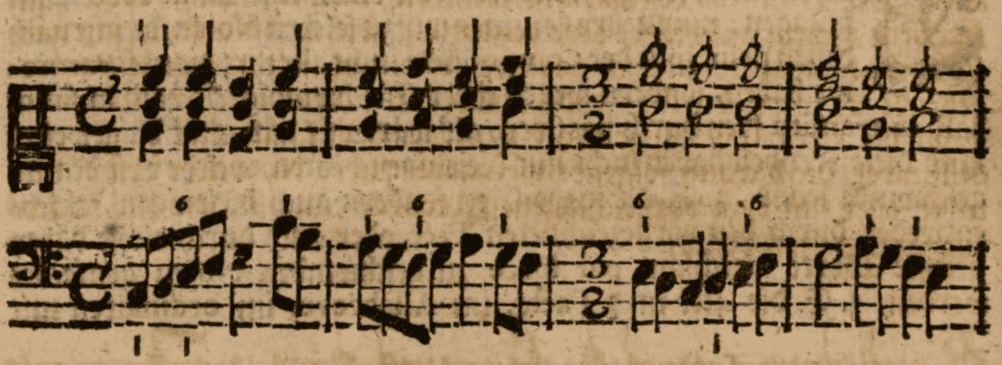
Heinichen then distinguishes two types of transitus:
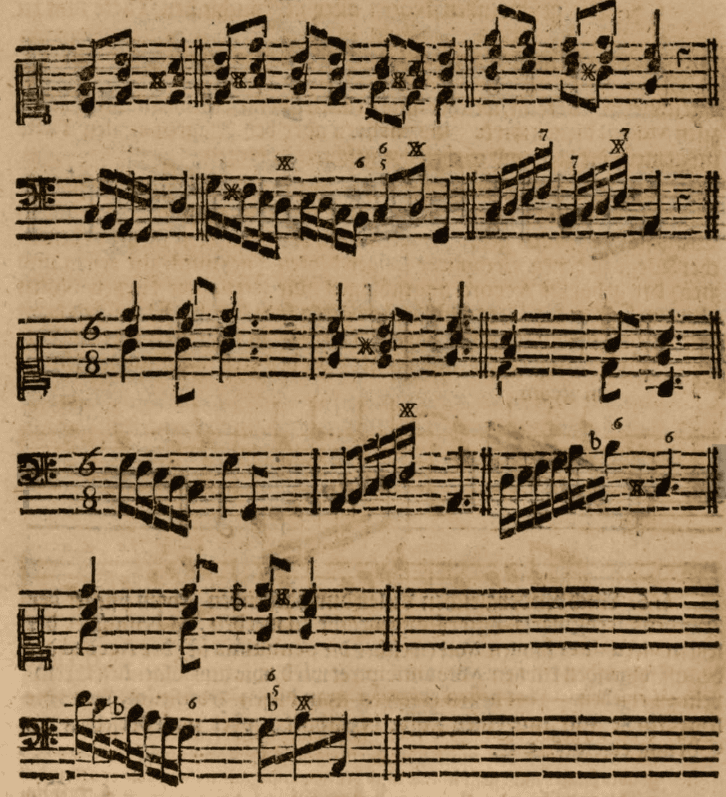
“§. 4. However, the transitus is of two kinds: regularis and irregularis. The transitus regularis results if the inherently long bass note sounds correct in the chord or consoniret, while the following inherently short bass note in passing through becomes a dissonance. The transitus irregularis occurs if the inherently long bass note sounds incorrect or dissoniret and becomes a consonance first on the immediately following inherently short bass note, or [in other words] coincides with the previously played chord, as is evident from the following examples:”
“§. 4. Es ist aber der Transitus zweyerley: regularis und irregularis. Der Transitus regularis ist, wenn die virtualiterlange Note zum Accorde richtig anschläget oder consoniret, die nechstfolgende virtualiter kurtze Note aber im durch passiren dissoniret, wie das nechts vorhergehende Exempel durchgehends ausweiset. Transitus irregularis ist, wenn die virtualiterlange Note zum Accorde falsch anschläget, oder dissoniret, die darauff folgende virtualiterkurtze Note aber erst consoniret, oder mit dem vorgeschlagenen Accorde eintrifft, wie aus folgenden Exempeln erhellet:”2
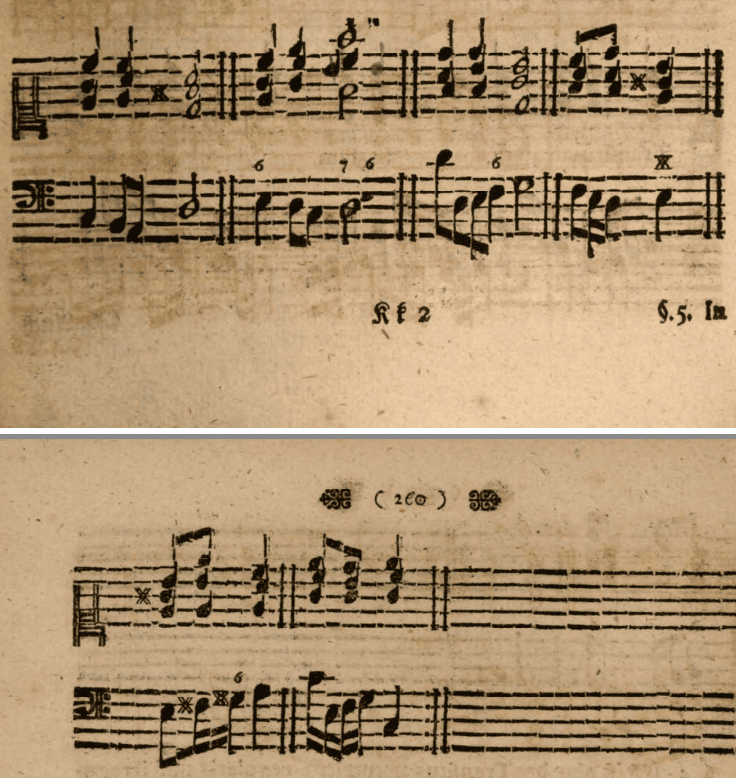
Note that this example contains two errors:
- In the alto part of the second fragment, b1 and c2 on the third and fourth beats should be swapped
- In the alto part of the third fragment, the second note should be a1, not b1.
The following guideline helps in recognizing a transitus irregularis:
“One recognizes this transitus most clearly when the final short note is figured, or when a leap follows it, for example:”
“Am besten erkennet man diesen Transitum, wenn die letzte kurtze Note mit einer Ziffer bezeichnet, oder nach derselben ein Sprung erfolget. z. E.”3
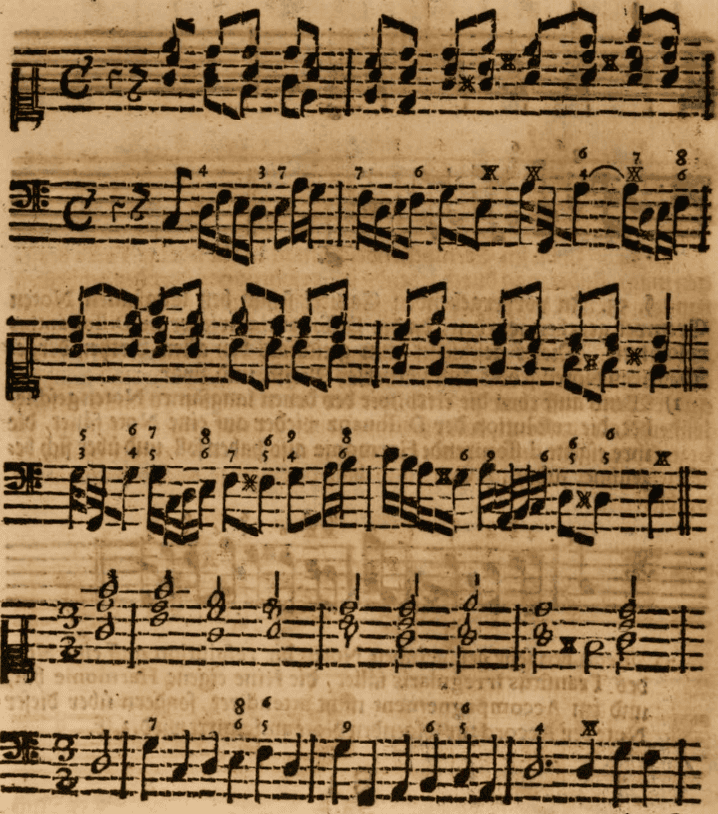
In the concluding section of the chapter On Rapid Notes and Various Time Signatures, Heinichen returns to the use of the transitus irregularis. Here he elaborates on several procedures for delaying the resolution of a dissonance in the context of rapid bass notes, procedures he had previously explained for slow bass notes. One such procedure involves coinciding a transitus irregularis with the resolution of a dissonance in the right hand, thereby postponing a fully consonant Satz by a single rapid note. Heinichen first gives an example in which the notes following each transitus irregularis are figured:
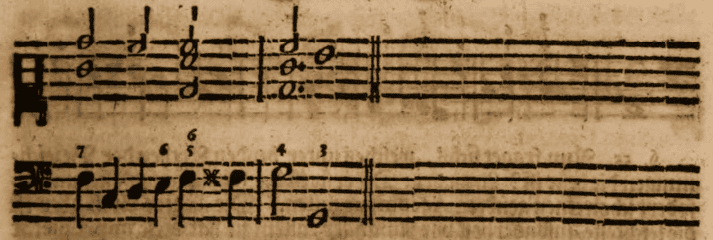
He then explains these examples, noting that some composers still prefer the traditional way of figuring a transitus irregularis, and immediately provides the same bass with the same implied realization, but figured in the traditional manner:
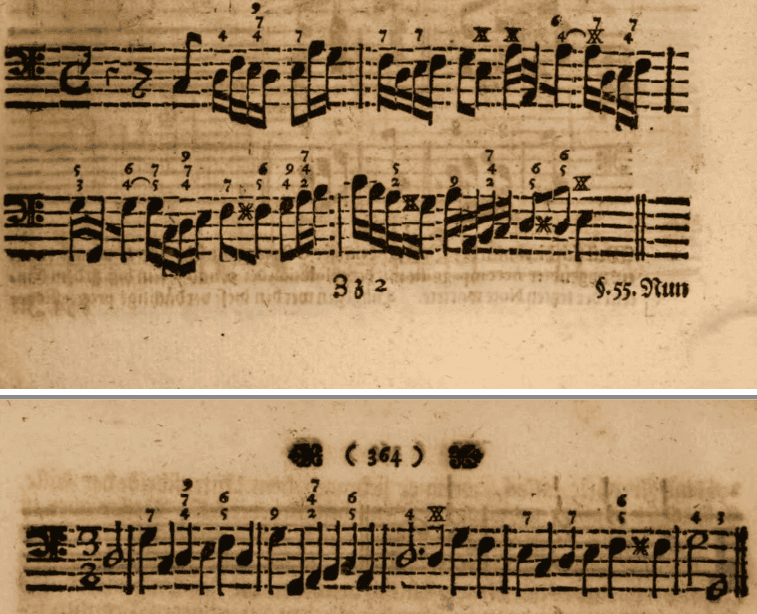
“§. 54. In these examples, … one consistently finds the resolutions indicated above the appropriate fundamental note, as we have hitherto also been accustomed to in the figuring of consonances in the case of the transitus irregularis. However, some composers tend to indicate such resolutions of dissonances (as well as the transitus irregularis in general) in a different manner, namely, precisely above the said transitus, sometimes with, sometimes without the other remaining voices. Accordingly, the two preceding examples, figured in this way, would appear as follows, while the previous accompaniment would remain unchanged:”
“§. 54. In diesem Exempeln … findet man durchgehends die resolutiones über der gehörigen fundamental-Note bezeichnet, wie wir bißhero auch in Bezeichnungen der Consonantien, bey dem vorgekommene Transitu irregularigewohnet gewesen. Es pflegen aber einige Compositores dergleichen resolutiones dissonantiarum(so wie überhaupt den Transitu irregularem) auf eine andere Arth, und zwar præcise über der, in gedachten Transitu vorfallenden Note, bald mit, bald ohne ihre übrigen zugehörigen Stimmen zu bezeichnen. Dahero würden die vorhergehenden 2. Exempel in solcher Bezeichnung also aussehen, und doch das vorige Accompagnement verbleiben:”4
Heinichen then assesses the advantages and disadvantages of both notational methods:
“§. 55. Now the question arises: which of the two kinds of indication is the better? Answer: The first is the more fundamental and already presupposes a practiced accompanist. The other manner, however, is the easier one, especially for beginners; yet it has this impropriety, that the figures 9, 7, 4, 5/2, etc., written above the notes, often appear to the eye as ‘religious’, resolution-bound dissonances, and thereby cause a fundamental accompanist more vexation and confusion than ease. Nevertheless, it would seem that this manner of indication cannot be entirely rejected in certain cases; one must therefore grant every composer the freedom to employ, according to the distinction of circumstances, now this, now that method of indication. It is better, however, to introduce a beginner immediately to the first, fundamental manner, since the other in itself presents not the slightest difficulty, and requires no particular art to strike the figures plainly as they stand above such a marked transitus irregularis.”
“§. 55. Nun fraget sichs, welches unter beyden Arthen der Bezeichnungen die beste ist? Antwort: Die erste ist die fundamentaleste, und erfodert schon einen geübten Accompagnisten. Die andere Arth aber ist die leichteste, insonderheit vor Anfänger, allein sie hat diese impropietät bey sich, daß die über denen Noten befindlichen Ziffern der 9. 7. 4. 5/2 &c. öffters denen Augen als religiöse, zur resolutiongeneigte dissonantieneinem fundamentalen Accompagnisten mehr Verdruß und Confusion, als Leichtigkeit verursachen. Indeß scheinet es, als wenn man diese Arth der Bezeichnung in einigen wenigen Casibus nicht gäntzlich verwerffen könne, und also muß man einem jedweden Compositoridie Freyheit lassen, wenn er sich nach dem Unterscheide der Fälle, bald dieser, bald jener Arth der Bezeichnung bedienet. Besser aber ist es, man führet einen Anfänger gleich zu der ersten fundamentalen Arth an, weil die andere Arth ohne diß nicht die geringste Schwürigkeit bey sich führet, und es gar keiner Künste brauchet, die Ziffern platterdings so anzuschlagen, wie man sie über dergleichen bezeichneten Transitu irregulari findet.”5
Adlung (1758)
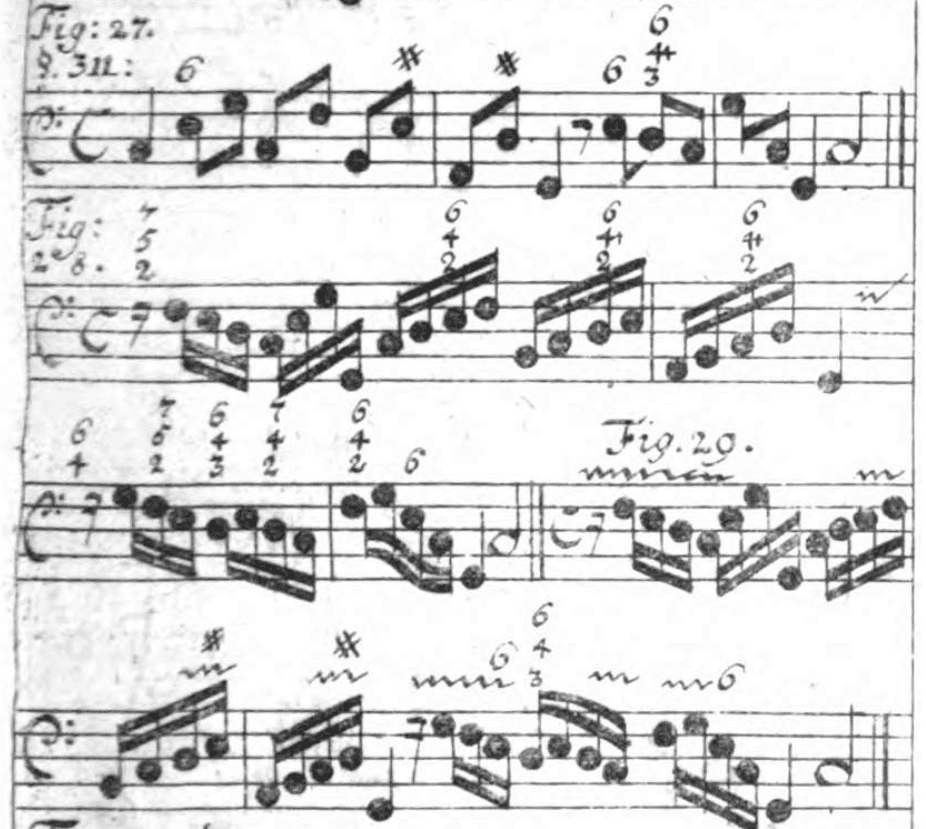
In the interest of simplifying thoroughbass figuring for beginners, Adlung proposes a horizontally extended curl to indicate that the implied chord at the end of the line is to be struck already from its beginning (which may occur over a note or a rest). He illustrates this in figure 29, contrasting it with the more elaborate, traditional figurings in figure 28, both representing an ornamented bass derived from a more elementary version presented in figure 27. Adlung formulates it as follows:
“Dissonant Sätze arise for the most part through the anticipation and delay of consonant ones. In the case of slow notes, one need therefore not be afraid of figurings placed above them, by which such figures are expressed; but in more rapid Sätze the player must very often infer them from the context of the melody, and at times must not determine the chords from the written notes, but rather according to the principal melody concealed within them. To the experienced I need say nothing here; but what is to be done when one has pupils whose understanding is not yet sufficient to perceive this? Would it not be advisable to indicate by a certain sign which the principal notes are, according to which the chords are to be arranged? In teaching, I make use of the sign shown in Fig. 29, until the pupils are able to extract the principal melody from the more rapid notes. This melody is presented in Fig. 27. When the composer alters it by means of quicker notes, as shown in Fig. 28, the chords would have to be indicated by many figures; in place of these, however, I have set in Fig. 29 a sign. Whenever this sign is seen above a note, or above a small rest, that note is not to determine the chord; rather, it is the note over which the sign ends that gives the chord. For example, if the sign begins above the first rest but ends above the fourth note, C, then the chord of C is to be struck at the rest, and not F, which is the first note; thus the essence of the melody (Fig. 27) remains in its proper integrity. For the composer’s figures or embellishments must not disturb that melody in its essential order. Whoever knows a more convenient sign may also employ it. If composers should at times make use of this as a reminder for the simple-minded, it can do no harm; and in rapid figuration a sign is always more intelligible than a series of numbers.”
“Dissonirende Sätze entstehen grossentheils durch die Vorausnehmung, (Anticipation) und Verzögerung (Retardation) der wohllautenden. Bey langsamen Noten muß man demnach vor überstehenden Ziefern zich nicht fürchten, durch welche solche Figuren ausgedruckt werden; aber bey geschwindern muß gar oft der Spieler aus dem Zusammenhange der Melodie solche errathen, und bisweilen die Griffe nicht einrichten nach den geschriebenen Noten, sondern nach der darinne verborgenen Hauptmelodie. Geübten darf ich allhier nichts vorsagen; aber was ist zu thun, wenn man Scholaren hat, deren Verstand noch nicht hinreichend ist, solches einzusehen? Sollte nicht gut seyn durch ein gewisses Zeichen anzumerken, welches die Hauptnoten sind, wornach die Griffe einzurichten? Ich bediene bey der Unterweisung mich desjenigen, so Fig. 29 zu sehen, so lange, bis die lernenden die Hauptmelodie aus den geschwindern Noten herauszuziehen vermögend sind. Diese Melodie ist in der 27ten Figur vorgestellt. Wenn nun der Setzer durch geschwindere Noten dieselbige verändert, wie Fig. 28 zu sehen, würden die Griffe durch viel Zahlen anzumerken seyn, an deren Stelle ich Fig. 29 ein Zeichen gesetzt habe. Wenn also dieses über einer Note gesehen wird, oder über einer kleinen Pause, so soll nicht dieselbige Note den Grif geben, sodern diejenige, wo das Ende des Zeichens gefunden wird. Als wenn über der ersten Pause sich das Zeichen abhebt, sich aber endet über der vierten Note C, so soll dieser Accord C bey der Pause angeschlagen werden, nich aber F, welches die erste Note ist; so bleibt der Hauptsatz der Melodie Fig. 27 in gebührender Richtigkeit. Denn die Figuren oder Manieren des Setzers müssen dieselbige Melodie ordentlich nicht verändern. Wer hierzu ein bequemeres Zeichen weiß, kann sich desselbigen auch bedienen. Wollen die Setzer zur Erinnerung vor die Einfältigen sich dessen bisweilen bedienen, kann es wohl keinen Schaden bringen, und in der Geschwindigkeit ist ein Zeichen jederzeit verständlicher, als eine Zahlreihe.”6
Note that Carl Philipp Emanuel Bach likewise includes the curl among several possible signs for indicating anticipated chords. His discussion, however, is restricted to Wechselnoten and in his example the curls extend only as far as the penultimate note before the chord-determining note (see below).
Marpurg (1761)
Friedrich Wilhelm Marpurg makes the following statement:
“When the attack of the harmony falls upon a Wechselnote, this is indicated by a Queerstrich, as in figure 1.”
“Wenn der Anschlag der Harmonie auf eine Wechselnote fällt: so wird solches durch einen Queerstrich angezeiget, wie bey fig. 1.”7
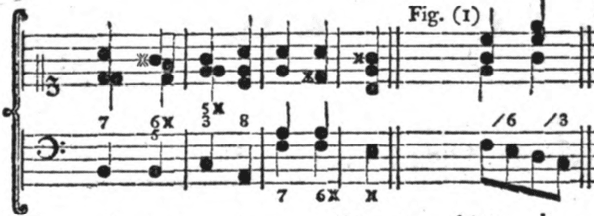
Note that Marpurg here uses the term Queerstrich, although it is usually employed to indicate a prolonged harmony. (For more information, see The Querstrich in Thoroughbass Figuring: What Can It Mean?.)
C.P.E. Bach (1762)
Carl Philipp Emanuel Bach first explains Wechselnoten with a musical example figured exactly, as his father would have done:
“§. 75. When the accompaniment that properly belongs to the virtually short note is anticipated and struck together with the long note, the passing note is irregular (transitus irregularis), and the notes are then called Wechselnoten:”
“§. 75. Wenn die Begleitung, welche der virtualiter kurzen Note zukommt, vorausgenommen, und zur langen Note angeschlagen wird, so ist der Durchgang irregulär (transitus irregularis) und die Noten heißt man alsdenn Wechselnoten:”8
He then explains an alternative way of figuring Wechselnoten:
Ҥ. 76. If one does not wish to figure the on-beat note, one either places the figures only above the off-beat notes, or marks the on-beat notes above with either an oblique line, a zero, a half zero, or an m, which, when necessary, is lengthened:

The sign with the oblique stroke in example (2) is the best.”
“§. 76. Wenn man die anschlagende Note nicht beziffern will, so setzt man entweder die Ziffern über die nachschlagenden Noten allein, oder bezeichnet die anschlagenden Noten noch oben ein entweder mit einem Seitenstrich, einer Null, einer halben Null, oder einem m, welches, wenn es nöthig ist, verlängert wird:
Das Zeichen mit dem schrägen Strich bey Numer [sic] (2) ist das beste.”9
G.M. Telemann (1773)
Georg Michael Telemann, grandson of Georg Philipp Telemann, quotes the section on Wechselnoten and their possible indications from C.P.E. Bach’s treatise in his own work. Like C.P.E. Bach, Telemann recommends using an oblique line (schräger Strich) to indicate Wechselnoten. However, G.M. Bach also suggests using an oblique line to indicate durchgehende Noten. While he notes that the Querstrich can serve this purpose as well, he considers it less common in this context.10
J.M. Bach (1780)
Johann Michael Bach presents a similar simplified way of indicating Wechselnoten, a term he uses as does C.P.E. Bach, although J.M. Bach employs only the oblique line to indicate the anticipated chord of the off-beat bass note:
“§. 2. Wechselnoten are the good parts of the bar, 1–3–5–7, which fill in the interval leading to the next note and, at the moment of attack, form a dissonance; they must proceed stepwise and have consonant notes before and after them.
§ 3. The dissonances produced by these notes are not figured. A (/) indicates that one is to take the chord from the following note for this one.”
“§.2. Wechselnoten werden die guten Tactglieder genennt, 1–3–5–7, die zur nächstfolgenden Note den Zwischenraum ausfüllen, und zum Anschlag dissoniren, vor und nach sich consonirende Noten, Stufenweise folgend, haben müssen.
§. 3. Die Dissonanzen, welche diese Noten verursachen, werden nicht beziefert. Ein (/) zeigt an, daß man den Accord von der folgenden zu dieser greife.”11
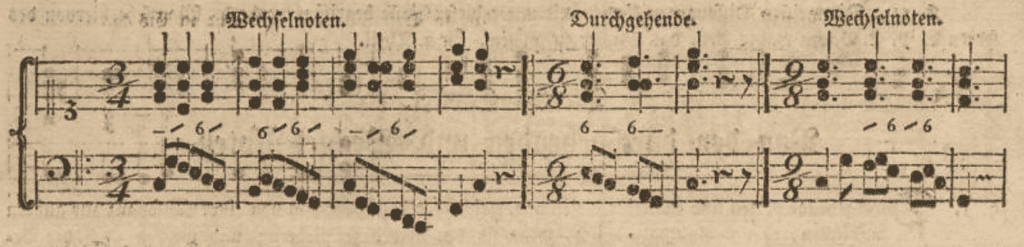
Note that the example following §§. 2 and 3 includes both Wechselnoten, indicated by oblique lines, and durchgehende Noten, indicated by Querstriche.
Kirnberger (1781)
In the section On the Various Thoroughbass Figuring (Von der verschiedenen Bezifferung des Generalbasses), Johann Philipp Kirnberger states the following:
“Composers differ greatly in the manner in which they figure their basses in irregular passing motions. Anyone who makes practical use of the thoroughbass will readily perceive the necessity of being acquainted with these various manners of figuring; moreover, since one does not have the liberty—if the harmony is to be properly maintained—of choosing at will which chords to assign to this or that tone, I shall present these differences more clearly in the following examples.
For the triad belonging to the following bass note, some have adopted the figuring indicated in Fig. L (a), where the intervals are given according to their degrees; others, however, employ the manner shown in Fig. L (b), in which the actual harmony is indicated by means of the Querstrich. This latter method is to be preferred to the former on account of its greater clarity.
In order further to encompass the majority of figuration types that occur both with the triad and its inversions, as well as with the chord of the seventh and its inversions, I have appended after Fig. L (b) various examples, in which the second manner is in every case the easier method of figuring.”
“Die Componisten sind in der Art, ihr Bässe bei irregulairen Durchgängen zu beziffern ganz verschieden. Die Nothwendigkeit, diese verschiedene Bezifferungen zu kennen, wird jeder einsehen, der vom Generalbaß einen ausübenden Gebrauch macht, und weil man überdem zur Aufrechthaltung der Harmonie nicht die Wahl, welche Accorde man zu diesem oder jenem Tone angeben will; um also diese Verschiedenheit desto genauer einzusehen, wil ich selbige in folgenden Beispielen anzeigen.
Für den Dreiklang von der folgenden Baßnote haben einige die bei Fig. L. (a) angemerkte Beziffering, wo die Intervalle ihren Graden nach angebracht sind; andere wiederum die bey Fig. L. (b) wo die eigentliche Harmonie durch den Querstrich angezeigt ist. Diese letztere Art ist jener, wegen mehrerer Verständlichkeit, vorzuziehen.
Um nun ferner die meisten Bezifferungen zu fassen, welche sowohl beim Dreiklange und seinen Verwechselungen, als beim Septimenaccord und seinen Verwechselungen vorkommen, habe ich hinter der Figur L. (b) verschiedene Beispiele gegeben, wo immer die zweite Art die leichteste Bezifferungsart ist.”12
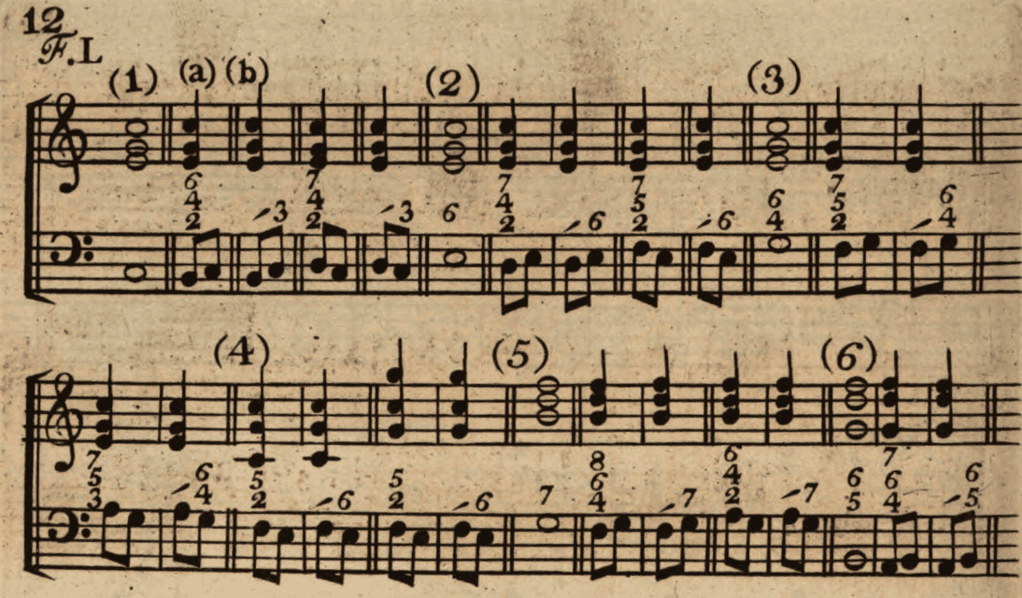
Note that, like Marpurg, Kirnberger here uses the term Queerstrich, although it is usually employed to indicate a prolonged harmony. (For more information, see The Querstrich in Thoroughbass Figuring: What Can It Mean?.)
Notes
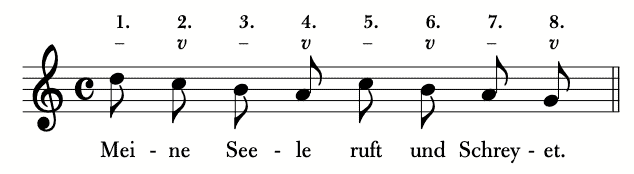
- Heinichen, 1728: 257–258. English translation in Buelow, 1992: 103–104; English translation of the last sentence is mine. As I explain in my book Johann Sebastian Bach’s Art of Fugue — Performance Practice Based on German Eighteenth-Century Theory, “In seventeenth-century and eighteenth-century Europe, the theoretical concept of metre with its hierarchic organization of notes seems to have been strongly embedded in the performance practice prevailing at the time. Depending on its position in the bar, a note could be ‘good’, and thus strong and/or long, or ‘bad’, that is weak and/or short” (Demeyere, 2013: 53). In his Praecepta der Musicalischen Composition Johann Gottfried Walther, a cousin of J.S. Bach, explains how the concept of ‘good’ and ‘bad’ notes should be reflected in performance: “Quantitas Intrinseca Notarum (which is also called Quantitas accentualis) refers to those lengths, in the case of several notes of equal value, which are performed unequally, so that these equal notes are alternatively long and short. For instance, [see example above]
In this example, the notes are, in their outward values, equal with each other (because they are purely quavers) but the inner value is such that the 1.3.5.7th are long, the 2.4.6.8th short. … This theory about the accent’s length has its specific advantages both vocally and instrumentally; since from this arises the tasteful differentiation of the voice or finger, so that one attacks strongly such a note which, depending on its number, is strong, while one expresses somewhat shorter and softer such a note which, depending on its number, is short.” (Quantitas Intrinseca Notarum (welche auch Quantitas accentualis genennet wird) ist diejenige Länge, wenn etliche dem valore nach sonst gleich geltende Noten, gantz ungleich tractiret werden, also, daß eine gegen die andere ihres gleichen, bald lang, bald kurtz ist. … In diesem Exempel sind zwar die Noten, der äuserlichen Geltung nach, einander gleich (weil es neml. lauter Achtel sind) aber der innerl. Geltung nach ist die 1. 3. 5. 7te lang; und die 2. 4. 6. 8te kurtz. … Diese Lehre von der Accent-Länge, hat so wohl vocaliter als instrumentaliter ihren sonderbahren Nutzen; denn hieraus entspringet die manirliche moderation der Stimme, oder Finger, daß man neml. eine solche Note, die der Zahl nach, lang ist, starck anschläget; hingegen eine solche Note, die der Zahl nach kurtz ist, auch etwas kürtzer und leiser exprimiret.) Walther, 1708/1955: 23–24. English translation of the first two sentences in Butt, 1990: 12–13; English translation of the last sentence is mine. The concept of Quantitas Intrinseca Notarum was treated for the first time in Wolfgang Caspar Printz’s Satyrischer Componist (1676), a treatise profoundly influencing Walther’s view on this matter. ↩︎ - Heinichen, 1728: 259. English translation of the first sentence and last phrase (from “as is evident from”) is mine; English translation of the last two sentences in Buelow, 1992: 104. ↩︎
- Heinichen, 1728: 261. ↩︎
- Heinichen, 1728: 363. ↩︎
- Heinichen, 1728: 364–365. ↩︎
- Adlung, 1758: 643–644. ↩︎
- Marpurg, 1761: 34. ↩︎
- C.P.E. Bach, 1762: 30. ↩︎
- C.P.E. Bach, 1762: 31. ↩︎
- G.M. Telemann, 1773: 74–94. G.M. Telemann employs the Querstrich in two ways. First, to prolong a chord when the Querstrich appears above several bass notes. Second —and this is a particular usage— to transfer an accidental present in one figuring to the next (G.M. Bach, 1773: 93). ↩︎
- J.M. Bach, 1780: 19. ↩︎
- Kirnberger, 1781: 86. ↩︎
Select Bibliography
Adlung, Jakob. Anleitung zu der musikalischen Gelahrtheit (Erfurt, 1758).
Arnold, Franck Thomas. The Art of Accompaniment from a Thorough-Bass (2 volumes) (Oxford: Oxford University Press, 1931; unabridged and unaltered republication by Dover Publications in 1965 (with a new introduction) and 2003).
Bach, Carl Philipp Emanuel. Versuch über die wahre Art das Clavier zu spielen — Zweyter Theil, in welchem die Lehre von dem Accompagnement und der freye Fantasie abgehandelt wird (Berlin, 1762).
Bach, Johann Michael. Kurze und systematische Anleitung zum General-Baß, und der Tonkunst überhaupt, mit Exempeln erläutert (Kassel, 1780).
Buelow, George J. Thorough-Bass Accompaniment according to Johann David Heinichen — Revised Edition (Lincoln and London: University of Nebraska Press, 1992).
Heinichen, Johann David. Der General-Bass in der Composition (Dresden, 1728).
Butt, John. Bach Interpretation — Articulation Marks in Primary Sources of J. S. Bach (Cambridge: Cambridge University Press, 1990).
Demeyere, Ewald. Johann Sebastian Bach’s Art of Fugue — Performance Practice Based on German Eighteenth-Century Theory (Leuven: Leuven University Press, 2013).
Kirnberger, Johann Philipp. Grundsätze des Generalbasses als erste Linien zur Composition (Berlin, 1781).
Marpurg, Friedrich Wilhelm. Die Kunst das Clavier zu spielen — Zweyter Theil, worinnen die Lehre vom Accompagnement abgehandelt wird (Berlin, 1761).
Printz, Wolfgang Caspar. PHRYNIS MITILENAEI Oder des Satyrischen Componisten [Band 1] (Quedlinburg, 1676).
Telemann, Georg Michael. Unterricht im Generalbaß-Spielen auf der Orgel oder sonst einem Clavier-Instrumente. (Hamburg, 1773).
Walther, Johann Gottfried. Praecepta der Musicalischen Composition (Weimar, 1708). Modern edition, ed. Peter Benary (Leipzig: Breitkopf & Härtel (Jenaer Beiträge zur Muzikforschung – Band 2), 1955).