This essay is the second in a series exploring Johann David Heinichen’s General-Bass in der Composition.
Heinichen takes four-part thoroughbass realization as his starting point, achieved in the case of a triad by doubling its fundamental note. On the harpsichord especially, this setting can be expanded into a full-voiced accompaniment by doubling further notes in the left hand.
This essay also takes George J. Buelow’s groundbreaking study on Heinichen’s treatise —Thorough-Bass Accompaniment according to Johann David Heinichen (third edition, 1992)— into account, while expanding on it and putting it into perspective. Note further that
- the translations of Heinichen’s quotations are mine
- the term “Oberstimme” refers to the upper part of the thoroughbass realization.
Heinichen starts his discussion on chords and figures with the triad:
“The first and foremost combination of several consonances, from which a musical harmony arises, is that known to all musicians as the Trias harmonica, or a harmony composed of three voices, which consists of the bass (the fundamental key), third and fifth.” “Die erste und vornehmste Zusammensetzung vieler Consonantien, woraus eine Musicalische Harmonie entspringet, ist die, allen Musicis Trias harmonica, oder eine aus drey Stimmen zusammen gesetzte harmonie, welche bestehet in der Basi (dem fundamental-clave) Tertia und Quinta.”1
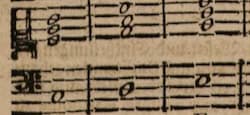
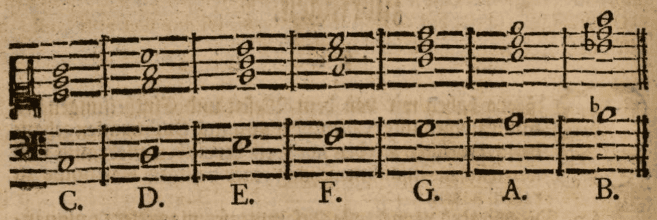
In order to make this chord practically usable in thoroughbass accompaniment, he says, one should transform the Trias harmonica into the Trias harmonica aucta (the expanded triad; “die vermehrte Trias harmonica”). To this end, the fundamental-clave is doubled an octave below the triad; it is this doubled note that becomes the bass, creating a four-part chord that Heinichen simply calls ein Accord. Indeed, a four-part thoroughbass texture is the starting point. As for the distribution of the four notes of an Accord, he advises the beginner to play the bass with the left hand while playing the three other notes with the right hand, and doing so on every scale step.2
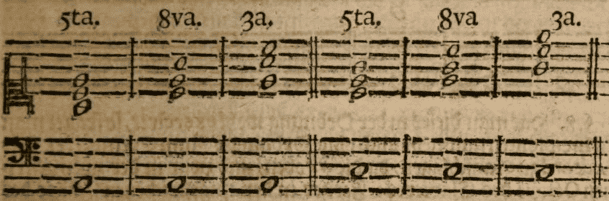
Moreover, Heinichen also advises to practice these triads in the three positions, thus with the fifth, the octave and the third in the Oberstimme.
According to Heinichen, however, more accomplished players, especially harpsichordists playing in operatic style, seek a richer kind of realization with a full-voiced left hand —the so-called full-voiced accompaniment (vollstimmiges Accompaniment). Although this approach is not to be excluded from the organ, it is less suited for that instrument because of the danger of producing a confused sound if the left hand is too thick, so caution is necessary. Towards the end of the chapter on the triad, Heinichen elaborates on all this, giving an extensive explanation of different ways of realizing thoroughbass with regard to the number and distribution of parts, depending on the style and era of the composition and on the type of keyboard instrument:
Ҥ. 28. At the end of this teaching an important question still arises, namely: whether all the examples given above could not be played in a fuller-voiced manner, or: whether the thoroughbass must necessarily remain throughout at such four-part accompaniment?
§. 29. To answer this thoroughly, it is known that the old world, following the thoroughbass’s first invention, played it in a very thin-voiced manner, and that even in the last years of the past century a three-part accompaniment (in which sometimes the right hand, sometimes the left, played a single part alone while the other hand carried the two remaining parts) was not at all uncommon, because the ancients, in accompanying on full-voiced instruments, contented themselves with the Trias harmonica simplex and the most necessary essential voices of each musical texture. In later times, however, people thought more about the Trias harmonica aucta and the doubling of several essential voices of musical textures; hence the four-voiced accompaniment became more fashionable. This was at first divided equally between both hands, namely two parts in the right hand and two parts in the left, in order thereby to display the art of a well-regulated quatro (just as, still today, in certain cases —especially on organs, with thinly-scored music— it is practiced by famous masters). But because this manner was not applicable everywhere, and especially not to the subsequently introduced use (contrary to the teaching of the ancients) of very fast basses, the four-part accompaniment came to be divided unequally between the hands: namely three parts for the right hand, and the single bass part for the left hand —which, however (as mentioned above),3 was given the freedom, where not hindered by the speed of the notes and the metre, to play the bass through in only octaves in such places.
§. 30. This latter manner is nowadays the most common and most fundamental (c) accompaniment, which is customarily taught to all beginners, and which we shall elaborate throughout the first section of this book. Those, however, who are already practiced in the art generally seek —especially on harpsichords— to reinforce the harmony still further, and to accompany with the left hand just as full-voiced as with the right; (d) from which, depending on the application of both hands, a 6-, 7-, up to 8-voiced accompaniment then arises.”
“§. 28. Bey Ende dieser Lehre fällt noch eine wichtige Frage vor, nemlich: Ob alle oben gegebene Exempel nicht könten vollstimmiger tractiret werden, oder: Ob der General-Baß überall bey dergleichen vierstimmigen Accompagnement nothwendig verbleiben müsse?
§. 29. Hierauf gründlich zu antworten, so ist bekannt, daß die alte Welt den General-Baß nach der ersten Erfindung desselben sehr schwachstimmig tractirete, und war noch in denen letzten Jahren des verwichenen Seculi ein dreystimmiges Accompagnement, (da bald die rechte, bald die lincke Hand eine Stimme allein, die andere Hand aber die zwey übrigen Stimmen führte,) nicht eben gar zu rar, weil die Alten sich bey dem Accompagnement vollstimmiger Instrumente mit der Triade harmonica simplici, und denen nöthigsten Essential Stimmen iedwedes musicalischen Satzes begnügten. In folgenden Zeiten aber dachte man mehr auf Triadem harmonicam auctam und Verdoppelung mehrer Essential Stimmen der musicalischen Sätze, dahero wurde das 4. stimmige Accompagnement mehr mode, welches man zwar anfänglich vor beyde Hände gleich theilte, nemlich zwey Stimmen in der rechten, und zwey Stimmen in der lincken Hand, um hierdurch die Künste eines wohl-regulirten Quatro zu zeigen, (gleichwie noch heut zu Tage in gewissen Fällen und sonderlich auf Orgeln bey schwacher Music, von berühmten Meistern practiciret wird.) Weil aber diese Art nicht überall, und sonderlich bey nachgehends, (wider die Lehre der Alten) eingeführten Gebrauch sehr geschwinder Bässe, nicht applicabel war: als wurde dieses 4. stimmige Accompagnement vor die Hände ungleich eingetheilet, nemlich drey Stimmen vor die rechte, und die eintzige Bass-Stimme vor die lincke Hand, welche iedoch (wie oben gemeldet,4) den Bass an solchen Orten in lauter Octaven fortzuführen, die Freyheit bekam, wo sie nicht von der Geschwindigkeit der Noten und der Mensur, verhindert wird.
§. 30. Dieses letztere nun ist heutiges Tages das gebräuchlichste und fundamentaleste (c) Accompagnement, welches man allen Anfängern zu lehren pfleget, und welches wir in der ersten Section dieses Buches durchgehends ausführen werden. Diejenigen aber, welche albereit in der Kunst geübet, suchen gemeiniglich, (sonderlich auf denen Clavecins) die Harmonie noch mehr zu verstärcken, und mit der lincken Hand eben so vollstimmig, als mit der rechten zu accompagniren, (d) woraus denn nach Gelegenheit der Application beyder Hände ein 6. 7. biß 8. stimmiges Accompagnement entstehet.”5
The indications “(c)” and “(d)” in paragraph 30 are references to the following footnotes:
“(c) Because in this [manner of accompaniment], beginners must necessarily be taught, all at once, the essential parts of every harmonic texture, the indispensable resolutions of every dissonance and the regular progressions of the various parts; with an all-too-full-voiced accompaniment (which we shall discuss presently), such skills would be partly inapplicable and partly treated only in disorderly and imperfect fashion.
(d) The more full-voiced one accompanies with both hands on harpsichords, the more harmonious the result. On organs, by contrast, one must certainly be careful not to become too enamoured of an all-too-voiced accompaniment in the left hand (especially with soft music and outside the tutti), because the constant rumbling of so many deep tones is unpleasant to the ear and not infrequently troublesome for the concertizing singer or instrumentalist. Judgement must be the deciding factor here.”
“(c) Weil in selbigen denen Incipienten die Essential-Stimmen aller harmonischen Sätze, die unentbehrlichen Resolutiones aller Dissonantien, und die Regul-mäßigen Progressiones verschiedener Stimmen zugleich, nothwendig gelehret werden müssen; Dergleichen Künste sonst bey einem allzuvollstimmigen Accompagnement, (wovon wir gleich itzo handeln werden,) eines Theils inapplicabel, andern Theils aber nicht anders als ohne Ordnung, und unvollkommen tractiret werden können.
(d) Je vollstimmiger man auf denen Clavecins mit beyden Händen accompagniret, ie harmoniöser fället es aus. Hingegen darff man sich freylich auf Orgeln, (sonderlich bey schwacher Music und ausser dem Tutti,) nicht zusehr in das allzuvollstimmige Accompagnement der lincken Hand verlieben, weil das beständige Gemurre so vieler tieffen Tone dem Ohre unangenehm, und dem concertirenden Sänger oder Instrumentisten, nicht selten beschwerlich fället. Das Judicium muß hierbey das beste thun.”6
A number of interesting things are mentioned in this quotation:
- Still in Heinichen’s time, a four-voiced style of thoroughbass playing existed with an equally distributed number of parts between both hands, according to him, a style that was used by accomplished organists in pieces with a limited number of parts.7
- The reason for the unequally distributed number of parts between both hands advocated by Heinichen is that basses in his time are generally “very fast”, that is, contain many quick notes, which requires them to be played as a single part by the left hand.
- When the bass is not ‘very fast’, the left hand can play it in octaves. (I will elaborate on this in a future essay.)
- The numbers of parts in the left hand differs depending on whether one plays thoroughbass on the organ or the harpsichord. The thicker a thoroughbass realization on the harpsichord, the better. Contrary to what Heinichen advocates earlier, however, full-voiced accompaniment is also possible on the organ, although care should be taken not to include too many low tones.
Note that the latter observation puts George J. Buelow’s statement that “the organist seldom abandoned four-part accompaniments” somewhat into perspective (Buelow, 1986/1992: 30). As a matter of fact, as a thoroughbass player on the organ with over 30 years of experience, I firmly advocate that a full-voiced accompaniment in which the left hand adds the fifth —but not the third— and doubles the bass note at the octave when realizing a triad gives an excellent sound and support for the ensemble when appropriate or required, on condition, of course, that the organ has enough wind pressure, unfortunately an issue with a lot of —unhistoric— chest organs…
I will elaborate on full-voiced accompaniment in a future essay.
Notes
- Heinichen 1728: 119. ↩︎
- Heinichen 1728: 120. ↩︎
- See Heinichen, 1728: 124–125. ↩︎
- See Heinichen, 1728: 124–125. ↩︎
- Heinichen 1728: 130–132. ↩︎
- Heinichen, 1728: 131 & 132. ↩︎
- This style of playing resembles the one that Johann Nikolaus Forkel (1749–1818), the first biographer of Johann Sebastian Bach, closely associates with the latter’s general manner of playing the organ, not specifically in relation to thoroughbass, calling it “open harmony” (“getheilte Harmonie”; Forkel, 1802: 20). The extent to which this is trustworthy information remains of course highly debatable, Forkel being born in Bach’s penultimate year, thus receiving all his information second-hand (albeit from Bach’s sons, mainly Carl Philipp Emanuel), and perhaps having a personal agenda with this biography. For more information, see Williams, 1994. ↩︎
Select Bibliography
Arnold, Franck Thomas. The Art of Accompaniment from a Thorough-Bass (2 volumes) (Oxford: Oxford University Press, 1931; unabridged and unaltered republication by Dover Publications in 1965 (with a new introduction) and 2003).
Buelow, George J. Thorough-Bass Accompaniment according to Johann David Heinichen (third edition, Lincoln and London: University of Nebraska Press, 1992).
⸻. The Italian Influence in Heinichen’s Der General-Bass in der Composition (1728), in: Basler Jahrbuch für Historische Musikpraxis XVIII, ed. Reidemeister, Peter (Winterthur: Amadeus Verlag, 1994), 47–65.
Christensen, Jesper Bøje. Die Grundlagen des Generalbaßspiels im 18. Jahrhundert: Ein Lehrbuch nach zeitgenössischen Quellen (Kassel: Bärenreiter, 1992).
⸻. Les Fondements de la Basse Continue au XVIIIe siècle : Une méthode basée sur les sources d’époques (Basel: Bärenreiter, 1995).
⸻. 18th Century Continuo Playing: A Historical Guide to the Basics (Kassel: Bärenreiter, 2002).
Forkel, Johann Nikolaus. Ueber Johann Sebastian Bachs Leven, Kunst und Kunstwerke (Leipzig, 1802).
Heinichen, Johann David. Der General-Bass in der Composition (Dresden, 1728).
Rampe, Siegbert. Generalbasspraxis 1600–1800 (Laaber: Laaber Verlag, 2014).
Williams, Peter. Johann Sebastian Bach and the Basso Continuo, in: Basler Jahrbuch für Historische Musikpraxis XVIII, ed. Reidemeister, Peter (Winterthur: Amadeus Verlag, 1994), 67–86.