Thoroughbass/Basso continuo

What Do Tasto Solo, All’Ottava and All’Unisono Mean?

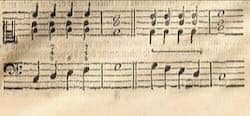
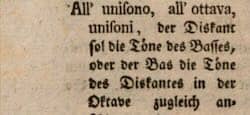
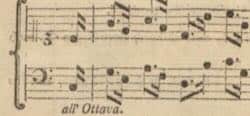
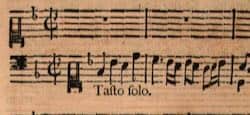
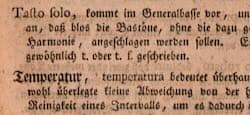
In this essay, I discuss the thoroughbass indications tasto solo (Italian, literally “single key”), all’ottava and all’unisono. Tasto solo indicates that the keyboard continuist should not provide chordal accompaniment but play only the continuo bass, though some sources also allow octave doubling in the right hand. All’ottava and all’unisono are synonymous, indicating doubling of the

What Do Tasto Solo, All’Ottava and All’Unisono Mean? Read More »

Telemann’s SSGBÜ: Number of Parts

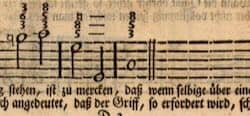
This essay explores Telemann’s views on the number of parts of a thoroughbass realization, as presented in his Singe-, Spiel- und General-Bass-Übungen. In the SSGBÜ, chords are typically four-part (bass plus three upper parts). For consecutive sixth chords, Telemann recommends three-part chords. In specific cases, five-part and full-voiced chords may be used. Additionally, when necessary,

Telemann’s SSGBÜ: Number of Parts Read More »

Telemann’s Singe-, Spiel- und General-Bass-Übungen: Context

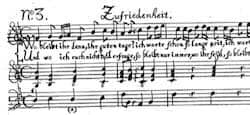
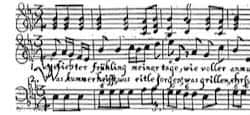
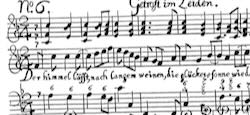
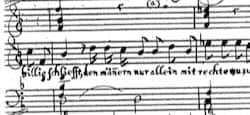
This essay is the first in a series exploring Georg Philipp Telemann’s Singe-, Spiel- und General-Bass-Übungen. Telemann’s Singe-, Spiel- und General-Bass-Übungen (1733–1734) comprise 48 songs that include not only written-out continuo realizations but also instructions on how to create them. This collection is therefore an invaluable source for understanding German continuo practice of that time.

Telemann’s Singe-, Spiel- und General-Bass-Übungen: Context Read More »