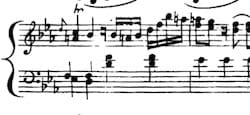
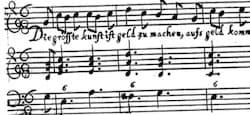
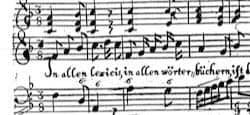
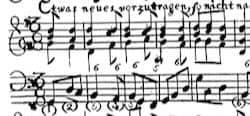
Telemann’s SSGBÜ: The Querstrich
For Telemann’s definition and use of the Querstrich, see The Querstrich in Thoroughbass Figuring: What Can It Mean?.
Telemann’s SSGBÜ: The Querstrich Read More »
For Telemann’s definition and use of the Querstrich, see The Querstrich in Thoroughbass Figuring: What Can It Mean?.
Telemann’s SSGBÜ: The Querstrich Read More »
In this essay, I discuss various ways in which accented passing notes were indicated in eighteenth-century German thoroughbass figuring. An accented passing note may be figured either literally or indirectly. In the latter case, the composer may omit figures over it or place an oblique line above it; only the following consonant note is figured,
Indicating Accented Passing Notes in Thoroughbass Read More »
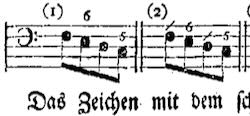
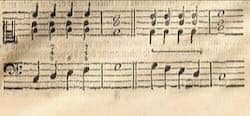
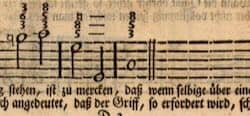
A Querstrich is a horizontal line in thoroughbass figuring indicating that a chord should be held or repeated. For more information and nuance, see The Querstrich in Thoroughbass Figuring: What Can It Mean?.
What Is a Querstrich? Read More »
In this essay, I discuss what a continuist should or can do when a Querstrich (literally “cross-stroke”, a horizontal or slightly oblique stroke used in thoroughbass notation) appears in thoroughbass figuring. A Querstrich in thoroughbass figuring can imply that a chord is to be held for all of its span or for part of it
The Querstrich in Thoroughbass Figuring: What Can It Mean? Read More »
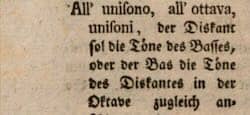
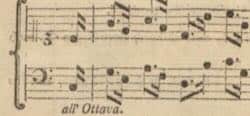
All’unisono (It. “in unison”) instructs the continuist to refrain from harmonic realization and to double the bass at the octave. In thoroughbass practice, this term is used as a synonym of all’ottava (It. “at the octave”). For more information and nuance, see What Do Tasto Solo, All’Ottava and All’Unisono Mean?.
What Does All’Unisono Mean? Read More »
All’ottava (It. “at the octave”) instructs the continuist to refrain from harmonic realization and to double the bass at the octave. In thoroughbass practice, this term is used as a synonym of all’unisono (It. “in unison”). For more information and nuance, see What Do Tasto Solo, All’Ottava and All’Unisono Mean?.
What Does All’Ottava Mean? Read More »
Tasto solo (It. “single key”) instructs the continuist to refrain from harmonic realization and to play the bass alone. For more information and nuance, see What Do Tasto Solo, All’Ottava and All’Unisono Mean?.
What Does Tasto Solo Mean? Read More »
In this essay, I discuss the thoroughbass indications tasto solo (Italian, literally “single key”), all’ottava and all’unisono. Tasto solo indicates that the keyboard continuist should not provide chordal accompaniment but play only the continuo bass, though some sources also allow octave doubling in the right hand. All’ottava and all’unisono are synonymous, indicating doubling of the
What Do Tasto Solo, All’Ottava and All’Unisono Mean? Read More »
This essay is the third in a series examining Telemann’s views on chordal rhythm in a thoroughbass realization. Here, I discuss chordal rhythm in a C time signature, as presented in his Singe-, Spiel- und General-Bass-Übungen. In the SSGBÜ, Telemann sets many arias in C, which may denote either 4/4 or 2/2. His realizations favour
Telemann’s SSGBÜ: Chordal Rhythm in C Read More »
This essay is the second in a series examining Telemann’s views on chordal rhythm in a thoroughbass realization. Here, I discuss chordal rhythm in a 3/4 time signature, as presented in his Singe-, Spiel- und General-Bass-Übungen. In the SSGBÜ, Telemann often writes a single chord above each bass note in arias in 3/4, mostly when
Telemann’s SSGBÜ: Chordal Rhythm in 3/4 Read More »