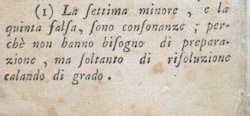
The minor seventh as an essential part of a seventh chord, and the (vertical) diminished fifth and augmented fourth were generally regarded in eighteenth-century Italy not as dissonances but as ‘false consonances’, whereby the false consonance proper —the note, not the interval— did not need to be prepared (though it could be) but had to be resolved. With the minor seventh and diminished fifth, the upper note of the interval counted as the false consonance (Italian: consonanza falsa), whereas with the augmented fourth, the lower note did.
Select Bibliography
Demeyere, Ewald. On Fedele Fenaroli’s Pedagogy: An Update, in: Eighteenth-Century Music 15/2 (2018), 207–229.
van Tour, Peter. Counterpoint and Partimento — Methods of Teaching Composition in Late Eighteenth-Century Naples (Uppsala: Universitet, 2015).