Contrary to what one might expect, a thoroughbass player does not always have to respect the figurings as they are indicated. In fact, as Telemann presents in his Singe-, Spiel- und General-Bass-Übungen, alternative chords and/or settings are in certain cases not only possible but even preferable.
Telemann explains how and when certain expected/figured chords can be transformed into an enriched chord and/or setting: 5/3 on ⑤ can be extended with a seventh and/or preceded by 6/4 or 5/4, and in specific situations 6/3 can be replaced by 6/5 or 6/4/3.
The majority of musical examples are taken from Derek Remeš’s digital and freely available edition of the SSGBÜ, which can be downloaded at https://doi.org/10.17877/TUDODATA-2025-MC06WAYR.
To facilitate the reading of this essay, I use Robert Gjerdingen’s black-circled figures to indicate scale steps in an upper part (e.g. ➍–➌) and white-circled figures to indicate scale steps in the bass (e.g. ⑦–①). And I add an accidental to a figure when the specific designation of a diatonic or a chromatically altered scale step is required. The list below should suffice to make the system of indications clear. Regardless of the mode,
♭③ always refers to the scale step a minor third above ①
③ always refers to the scale step a major third above ①
♭⑥ always refers to the scale step a minor second above ⑤
⑥ always refers to the scale step a major second above ⑤
⑦ always refers to the scale step a minor second below ①
Note further that
- the translations of Telemann’s quotes are mine
- “bar 1a” refers to the first half of bar 1, and “bar 1b” to the second half.
7/5/3 Instead of 5/3 on ⑤
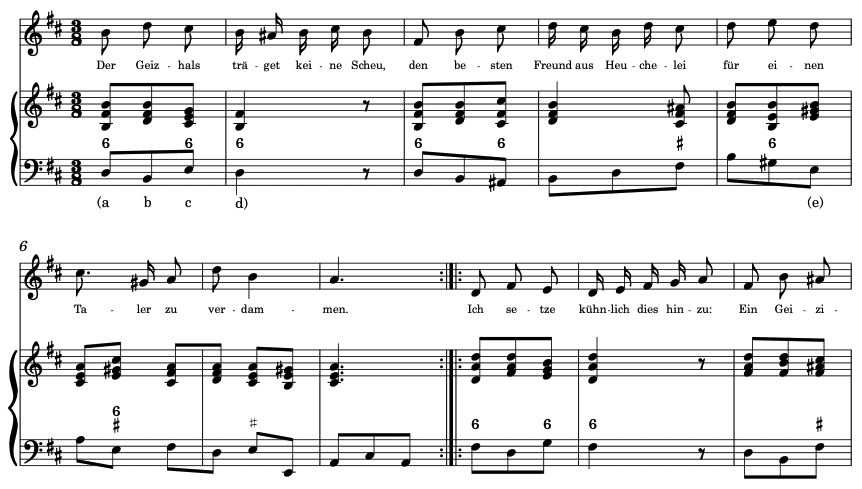
(Note that b1 should be added to the realization in bar 2 as it appears in Telemann’s edition.)
In aria 27 at (e), Telemann allows the seventh to be added above ⑤, even when not figured:
“When the minor seventh is not played here, it is because the bass is not figured as such. Nevertheless, such sevenths adorn the harmony and seem to be, as it were, an essential part of those chords whose bass moves a fourth up or a fifth down:

whoever wishes to, therefore, may include them, even where they are not marked.”
“Wann hier die kleine 7.me nicht mitgeschlagen wird, so geschicht es, weil der bass nicht damit beziefert ist. Indess zieren soche 7.men die harmonie u. scheinen gleichsam ein wesentliches stück derer accorde zu seÿn, welche sich eine 4.te hinauf- oder eine 5.te herunterwerts bewegen:
wer also will, der greife sie mit, auch da, wo sie nicht gezeichnet sind.”
(I will discuss the added 6/4 chord on beat 2 of bar 7 below.)
On the third beat of bar 17 of aria 16, the vocal line again produces the minor seventh; here, however, Telemann effectively includes it also in the chord, despite the absence of 7 in the figuring:
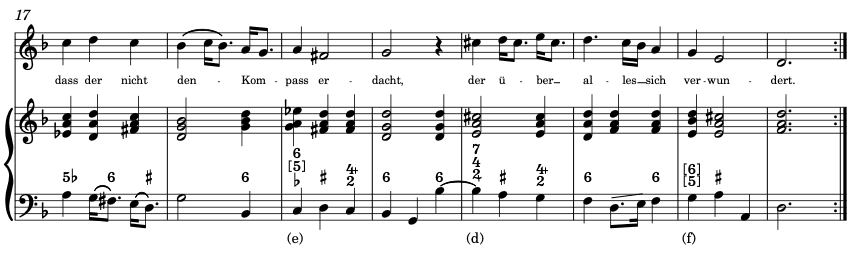
In aria 42, two instances occur where a minor seventh is added to the major triad on ⑤, on beat 3 of bar 19 and on the second eighth note of bar 22. Note how the bass of the second instance does not progress to ① but to ⑥, resulting in an ideal voice leading of a deceptive cadence with stepwise motion in all parts.
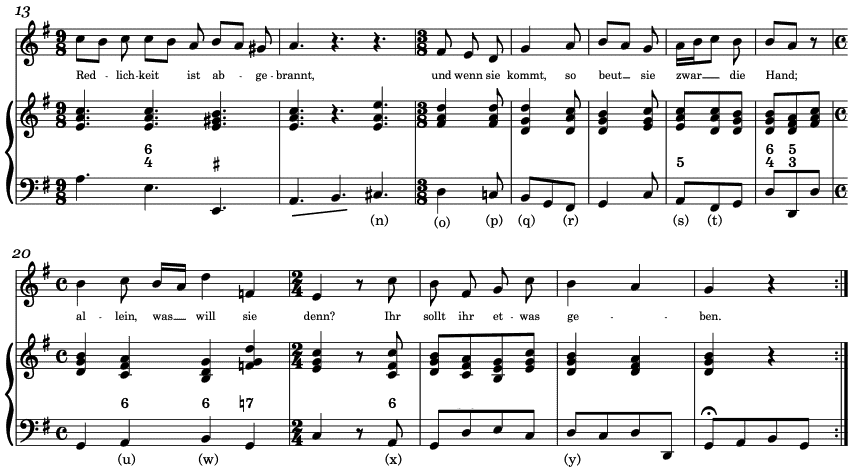
Note that when Telemann adds 7 to 5/3 on ⑤ in the examples above, he retains the fifth, resulting in a complete seventh chord. As I discuss in my essay Telemann’s SSGBÜ: Number of Parts, Telemann usually writes complete seventh chords. Note also how this results in a descending leading note.
6/4–5/3 Instead of 5/3 on ⑤
Consider the penultimate bar of the previous example. While figuring is completely absent from that bar, Telemann still sets the first quarter note as 6/4, the second as its resolution —5/3— a realization clearly suggested by the descending second ➌–➋ of the vocal line.
In the context of several cadences within the SSGBÜ, however, Telemann allows the addition of 6/4 at the start of ⑤, even when (♯)3 is indicated above its start and the vocal line seems at first sight to suggest 5/3. See bar 7 at (r) in the following example:
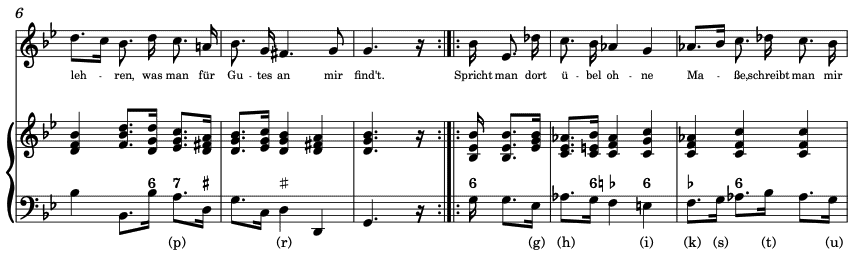
Telemann explains the presence of the ornamental 6/4 by reference to how a singer would ornament the dotted quarter note f♯1:
“the 6/4 in the right hand are taken as ornaments, since the singer emphasizes the g1 as the 4 before the trill.”
“die 6/4 in der rechten hand [werden] für maniren genommen, weil doch der sänger das g als die 4, stark hören läst, ehe das tr. kömmt.”
Similar examples of an additional 6/4 at the start of ⑤, despite the indication of 5/3, occur in bar 7 of aria 20 and in bar 7b at (b) of aria 36. As with what Telemann writes in relation to (r) in aria 5, we may suppose that in both cases Telemann expects the singer to sing a fourth as an appoggiatura —in this case b♭1– followed by a trill.
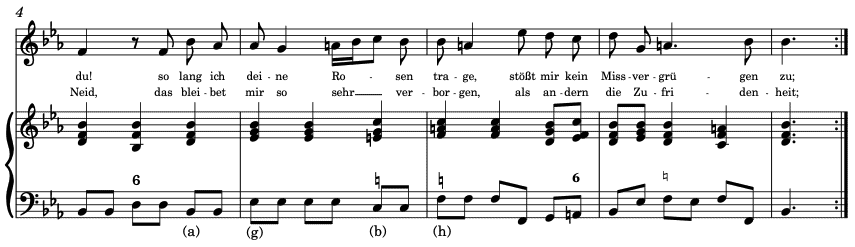
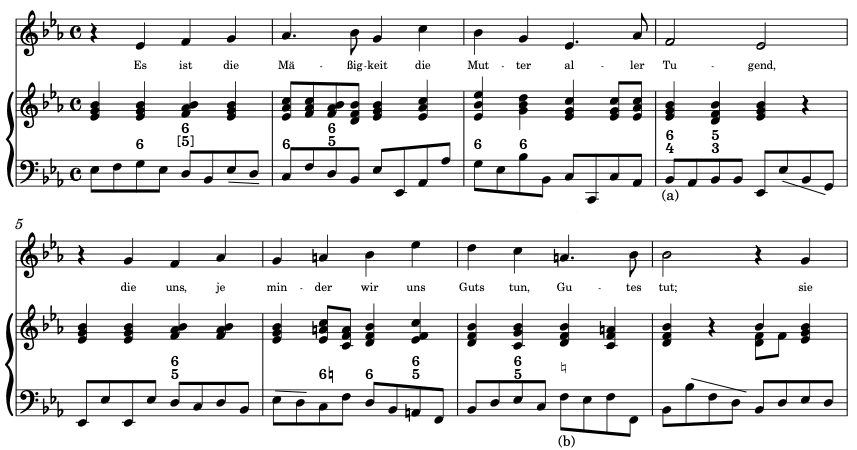
Note that in the discussed cadences of the three previous examples, ➐ in the vocal line lasts each time a dotted quarter note, being followed by an anticipation of ➊ with the length of an eighth note.
In aria 36 at (a), however, Telemann does specify the 6/4 chord at the start of ⑤, yet notationwise again not reflected in the vocal line. Instead of writing a dotted quarter note e♭1 followed by an anticipation f1, he writes a half note f1. This seems to imply that Telemann expects the singer to add at least an appoggiatura g1 before the written half note f1, thereby shortening it, and possibly also a trill on the f1. This also improves the melodic quality of the vocal line, changing the descending leap of a third from a weak part of a beat to a strong beat into a stepwise motion. According to Telemann, the inclusion of this 6/4 is the result of “the freedom of right-hand chords during cadences” (“die freÿheit der griffe beÿ schlüssen”).1
Similar examples of an unornamented ➋ in the vocal part above a 6/4–5/3 progression on ⑤ occur in the penultimate bar of aria 6 and in bar 7 of aria 27:
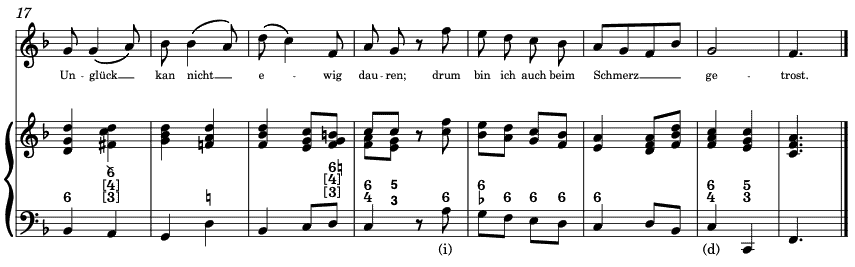
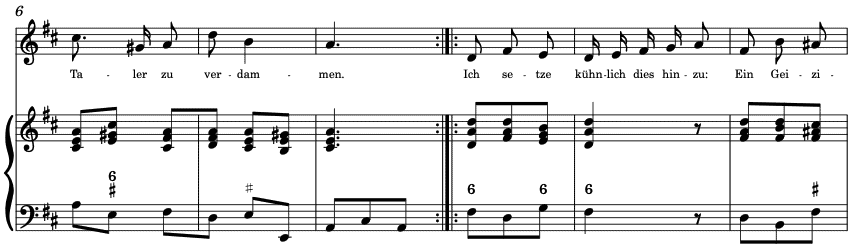
Note that all these examples of a 6/4–5/3 progression are in fact textbook illustrations of a regular cadenza composta/compound cadence, that is, a cadence in which ⑤ lasts two beats.
5/4–5/3 Instead of 5/3 on ⑤
Alternatively, one can also play an additional 5/4 instead of 6/4 on ⑤ under the same conditions, as is the case during the final cadence of aria 19:
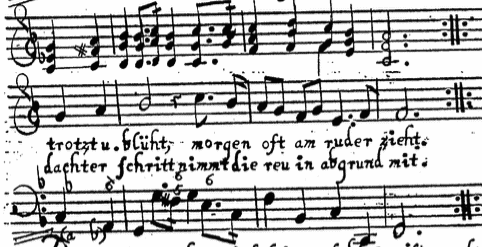
Note how in the example above, an additional minor seventh —likewise not indicated in the figuring— is also played simultaneously with 3, the resolution of 4.2
6/4/3 Instead of 6/3 on ②
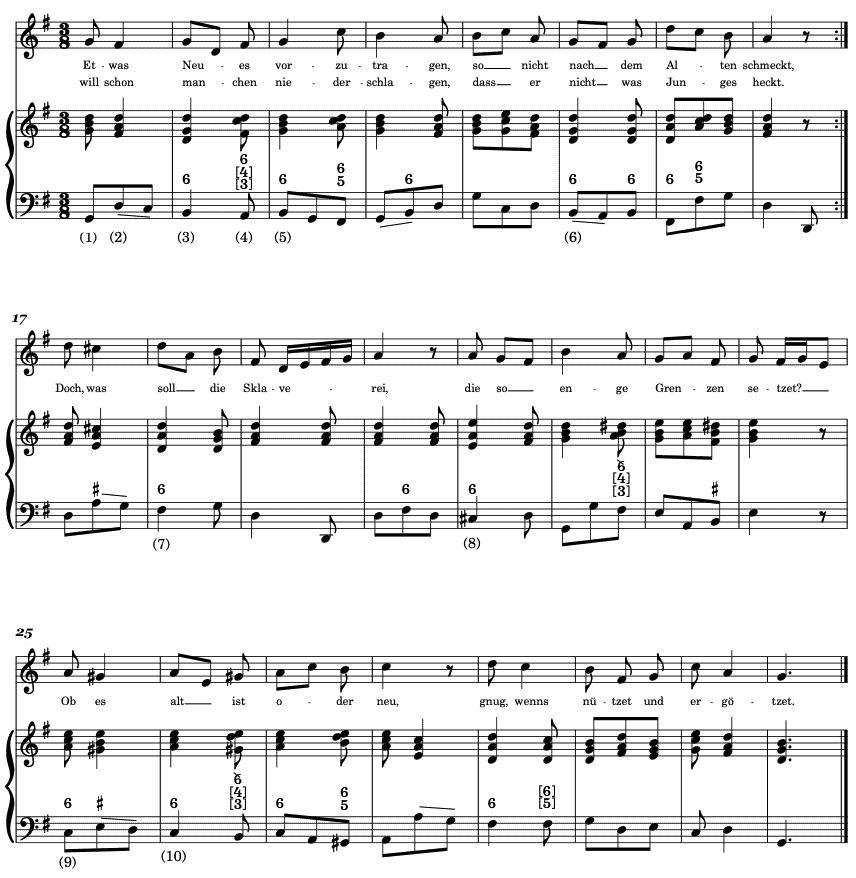
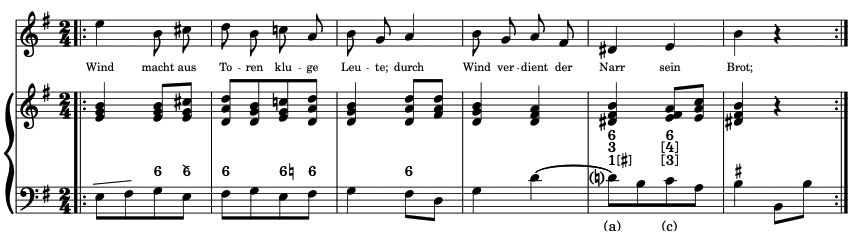
In the commentary below aria 2, Telemann returns to the four occurrences of ② indicated with 6 in aria 1:
“At (4) of the previous aria, as also at the end of bars 22 and 26, a 4 is played in the right hand, which is not indicated above the bass. Note here: that whenever the bass descends a semitone or whole tone after a 6 into a [5/3] chord, one may always add to that 6 also the 4, together with the 3.”
“In voriger aria beÿ (4), wie auch am ende des 22ten und 26ten tactes, wird oben eine 4. gegriffen, so doch über dem basse nicht stehet. Hierbeÿ merke man: dass, so oft sich der bass, nach einer 6, einen halben oder ganzen ton herunter, in einen accord, beweget, man allemal, zu solcher 6 annoch die 4, nebst der 3, mitnehmen könne.”3
There seems to be somewhat of a contradiction, however, since only one of the four examples really fits the description above, that is, the one in bar 22, where ② descends (directly) stepwise to ①. As for the other three occurrences of ② set with 6/4/3, they are followed by ③ set as 6/3, before descending to ① set as 5/3.
Still, in reference to two stepwise ascending bass motions ②–③ in aria 6, Telemann writes the following:
“The unfigured 4 accompanying a 6, mentioned under nos. 1 and 2, also occurs with a 6 when the bass immediately thereafter ascends a semitone or whole tone into another 6. (a) (b). Note only that in both cases the first 6 must be major.”
“Die ungezeichnete 4 beÿ einer 6, deren beÿ No. 1. und 2. gedacht wird, findet auch beÿ einer 6 statt, wann der bass gleich drauf, durch einen halben oder ganzen ton, in eine andre 6 hinauf trit. (a) (b). Nur merke man, dass so wohl dort, als hier, die erste 6 eine grosse seÿn müsse.”
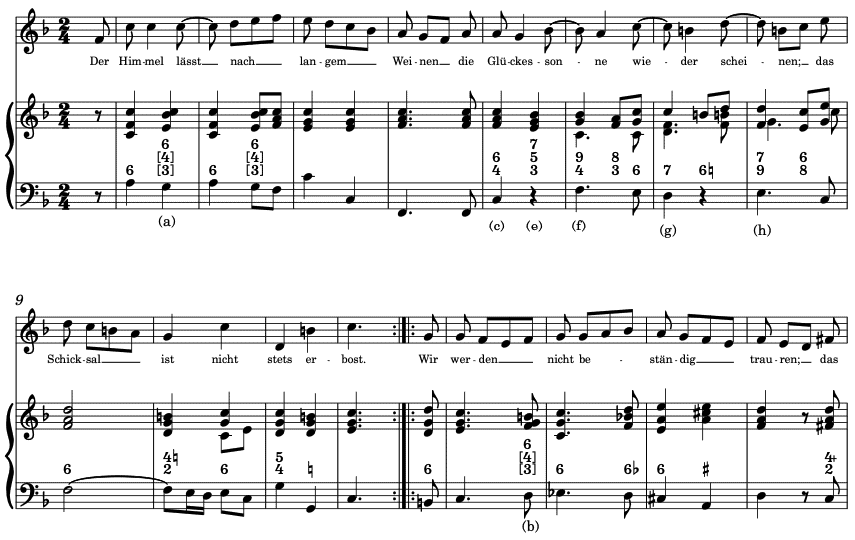
Note that the voice leading in both cases is free:
- the bottom note of the dissonant vertical second ‘resolves’ on both occasions via a downward leap of a fourth rather than of stepwise
- ➐ at (a) does not rise stepwise to ➊ but leaps down a third to ⑤.
6/4/3 Instead of 6/3 on (♭)⑥
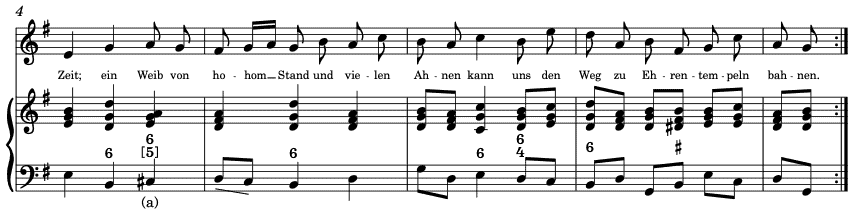
While 6/4/3 as a substitution for 6/3 has occurred only on ② in the examples above, it can also occur on ⑥ and ♭⑥, respectively, as is clear from bar 19 in aria 6 and at (c) in aria 29:
6♮/5♭/3 Instead of 6♮/3 on ② (Minor Key)
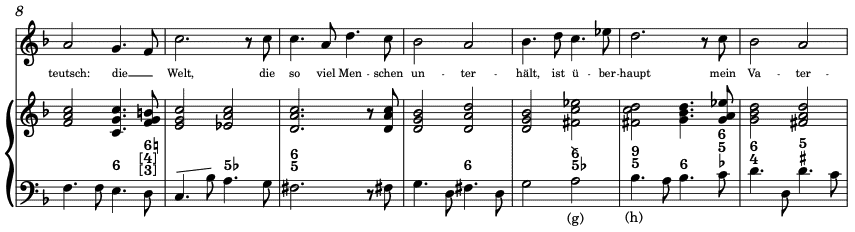
Instead of playing 6♮/3 or 6♮/4/3 on ② of a ②–③ bass motion in minor, one can also decide to play 6♮/5♭/3, even if the diminished fifth is unfigured. Regarding aria 11 at (g), Telemann formulates the following:
“The 5♭ is not always written; it occurs, however, invariably with the 6 [with slash] 6♮ when the bass ascends stepwise in a minor key, and when the composer has not employed the 4 at the same point (likewise unfigured), for which a good anticipatory ear is required. A 3 accompanies it.”
“Die 5♭ wird nicht stets geschrieben; sie findet aber allemal beÿ den 6 [mit Strich] 6♮ statt, wann die bewegung hinaufwerts in einen weichen ton geschicht, und wann der componist nicht die 4 daselbe (ebenfalls ungezeichnet) angebracht hat, wo zu ein gutes vorher-lauschendes ohr gehoret. Eine 3 begleitet dieselbe.”
6/5♭/3 Instead of 6/3 on ⑦
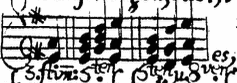
When the bass progresses from ⑦ to ①, it is always possible to add a diminished fifth to the sixth chord, even when unfigured, in itself but also to avoid voice-leading issues. This is how Telemann formulates it with regard to aria 12 at (a):
“The diminished fifth is quite a useful thing, in that it can be inserted in all kinds of situations. At (a) it is not indicated, yet it is readily tolerated by the 6; and without it, we would either have to play only three voices, or, despite all the artfulness of this bar, produce octaves or fifths:”
“Es ist doch ein nützliches ding um die kleine 5, dass man sie beÿ allerhand vorfällen einschieben kann. Beÿ (a) stehet sie nicht, wird doch aber von der 6 gern geduldet; und hätten wir, ohne sie, nur dreÿ stimmen anschlagen, oder, beÿ allem künsteln der noten dieses tacts, 8.ven oder 5.ten anbringen müssen:”
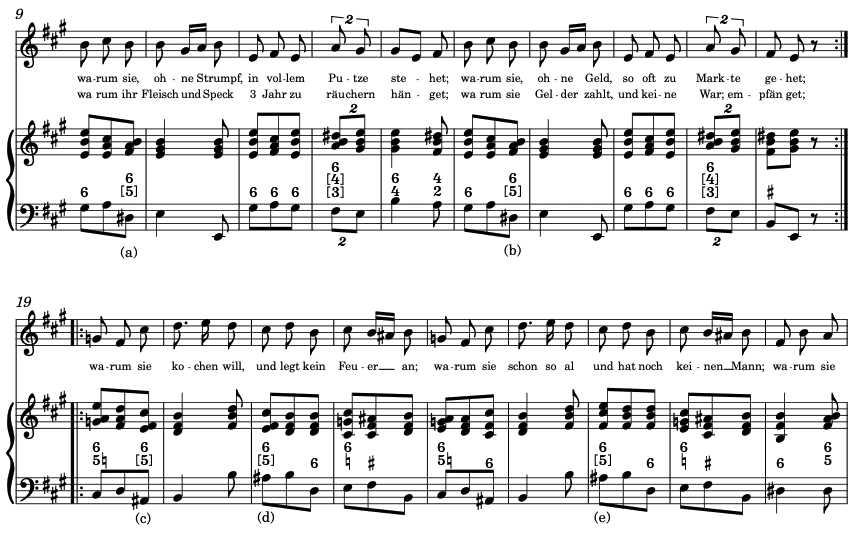
And in aria 13, Telemann gives five examples where a figured 6 is realized as a 6/5♭/3, stating the following:
“What was said at the very beginning of the preceding No. 12 concerning the diminished fifth is here [in aria 13] illustrated by several examples at (a) (b) (c) (d) (e).”
“Was im vorigen No. 12 gleich anfangs wegen der kleinen 5 gesagt worden, davon zeigen sich hier mehrere exempel bey (a) (b) (c) (d) (e).”
6/5/3 Instead of 6/3 on ④
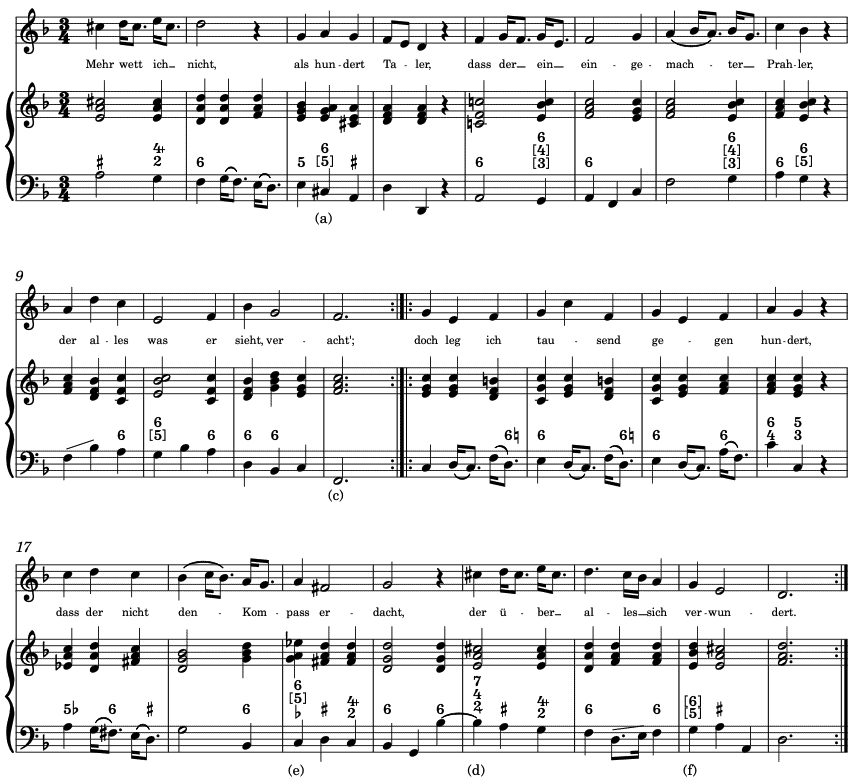
When ④ progresses to ⑤, and ④ is figured with 6, an unfigured 5 can be added in the right hand, both as a regular interval in its own right and to achieve —for Telemann— the standard mandatory four-part texture. Telemann explains the added 5 to a figured 6 and its contrapuntal merits in relation to both a ⑦–(⑤–)① (in D minor) and a ④–⑤ progression (in G minor) in aria 16:
“(a) (e) Again two unfigured fifths with a sixth. They often help to catch the fourth voice. (a) From this chord to the following one, the alto and the bass form parallel fifths; these are permitted as long as one of them, or both, are diminished.”
“(a) (e) Wiederum zwo ungezeichnete 5.ten beÿ einer 6.te. Sie helfen öfters, um die vierte stimme zu erhaschen. (a) Von dieser, bis zur folgenden, machen oben die mittelsten noten zwo 5.ten; solche werden erlaubt, wann eine davon, oder alle beÿde, klein sind.”
When ④ progresses to ⑤ in the context of a cadence with ④ remaining unfigured, Telemann writes that 6/5/3 can be played on ④. This is how he formulates it with regard to (f) in the penultimate bar of this aria:
“At cadences, 6/5[/3] [on ④] can also be played without figures.”
“Beÿ schluss-clausuln kann 6/5 auch ohne ziefern gegriffen werden.”
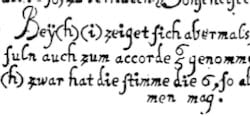
With regard to aria 18 at (h) and (i), Telemann makes a similar remark, stating that “a 6/5 chord may also be played at cadences” (“beÿ schluss-clausuln auch zum accorde 6/5 genommen werden können”). Specifically with regard to (h), where ④ is realized with 5/3, he states that “the voice has the 6, which however the thumb may also take” (“die stimme die 6 [hat], so aber auch der daum nehmen mag”).
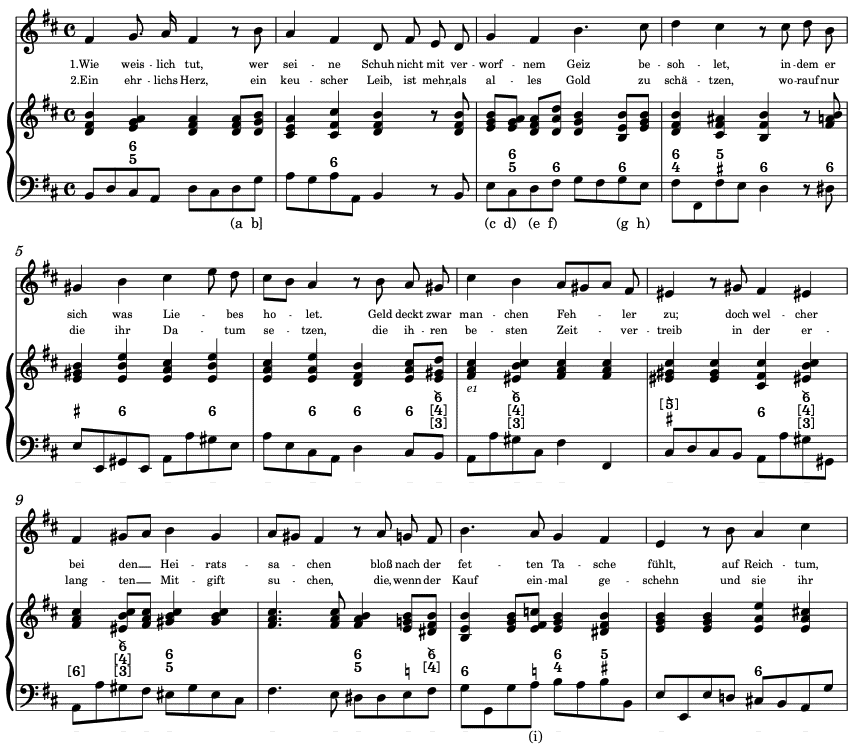
(It would appear that Remeš did not copy the realization from Telemann’s original edition but from Hobohm’s, which erroneously gives f♯1 in the tenor part instead of e1, as clearly notated in Telemann’s edition. Still, Remeš marks “e1” below the right hand to indicate that f♯1 cannot be correct.)
Notes
- Note that in his edition of the SSGBÜ, Remeš argues that “(a) does not show any freedom of figuring, as Telemann indicates 6/4–5/3 in the figures”. This freedom, of course, should be regarded in relation to the vocal line. ↩︎
- Remeš’s edition erroneously omits this seventh b♭1, marking a c2 instead; this is why I show the original edition, even though it is somewhat more difficult to read, both on account of the edition itself and because the vocal part appears between the bass and the right-hand realization. ↩︎
- Note that in his edition, Remeš is uncertain to which aria bars 22 and 26 refer. It is clear, however, that Telemann also refers to aria 1, whose bars 22 and 26 indeed include a 6/4/3 chord. In fact, Remeš chose to compress the opening sixteen bars —consisting of two musically identical eight-bar phrases set to different text— into eight bars with a repeat. As a result, the second system of his edition begins with bar 9 instead of bar 17 of the original, an inconsistency that Remeš apparently overlooked in making this assessment and that I have corrected in the example above. ↩︎
Select Bibliography
Arnold, Franck Thomas. The Art of Accompaniment from a Thorough-Bass (2 volumes) (Oxford: Oxford University Press, 1931; unabridged and unaltered republication by Dover Publications in 1965 (with a new introduction) and 2003).
Christensen, Jesper Bøje. Die Grundlagen des Generalbaßspiels im 18. Jahrhundert: Ein Lehrbuch nach zeitgenössischen Quellen (Kassel: Bärenreiter, 1992).
Christensen, Jesper Bøje. Les Fondements de la Basse Continue au XVIIIe siècle : Une méthode basée sur les sources d’époques (Basel: Bärenreiter, 1995).
Christensen, Jesper Bøje. 18th Century Continuo Playing: A Historical Guide to the Basics (Kassel: Bärenreiter, 2002).
Heinichen, Johann David. Der General-Bass in der Composition (Dresden, 1728).
Mattheson, Johann. Kleine General-Bass-Schule (Hamburg, 1735).
Rampe, Siegbert. Generalbasspraxis 1600–1800 (Laaber: Laaber Verlag, 2014).
Telemann, Georg Philipp. Singe-, Spiel- und General-Bass-Übungen (Hamburg, 1733–34).
Telemann, Georg Philipp. Singe-, Spiel- und General-Bass-Übungen TWV 25:39-85 für Singstimme & Tasteninstrument — Revidierte Neuausgabe, ed. Wolf Hobohm (Magdeburg: Edition Walhall – Verlag Franz Biersack, 2003).
Zohn, Steven. Music for a Mixed Taste: Style, Genre, and Meaning in Telemann’s Instrumental Works (New York: Oxford University Press, 2008/2015 (revised paperback edition)).