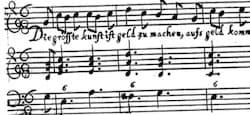
This essay is the fifth and last in a series examining Telemann’s views on chordal rhythm in a thoroughbass realization. Here, I discuss chordal rhythm in a 6/8, 9/8 and 12/8 time signature, as presented in his Singe-, Spiel- und General-Bass-Übungen, whose principles are the same.
In arias in 6/8, 9/8 and 12/8, Telemann usually writes a single chord per dotted quarter note. A quicker chordal (quarter note – eighth note) does occur when the harmony requires it or in specific cases. As for successive eighth-note chords, they are nowhere to be found.
All musical examples are taken from Derek Remeš’s digital and freely available edition of the SSGBÜ, which can be downloaded at https://doi.org/10.17877/TUDODATA-2025-MC06WAYR. Note further that
- the translations of Telemann’s quotes are mine
- “bar 1a” refers to the first half of bar 1, and “bar 1b” to the second half.
Of the 48 arias in the SSGBÜ, two are entirely written in 6/8 (nos. 2 and 33), one is entirely written in 9/8 (no. 48), three are entirely written in 12/8 (nos. 10, 30 and 35), while aria 42 contains only one 9/8 passage in bars 13–14 (this aria also contains passages in 2/4, 3/4, 4/4 and 3/8).
Rule of Thumb: A Single Chord per Dotted Quarter Note
In 6/8, 9/8 and 12/8, the standard chordal rhythm is one chord per dotted quarter note. When the harmony demands it, however, a quicker chordal rhythm is called for. In the SSGBÜ, the quickest chordal rhythm in these compound metres is a quarter note followed by an eighth note. (The chordal rhythm never descends to successive eighth notes.) See, for example, aria 2:
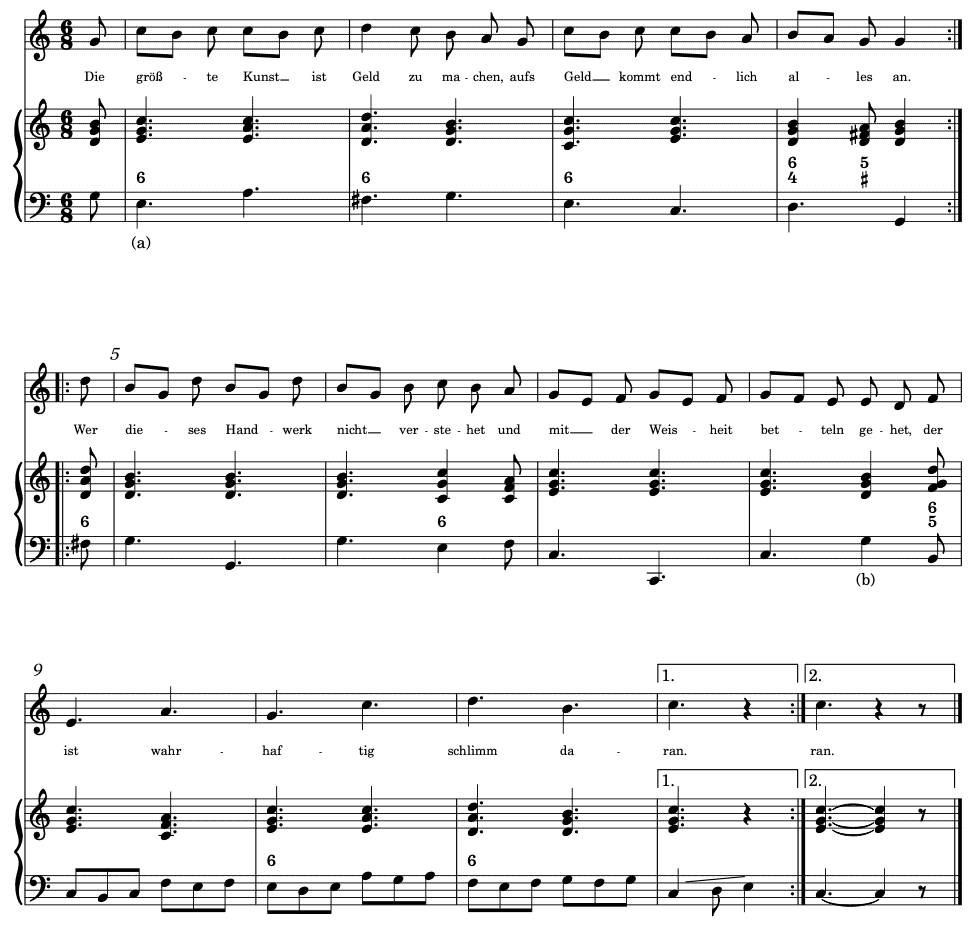
Note, for that matter, how Telemann resolves the 6/4 chord in bar 4a not on the second eighth note (following the vocal part) but on the third, creating an interesting clash between the vocal part and the right hand.
Restriking Chords
While it is common for Telemann to strike only one chord per dotted quarter note if the harmony does not require a faster harmonic rhythm, in aria 33 (also in 6/8) he repeats the same chord —even multiple times— in the same rhythm as the repeated notes in the bass, eighth note – quarter note:
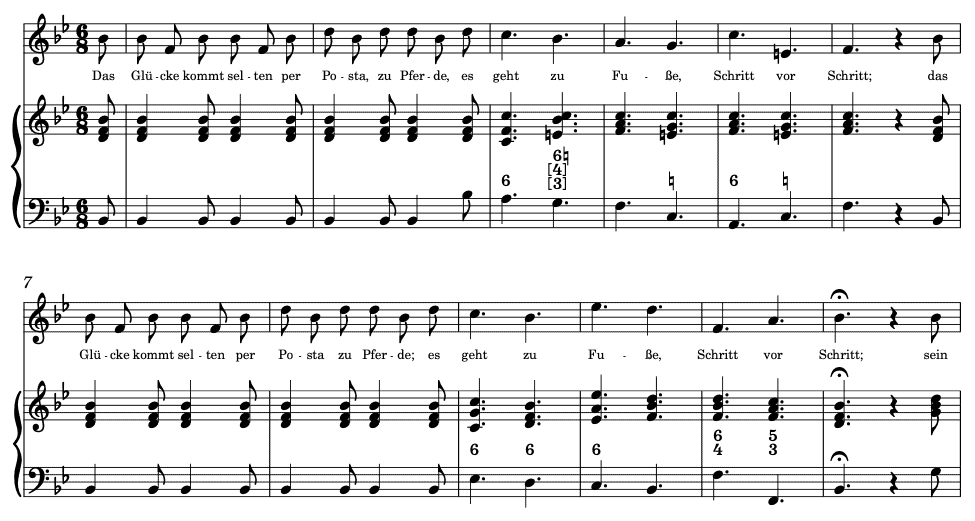
Since this is an isolated situation in the SSGBÜ and moreover seems to be something of a musical translation of the horse mentioned in the text, it remains unclear whether this is regular procedure. However, when the bass leaps an octave down from a quarter note to an eighth note, the right hand repeats the chord with the same rhythm of the bass. See, for example, beat 2 of bars 2 and 6 of aria 35:
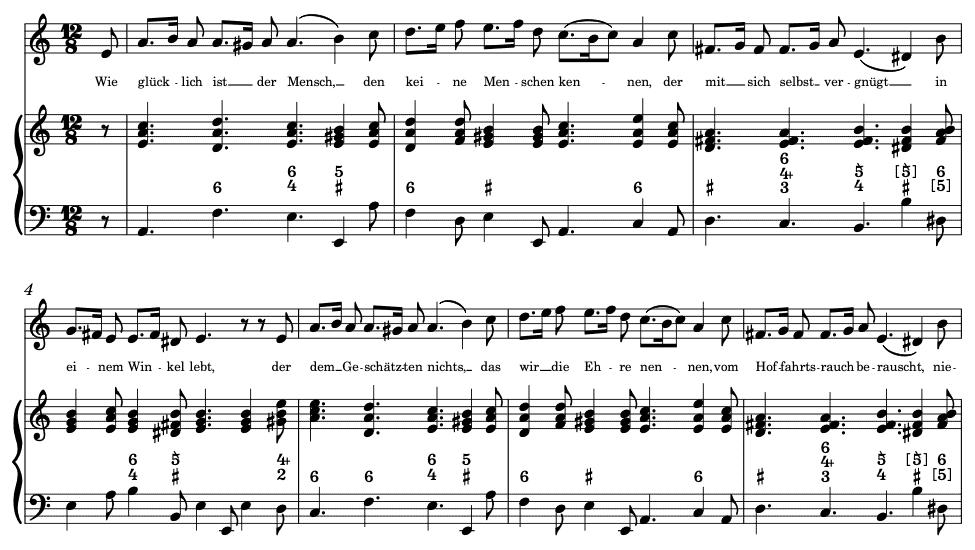
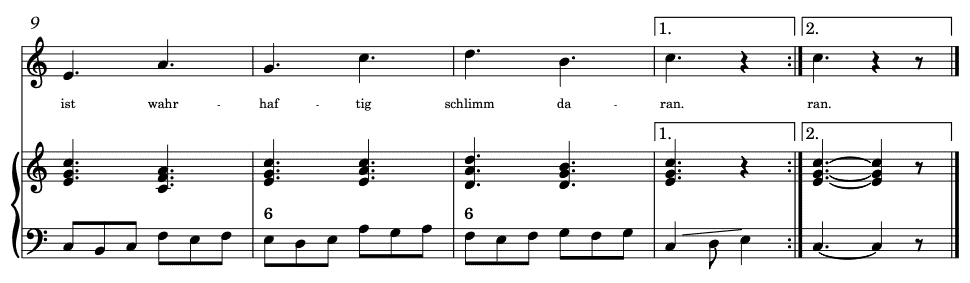
On the other hand, note that Telemann could have repeated the chord on the third eighth note of each beat in bars 9–11 of aria 2, yet chose not to.
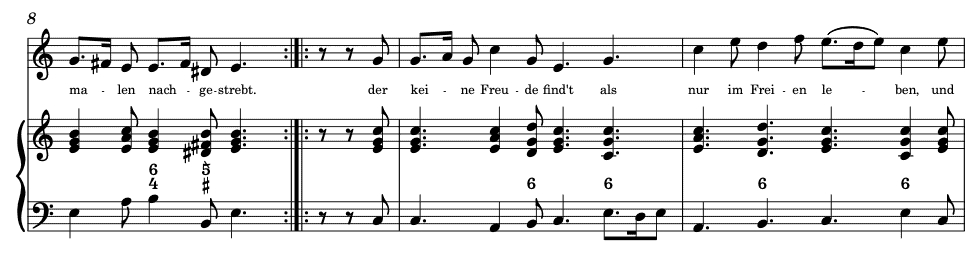
The last eighth note of the ‘siciliano rhythm’ on beat 4 of bar 9 of aria 35 is not set with a chord either:
Select Bibliography
Arnold, Franck Thomas. The Art of Accompaniment from a Thorough-Bass (2 volumes) (Oxford: Oxford University Press, 1931; unabridged and unaltered republication by Dover Publications in 1965 (with a new introduction) and 2003).
Christensen, Jesper Bøje. Die Grundlagen des Generalbaßspiels im 18. Jahrhundert: Ein Lehrbuch nach zeitgenössischen Quellen (Kassel: Bärenreiter, 1992).
Christensen, Jesper Bøje. Les Fondements de la Basse Continue au XVIIIe siècle : Une méthode basée sur les sources d’époques (Basel: Bärenreiter, 1995).
Christensen, Jesper Bøje. 18th Century Continuo Playing: A Historical Guide to the Basics (Kassel: Bärenreiter, 2002).
Heinichen, Johann David. Der General-Bass in der Composition (Dresden, 1728).
Mattheson, Johann. Kleine General-Bass-Schule (Hamburg, 1735).
Rampe, Siegbert. Generalbasspraxis 1600–1800 (Laaber: Laaber Verlag, 2014).
Telemann, Georg Philipp. Singe-, Spiel- und General-Bass-Übungen (Hamburg, 1733–34).
Telemann, Georg Philipp. Singe-, Spiel- und General-Bass-Übungen TWV 25:39-85 für Singstimme & Tasteninstrument — Revidierte Neuausgabe, ed. Wolf Hobohm (Magdeburg: Edition Walhall – Verlag Franz Biersack, 2003).
Zohn, Steven. Music for a Mixed Taste: Style, Genre, and Meaning in Telemann’s Instrumental Works (New York: Oxford University Press, 2008/2015 (revised paperback edition)).