In this essay, I discuss the thoroughbass indications tasto solo (Italian, literally “single key”), all’ottava and all’unisono.
Tasto solo indicates that the keyboard continuist should not provide chordal accompaniment but play only the continuo bass, though some sources also allow octave doubling in the right hand. All’ottava and all’unisono are synonymous, indicating doubling of the bass part in octaves in the right hand.
To avoid cluttering the text with full titles and publication dates, I refer to the sources by author only, with abridged references provided in the footnotes. In the cases of Friedrich Wilhelm Marpurg and Georg Friedrich Wolf, from whom I cite two different treatises, the individual works are named in the main text. Full bibliographical details are given in the Select Bibliography. All translations are my own.
Tasto Solo : Playing Only The Bass
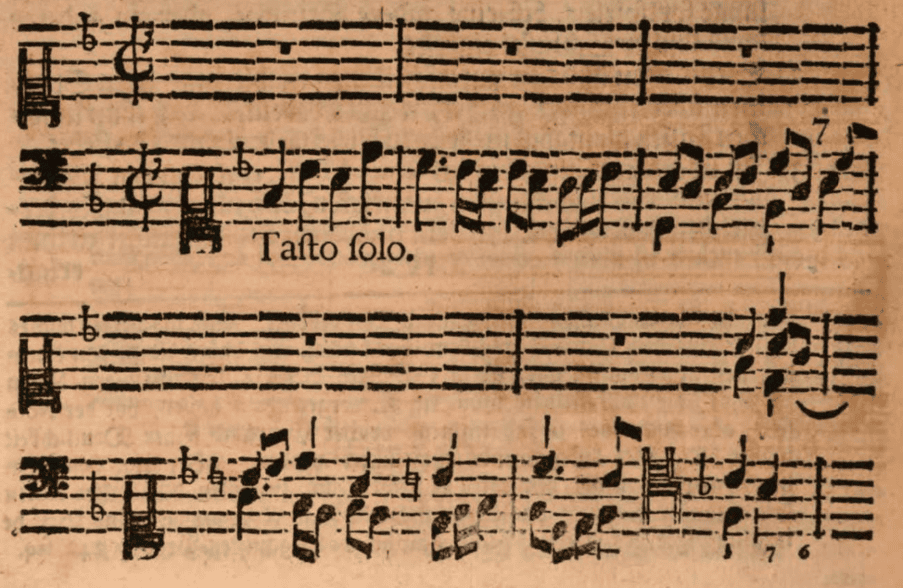
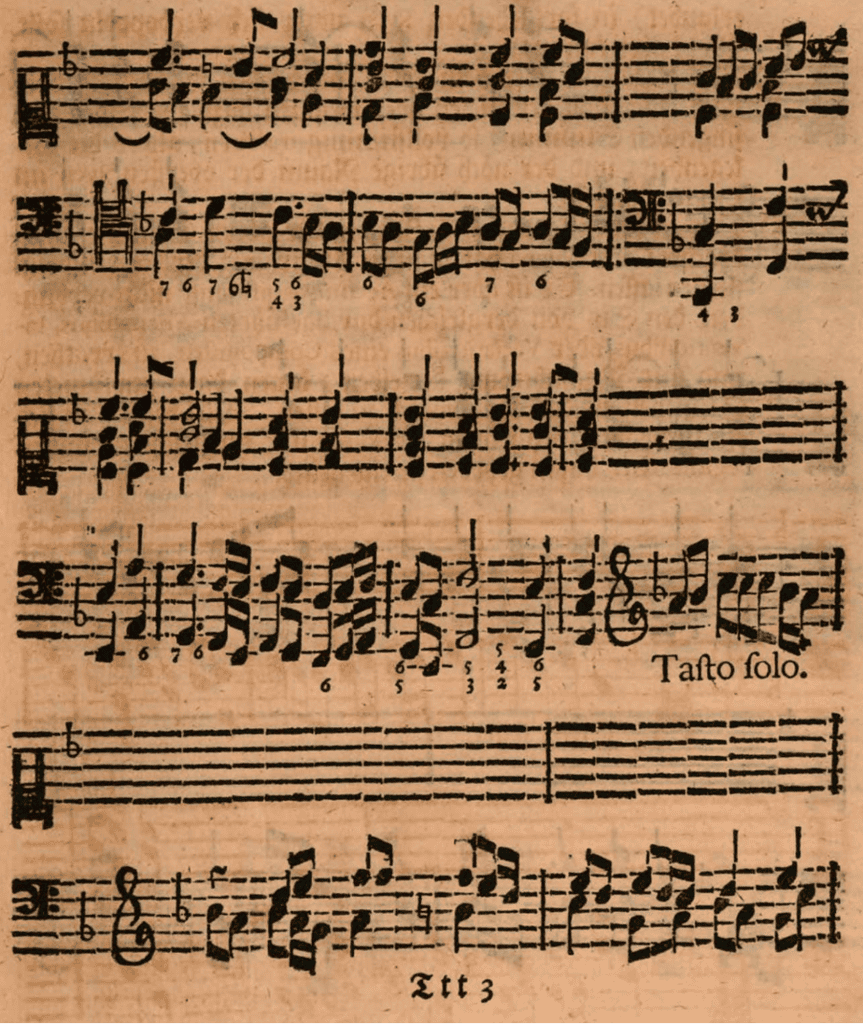
Below are several eighteenth-century sources that explain tasto solo as an indication to play only the bass, without any added harmony. Johann David Heinichen describes it as follows:
“In the cited example [on the following page; see below this quote] one finds twice the indication of the words Tasto solo. In the Italian language, the wooden keys on the harpsichord, organ, etc. are called tasti, from tastare, to touch or feel; thus the words Tasto solo signify as much as that one should play those notes on single keys, or with single fingers, without further accompaniment, and continue to do so until a voice, or another musical clef, enters.”
“Findet man in besagten Exempel zweymahl die Unterschrifft der Worte: Tasto solo. In welscher Sprache werden die höltzern Claves auf dem Clavicembal, Orgel, etc. Tasti genennet; von tastare, anrühren, anfühlen, also deuten die Worte: Tasto solo, so viel an, daß man solle dieselben Noten mit eintzeln Clavibus, oder eintzeln Fingern, ohne ferneres Accompagnement, so lange fortspielen, biß eine Stimme, oder ein anderer Musicalischer Schlüßel eintritt.”1
Johann Gottfried Walther states the following about tasto solo:
“Tasto solo (Ital.) occurs in figured bass and means that, at that place, the notes are to be played entirely alone, without playing anything in the right hand; and this lasts for so long until one again encounters figurings, or the words Accordo or Accompagnamento, which indicate that one should stop playing simply [i.e., tasto solo] and once again play with the right hand with belongs there.”
“Tasto solo (ital.) kömmt in General-Basse vor, un bedeutet: daß an dem Orte die Noten gantz allein, ohne etwas mit der rechten Hand dazu zu greiffen, gespielt werden sollen; und dieses währet so lange, biß man wiederum Ziefern, oder die Worte: Accordo oder Accompagnemento antrifft, welche anzeigen, daß man einfach zu spielen aufhören, und wiederum mit der rechten Hand das gehörige darzu greiffen soll.”2
A similar description is provided by David Kellner:
“Where the words tasto solo stand beneath the thoroughbass, this indicates that the bass is to be played alone and without chordal accompaniment, and is to continue in this manner until Accompagnamento or Accordo appears, or until figures are again encountered.”
“Wo die Worte Tasto solo unter dem General-Baß stehen, da wird der Baß gantz schlecht und ohne Accompagnementgespielet, biß Accompagnamento oder Accordo stehet, oder auch Signaturen sich einfinden.”3
Johann Adam Hiller puts it more succinctly:
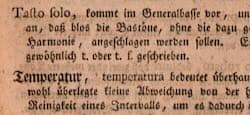
“Tasto solo, t. s., occurs often in thoroughbass when only the plain bass notes, without any added harmony, are played.”
“Tasto solo, t. s. kommt om Generalbasse oft vor, wenn blos die einfachen Baßnoten, ohne dazu gegriffene Harmonie, angeschlagen werden sollen.”4
While Meinrad Spiess essentially defines tasto solo in the same way as the sources discussed above —i.e. as playing the bass without chordal accompaniment— his link with the French term point d’orgue and his organ-centred explanation suggest that he primarily envisages the term as a sustained bass, realized as a pedal point:
“Tasto solo. This occurs in thoroughbass and signifies that one should play the note alone, and hold it for as long as one does not again add figures, or the words Accord or Accompagnement, or until the harmony proceeds further. The French call it point d’orgue. Without doubt this is because, on organs, it is very common to sustain such keys for a long time with the pedal, and above them to perform all manner of variations and unusual syncopations with both hands.”
“Tasto solo. Stehet im General-Bass, und bedeutet, daß man die Notam allein, und so lang halten solle, biß man wiederum Zifferen, oder die Word Accord, Accompagnement hinzu setzet, oder die Harmonia weiter gehet. Die Frantzosen nennen es Point d’Orgue. Ohne Zweifel, weilen es auf Orglen sehr gebräuchlich, dergleichen Claves lange Zeit mit dem Pedal anzuhalten, und darüber mit beyden Händen allerhand Variationes und fremde Syncopationes zu machen.”5
Tasto Solo : With Octaves In The Right Hand
Until now, all the sources discussed agree that, when playing tasto solo, the right hand does nothing while the written bass part is played only by the left hand. For Leonhard Reinhard and Jacob Adlung, however, tasto solo also allows adding octaves in the right hand to the bass.
This is how Reinhard formulates it:
“When all the voices move at the same pitch, which is called unison, the thoroughbass player must play tasto solo, that is, to play the bass alone with the left hand; or he is free to use the right hand as well, but with it he may do nothing except play the bass in the octave. And thus only in this case is it permitted to produce two octaves and fifths in succession.”
“Wann alle Stimmen in einerley Ton gehen, welches Unisonogenennet wird, muß der General-Bassist Tasto Solo, daß heißt mit der lincken Land den Bassallein spielen, oder es stehet ihm frey, die rechte Hand auch zu gebrauchen, doch darff er mit derselben nichts, als eben diesen Bassin der Octavspielen. Und also ist es nur hier erlaubt, zwey Octavenund Quintennach einander zu machen.”6
(Note that Reinhard’s reference to parallel fifths that are allowed in this context is somewhat puzzling, since he only allows doubling at the octave here.)
Here is how Adlung explains it:
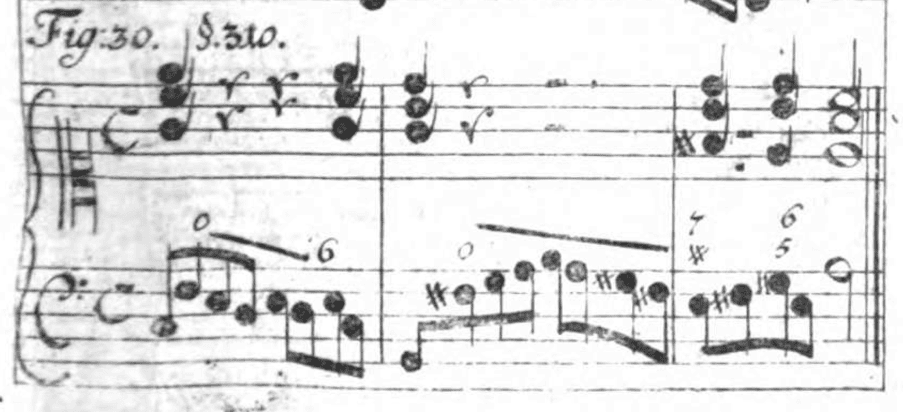
“It is furthermore well known that by the appended word tasto, or tasto solo, it is indicated that nothing at all is to be played in addition to the bass notes—unless one might wish to add octaves; and when many notes in succession are to be treated in the same manner, I have nothing to object to this, except that in writing one should not forget to remind the player, either by means of figures or by the written indication acc. (that is, Accompagnement), to resume forming chords with the right hand. However, if it should please the composer to omit the chords for only a few notes—since, on account of their small number, it would be neither practical nor convenient to make use of the aforementioned words—then an over-written zero (0) could indicate this. I have illustrated this in Fig. 30; and if, after such a zero, the preceding sign of the Queerstrich follows, then such notes likewise receive no chords.”
“Es ist ferner bekannt, daß durch das beygeschriebene Wort tasto, oder tasto solo, angedeutet wird, ausser den Baßnoten gar nichts mit zu greifen, man müßte denn Octaven darzu nehmen wollen; und wenn viel Noten nach einander auf gleiche Art zu tractiren, habe ich hierwider nichts einzuwenden, als daß man im Schreiben nicht vergesse entweder durch einen Ziefersatz, oder durch Beschreibung der Buchstaben acc. (das ist: Accompagnement) den Spieler zu erinnern, mit der rechten Hand wiederum Griffe zu machen. Allein, wenn dem Componisten gefallen sollte, bey wenigen Noten die Griffe wegzulassen; da es der Wenigkeit wegen weder thunlich noch bequem sich obiger Worte zu bedienen; so könnte eine überschriebene Null 0 solches andeuten. Ich habe solches Fig. 30 vorstellig gemacht, und wenn nach solcher Null das vorhergehende Zeichen des Queerstrichs folget, bekommen solche Noten auch keine Griffe.”7
(For an explanation of Queerstrich, see What Is a Queerstrich?)
Tasto Solo vs. Playing in Octaves
Several eighteenth-century sources, however, make a distinction between a bass-only realization and one in octaves. A bass-only realization is called tasto solo, while a realization in octaves is often labelled all’ottava or all’unisono.
This is how Friedrich Wilhelm Marpurg formulates it in the second volume of his Kunst das Clavier zu spielen:
Ҥ 19.
In passages where all the voices proceed in unison or in octaves, the accompanist must not play any chords, but should either play the bass alone with the left hand, or double it with the right. If figures appear above the bass in such passages, this is a sign that the composer did not know what he was doing, and a mark of his poor understanding.
§ 20.
Where tasto solo is indicated, no chords are to be played; the bass is struck alone, and the note is renewed from time to time whenever its sound begins to fade.”
Ҥ. 19.
An Oertern, wo alle Stimmen in Einklängen oder Octaven fortgehen, muß der Accompagnist keine Accorde anschlagen, sondern entweder den Baß mit der linken Hand allein spielen, oder selbigen mit der rechten verdoppeln. Finden sich an dergleichen Oertern Ziffern über dem Basse: so ist solches ein Zeichen, daß der Componist nicht gewußt, was er gemacht hat, und ein Zeichen seiner schlechten Einsichten.
§. 20.
Wo tasto solosteht, werden ebenfals keine Accorde gegriffen, sondern man schlägt den Baß allein an; und erneuert den Anschlag von Zeit zu Zeit, wenn sich der Ton zu verliehren anfängt.”8
The final phrase explains itself in the light of the fact that Marpurg appears here to refer to how a keyboard continuist should handle a pedal point, as discussed in the second, expanded edition of his Handbuch bey dem Generalbasse und der Composition, published one year after the second volume of his Kunst das Clavier zu spielen:
“In thoroughbass, the pedal point is generally indicated with tasto solo, which signifies that the accompanist should play nothing but the bass note, without adding any chords above it.”
“Im Generalbasse wird der Orgelpunct insgemein mit Tasto solobezeichnet, welches andeutet, daß der Accompagnist nichts als die Baßnote anschlagen soll, ohne Accorde darüber zu machen.”9
Carl Philipp Emanuel Bach states the following:
Ҥ 28. The single-voiced accompaniment consists either of the prescribed bass notes alone, or of their doubling in the right hand.
§ 29. In the first case, one writes above the notes t. s., tasto, tasto solo; in the second, all’unisono, unisoni.”
“§. 28. Das einstimmige Accompagnement bestehet entweder aus den vorgeschriebenen Baßnoten allein, oder aus ihrer Verdoppelung mit der rechten Hand.
§. 29. Im erstern Falle setzt man über die Noten t. s. tasto, tasto solo; im zweyten, all’unisono, unisoni.”10
As does Marpurg, Carl Philipp Emanuel Bach rejects the practice of accompanying ensemble or orchestral unisons with a chordal thoroughbass, elaborating this position in a lengthy paragraph.11
Johann Michael Bach also describes both the tasto solo and the playing-in-octaves practices, the latter of which he calls all’ottava or all’unisono. Like Spiess, Johann Michael Bach associates tasto solo with a pedal point. Below are his descriptions of both practices:
“On the Pedal Point (Point d’orgues)
§ 1. The pedal point (Point d’orgues) derives from the organ, from sustaining a note in the pedal, while the other voices begin with a consonant harmony and then continue with suspensions, for which the lowest middle voice must be regarded as the bass, against which suspensions are regularly prepared and resolved, until finally all the voices return to the consonant harmony of the sustained bass.
§ 2. This typically occurs on the dominant, as well as at the end on the tonic. The words t. s. or tasto solo are placed above or below the notes as a sign that the accompanist should play only the bass note, without realizing the harmony of the other voices. …
On all’Ottava, or all’Unisono
§ 1. When all the voices proceed in unison or in octaves, this is indicated by all’Ottava or all’Unisono above or below the notes. The accompaniment then continues only in octaves.”
“Von dem Orgel-Punct (Point d’orgues).
§. 1. Der Orgelpunct (Point d’orgues), rührt von der Orgel her, vom Aushalten im Pedal, wozu die übrigen Stimmen mit einer consonirenden Harmonie anfangen, und alsdann in Bindungen fortfahren, zu welchen die unterste Mittelstimme als der Baß angesehen werden muß, gegen welche regelmäßig gebunden und aufgelöset wird, bis zuletzt alle Stimmen in die consonirende Harmonie des aushaltenden Basses wieder eintreten.
§. 2. Auf der Dominante, wie auch am Ende auf der Hauptnote (Tonica), pflegt dieses zu geschehen. Die Wörter: t. s. tasto solo, werden darüber oder darunter gesetzt, zum Zeichen, daß der Accompagniste nur die Baßnote anschlage, ohne die Harmonie der übrigen Stimmen mitzumachen. …
Vom all’Ottava, oder all’ Unisono.
§. 1. Wenn alle Stimmen im Einklang oder Octave mit einander fortgehen, wird dieses durch all’Ottavaoder all’Unisonoüber oder unter den Noten angezeigt. Das Accompagnement geht alsdann blos in Octaven mit fort.”12
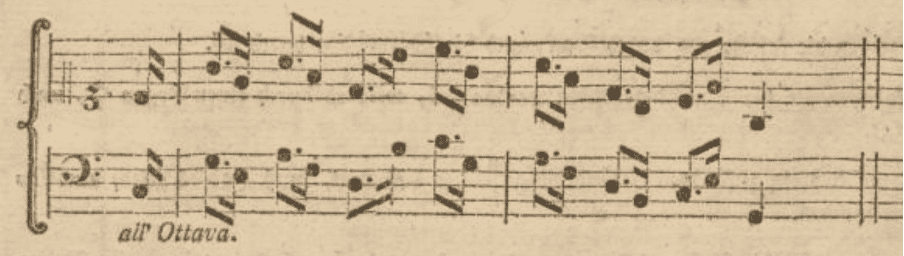
Another source that clearly distinguishes between tasto solo and playing in octaves is Georg Friedrich Wolf’s Kurzgefaßtes musikalisches Lexikon. It describes tasto solo as follows:
“Tasto solo occurs in thoroughbass, and indicates that only the bass notes, without the accompanying harmony, are to be played. It is usually written as t. or t. s.”
“Tasto solo, kommt im Generalbasse vor, und zeigt an, daß blos die Bastöne, ohne die dazu gehörige Harmonie, angeschlagen werden sollen. Es wird gewöhnlich t.oder t. s. geschrieben.”13
According to Wolf, this is what a keyboard continuist should do when the indication Unisono or Unisoni appears in the part:
“Unisono, Unisoni, in unison, is written above the bass notes for which no harmony, but the very same notes —only in another octave— are to be played.”
“Unisono, Unisoni, im Einklange, wird über die Töne des Basses gesetzt, zu welchen keine Harmonie sondern eben dieselben Töne nur in einer andern Octave angeschlagen werden sollen.”14
In his slightly earlier Unterricht in Klavierspielen — Zweite, ganz umgearbeitete Ausgabe, Wolf describes the same practices more succinctly:
“Tasto solo, tasto, (t. s.) single-voiced. …
All’unisono, all’ottava, unisoni, the treble should play the notes of the bass, or the bass the notes of the treble, simultaneously in the octave.”
“Tasto solo, tasto, (t. s.) einstimmig. …
All’unisono, all’ ottava, unisoni, der Diskant sol die Töne des Basses, oder der Bas die Töne des Diskantes in der Oktave zugleich anschlagen.”15
Notes
- Heinichen, 1728: 515. ↩︎
- Walther, 1732: 595. ↩︎
- Kellner, 1737: 13. ↩︎
- Hiller, 1792: 83. ↩︎
- Spiess, 1745: 9 (Anhang). ↩︎
- Reinhard, 1744: 26. ↩︎
- Adlung, 1758: 642–643. ↩︎
- Marpurg, 1761: 35–36. ↩︎
- Marpurg, 1762: 31. ↩︎
- C.P.E. Bach, 1762: 6. ↩︎
- C.P.E. Bach, 1762: 172–173, §3. ↩︎
- J.M. Bach, 1780: 25–26. ↩︎
- Wolf, 1787: 157. ↩︎
- Wolf, 1787: 172. ↩︎
- Wolf, 1784: 82–83. ↩︎
Select Bibliography
Adlung, Jakob. Anleitung zu der musikalischen Gelahrtheit (Erfurt, 1758).
Bach, Carl Philipp Emanuel. Versuch über die wahre Art das Clavier zu spielen — Zweyter Theil, in welchem die Lehre von dem Accompagnement und der freye Fantasie abgehandelt wird (Berlin, 1762).
Bach, Johann Michael. Kurze und systematische Anleitung zum General-Baß, und der Tonkunst überhaupt, mit Exempeln erläutert (Kassel, 1780).
Heinichen, Johann David. Der General-Bass in der Composition (Dresden, 1728).
Hiller, Johann Adam. Anweisung zum Violinspielen, für Schulen und zum Selbstunterrichte. — Nebst einen kurzgefassten Lexicon der fremden Wörter und Benennungen in der Musik (Leipzig, 1792).
Kellner, David. Treulicher Unterricht im General-Bass … Zweyte und vermehrte Auflage. Nebst einer Vorrede Hn. G. P. Telemanns (Hamburg, 1737).
Marpurg, Friedrich Wilhelm. Die Kunst das Clavier zu spielen — Zweyter Theil, worinnen die Lehre vom Accompagnement abgehandelt wird (Berlin, 1761).
—. Handbuch bey dem Generalbasse und der Composition – Zweyte, vermehrte und verbesserte Auflage (Berlin, 1762).
Reinhard, Leonhard. Kurtzer und deutlicher Unterricht von dem General-Bass (Augsburg, 1744).
Spiess, Meinrad. Tractatus musicus compositorio-practicus (Augsburg, 1745).
Walther, Johann Gottfried. Musicalisches Lexicon (Leipzig, 1732).
Williams, Peter. Tasto solo (It.: ‘single key’) (Grove Music Online, accessed 23 January 2026).
Wolf, Georg Friedrich. Unterricht in Klavierspielen — Zweite, ganz umgearbeitete Ausgabe (Halle, 1784).
—. Kurzgefaßtes musikalisches Lexikon (Halle, 1787).