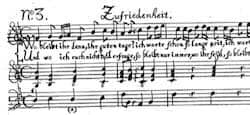
This essay is the third in a series examining Telemann’s views on chordal rhythm in a thoroughbass realization. Here, I discuss chordal rhythm in a C time signature, as presented in his Singe-, Spiel- und General-Bass-Übungen.
In the SSGBÜ, Telemann sets many arias in C, which may denote either 4/4 or 2/2. His realizations favour metric clarity, typically placing a chord on each beat. Shorter bass notes may receive their own chord, at the player’s discretion.
All musical examples are taken from Derek Remeš’s digital and freely available edition of the SSGBÜ, which can be downloaded at https://doi.org/10.17877/TUDODATA-2025-MC06WAYR. Note further that
- the translations of Telemann’s quotes are mine
- “bar 1a” refers to the first half of bar 1, and “bar 1b” to the second half
- the term “Oberstimme” refers to the upper part of the thoroughbass realization
- “⑤” refers to the fifth scale step in the bass.
Of the 48 arias in the SSGBÜ, sixteen are entirely written in C (nos. 3, 4, 11, 14, 17, 18, 19, 23, 31, 32, 36, 38, 43, 44, 45 and 47), while the following two arias contain passages in C:
- aria 7: the first and third sections, from the upbeat to bars 1 to 5 and the upbeat to bars 12 to 16 (the second and fourth sections, from bars 6 to 11 and from bars 17 to 22, are in 3/2)
- aria 42: bar 20 (this aria also contains passages in 2/4, 3/4, 3/8 and 9/8).
(No. 40 is also written in C, but as a secco recitative it is not representative in the context of this essay. I will devote a separate essay to recitative playing according to Telemann.)
C is the most frequently used time signature in the SSGBÜ. Seventeenth- and eighteenth-century German authors such as Daniel Speer, Friedrich Niedt and Johann Gottfried Walther referred to C as schlechter Tact, a term that may be translated as “simple time signature”. From a modern perspective, C is commonly understood as an alternative sign for 4/4. Telemann, however, appears not always to use it in this sense. In several cases, C appears to have been understood as 2/2 (or cut time), a metrical interpretation consistent with contemporary descriptions of 4/4 and 2/2, yet one for which a clear distinction in time-signature notation was still usually maintained. For instance, J.F.B.C. Majer writes in his Museum Musicum Theoretico Practicum (1732) that both 2/2 and 4/4 are to be conducted in two, while nonetheless employing two distinct signs for these metres, “2” and “C”, respectively.1 He further explains that C and 𝇍 differ only in tempo, with C signifying a slow metre (einen langsamen [Tact]) and 𝇍 a somewhat faster one (einen etwas geschwindern Tact).2 Similarly, Johann Mattheson argues —still very forcefully in his Vollkommene Capellmeister (1739)— that every metre consists of only two parts, a thesis and an arsis.3 (The following generation, however, would further diversify this model; one of the most extensive accounts of various metres is found in Kirnberger’s Kunst des reinen Satzes from the 1770s.)
Of the eighteen arias that are (partly) written in C, I would argue that at least five actually indicates 2/2 (nos. 4, 7, 11, 32 and 44), while no. 47 remains somewhat ambiguous as to whether it represents 4/4 or 2/2. Notably, none of the arias in the SSGBÜ are explicitly marked with “𝇍” or “2/2”. The absence of such a common metre is striking, especially given that the slightly less common 3/2 does occur, albeit only once, in aria 7 Redlichkeit (Integrity).
A General Guideline
Only at a relatively late stage in the SSGBÜ does Telemann articulate the following general guideline, in connection with aria 36 set in C, which unequivocally represents 4/4:
“The irregular [rhythmic] motion of the right hand in this aria arises from the harmony, changing sometimes less, sometimes more. Apart from this, one would always prefer to choose the great weight [i.e., to play quarter-note chords].”
“Die ungleiche bewegung der rechten hand in dieser arie rühret von der bald weniger, bald mehr, ändernden harmonie her. Ausser dieser hätte man lieber allemal das grosse gewicht erwählet.”
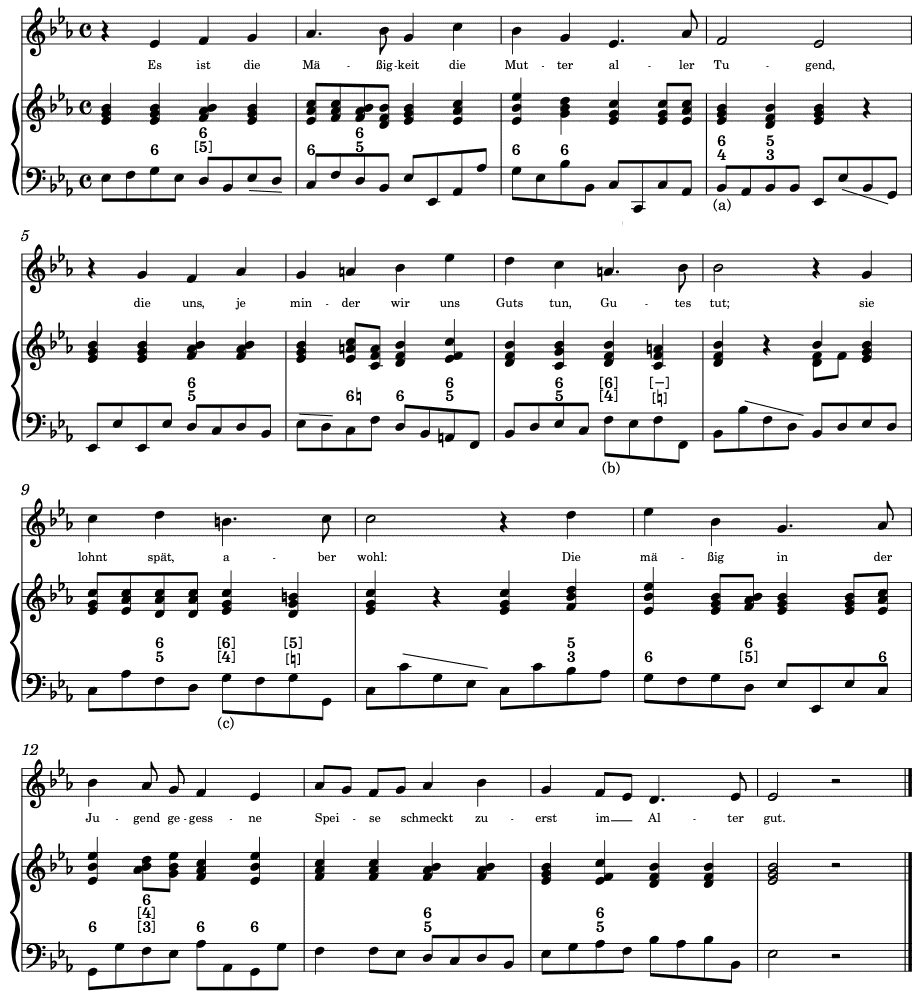
The reason I argue that this aria is clearly conceived in 4/4 rather than 2/2 lies in its harmonic rhythm. Admittedly, the harmony occasionally spans a half note (bars 1a, 4b, 5, 8a, 10a, 13 and 14b). In those bars, however, chords are still articulated on every quarter note, thereby marking every beat of a 4/4 metre, even when this results in the mere repetition of the same chord. Exceptions occur at phrase endings (bars 4b, 8a, 10a and 15a). While the final chord of the aria lasts a half note, internal phrase endings consist of a quarter-note chord followed by a quarter-note rest. Despite these occasional moments of half-note harmonic rhythm, the prevailing harmonic rhythm proceeds by quarter notes, and at times even by eighth note (bars 2a, 3b, 6a, 11 and 12a). I will return to these differences in harmonic rhythm below.
Standard Chordal Rhythm in C Interpreted as 4/4: Quarter-Note Chords
Quarter-note realizations do indeed seem to have been the norm in Telemann’s arias in C representing 4/4. Consider aria 19:
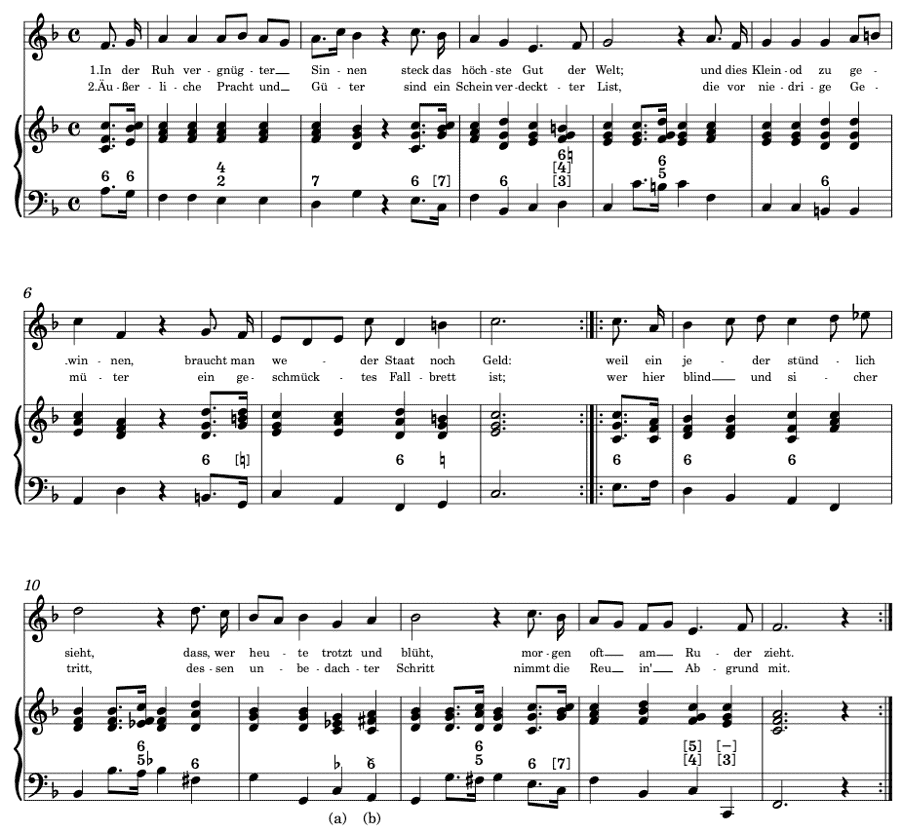
In this aria, the numerous quarter notes in the bass are consistently realized with quarter-note chords, even when this leads to four consecutive statements of the same chord, as in bar 1. Note also that when the harmonic rhythm slows to half notes, most clearly in bar 5, both hands nevertheless continue to articulate quarter notes. For Telemann, therefore, the option of realizing these four quarter notes in C representing 4/4 with only two half-note chords does not appear to have been a genuine alternative.
Note that, when ⑤ lasts two beats, as is the case in the penultimate bar, Telemann allows the addition of 6/4 or 5/4 at the start of ⑤, even when (♯)3 is indicated above its start and the vocal line seems at first sight to suggest 5/3. For more information, see my essay Telemann’s SSGBÜ: Chord Substitutions and Additions.
Standard Chordal Rhythm in C Interpreted as 2/2: Half-Note Chords
By contrast, when quarter notes in the bass are realized not with quarter-note but half-note chords, and when a half-note chordal rhythm predominates more generally, this strongly suggests that C is to be understood as 2/2, rather than 4/4. A clear example of this practice can be found in aria 44.
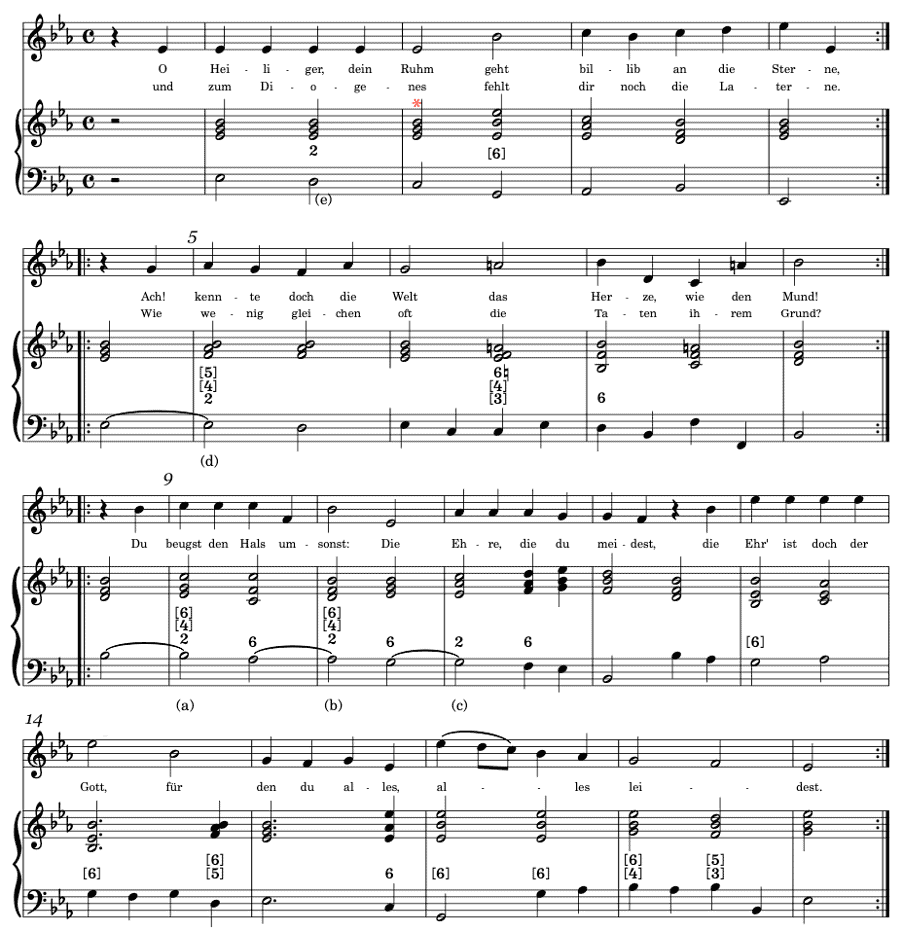
(Note that the realization in Remeš’s digital edition contains an error in bar 2a, indicated by a red asterisk (the same error also occurs in Hobohm’s edition): the first note in the Oberstimme should be c2, not b♭1. In addition, the bar numbers in this edition are incorrect; I have corrected them here.)
Although the interpretation of C as 2/2 is already evident from the first five bars of this aria, which contain only half notes in the bass that are realized with half-note chords, this metre is also confirmed by Telemann’s treatment of bars 6, 7, 12b, 14b, 16b and 17. In these passages he writes half-note rather than quarter-note chords, even in situations where the realization might have been improved by assigning independent chords to certain metrically weak bass notes. One example is the doubled E♭ on the final quarter note of bar 6, set against the a♮1 in the Oberstimme and the vocal line.)
What About Notes Shorter than One Beat?
It is interesting to observe how, in an aria in C representing 2/2, Telemann deliberately ignores certain otherwise obvious quarter-note chords. By contrast, in aria 19 (see also above), every sixteenth note in the bass —always the second note of a dotted rhythm— receives its own chord. Even when the harmony itself remains essentially unchanged, as on beat 4 of bars 2, 6 and 12, Telemann nonetheless writes a newly struck, fully articulated chord in the right hand. (This practice contrasts with that of a more overtly galant composer such as C.P.E. Bach, and with what would likely be the reflex or instinct of many continuo players today.)
Referring to several instances in aria 11, Telemann gives three reasons why a shorter note in the bass may receive its own chord:
- when the shorter note has its own figuring(s)
- when the shorter note requires its own harmony, even if unfigured
- when one wishes to strengthen the harmony at the moment of the shorter note, even if the same or related harmony has already sounded on the longer note.
Telemann formulates this as follows:
“The shorter notes in the bass are then to be struck with a chord in the right hand when figurings, ♯, ♭, or ♮, appear above them, as at (d) and (e), when the harmony changes, as at (a), where the D minor chord changes to G minor, and at (b), where D minor changes to B flat major; or when one wishes to fill out the harmony, as at (c), etc.”
“Die kleinern noten im basse sind alsdann oben mit anzuschlagen, wann sich ziefern, ♯, ♭ oder ♮, darüber befinden (d) (e) wann die harmonie ändert, wie beÿ (a) wo der accord d ins g, u. beÿ (b) wo d ins b trit; oder wenn man die harmonie ausfüllen will; (c) etc.”
(Note that aria 11 is most likely conceived in 2/2, rather than 4/4; its eighth notes thus occupy the same metrical level as the sixteenth notes in aria 19 (see above).)
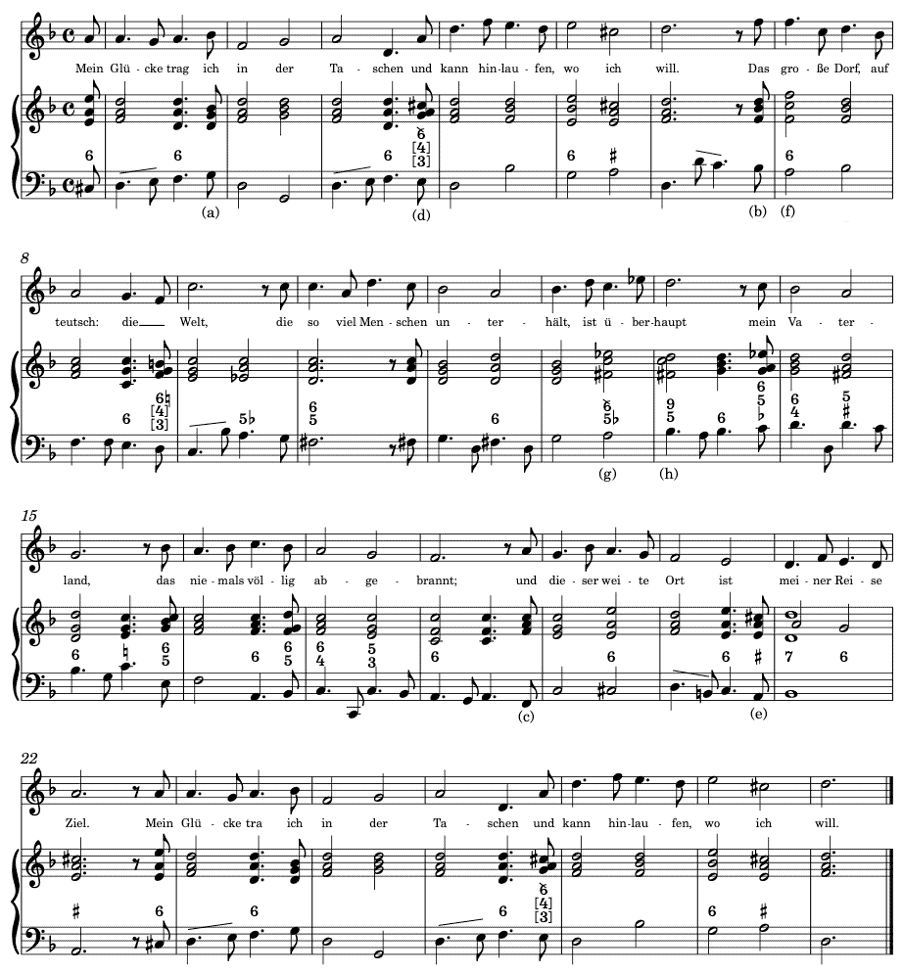
The third situation in particular —namely, cases in which the harmonic situation does not really change— remains largely at the performer’s discretion. A comparison between the realizations of bars 11b and 18b is instructive. In both cases, a sixth chord in the middle of the bar is followed on the final eighth note by a triad representing the same harmony. In bar 11b, however, the final eighth note does not receive its own chord, whereas in bar 18b it does. The explanation that this difference might be attributable to the absence of a final eighth note in the vocal line in bar 11b —present, by contrast, at the end of bar 18b— is not entirely convincing. One might then ask why, for example, Telemann does not realize the final eighth note of bar 9.
Telemann offers further guidance on the realization of notes shorter than one beat elsewhere. Referring to aria 18 Heyraht (Marriage), set in C in a manner that clearly indicates 4/4, Telemann discusses several instances in which successive eighth notes require different harmonies within the context of a walking bass in eighth notes:
“The matter of simple chord-striking in walking basses has already been discussed; here, no eighth-note [chord in the right hand] has been added without reason: (a b) the D-major chord moves to a G-major chord; (c d) the 6/5 must be audible; (e f) to create a similar [rhythmic] motion with the first two notes; (g h) to avoid two octaves between the middle part [i.e., the alto] and the bass, namely e–f♯. Otherwise, the rule is: the simpler, the better. (h) (i) show once again that in closing cadences one may also take the 6/5 chord; at (h), to be sure, the voice has the 6, which the thumb may also take.”
“Vom einfältigen anschlagen beÿ spatzierenden bässen ist schon gedacht worden; hier ist kein 8.tel ohne uhrsache an gebracht: (a b) der accord d trit ins g; (c d) die 6/5 müssen gehört werden; (e f) mit den ersten 2 noten eine gleiche bewegung zu machen; (g h) zwo 8.ven in der mittel-partie mit dem basse, als: e fis, zu verhüten. Sonst heist es: je schlechter, je besser. Beÿ (h) (i) zeiget sich abermals, dass beÿ schluss-clausuln auch zum accorde 6/5 genommen werden können; beÿ (h) zwar hat die stimme die 6, so aber auch der daum nehmen mag.”
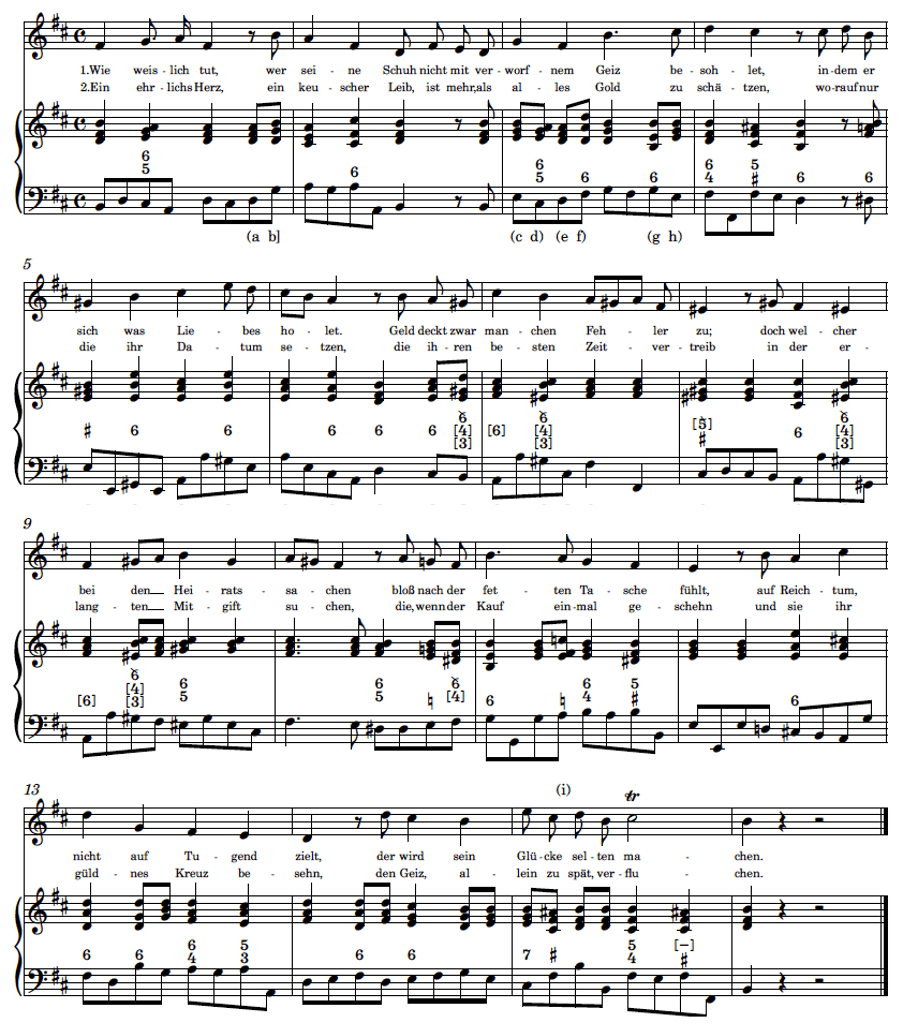
(Telemann’s “once again” refers to bar 23 of aria 16 (not shown here). I discuss the replacement, or rather the expansion, of a triad or sixth chord into a 6/5 chord —including the one in bar 23 of aria 16— in my essay Telemann’s SSGBÜ: Chord Substitutions and Additions.)
Two Successive Figurings on One Beat
In the examples discussed thus far, the quicker chordal rhythm results from shorter note values in the bass. However, a quicker chordal rhythm may also arise when a bass note that spans one beat has two successive figurings rather than a single one. In such cases, two eighth-note chords occur over a quarter note in the bass. An example of such chordal rhythm can be seen on the second beat of bar 2 of aria 31, where the quarter note g has two successive figurings: 6/4 and 5/♮. Here, the two eighth notes in the vocal line, e♭2–d2, reinforce —or, one might argue, even necessitate— these figurings and their corresponding realization.
A Chord on a Rest
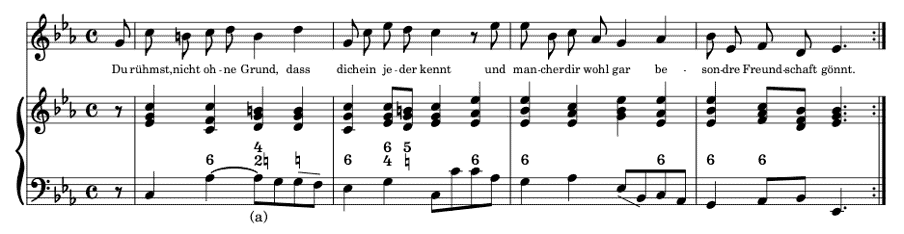
Also in C, Telemann illustrates that right-hand chords can be played on rests in the bass. (For examples in 2/4, 3/4 and 3/8, see my essays Telemann’s SSGBÜ: Chordal Rhythm in 2/4, Telemann’s SSGBÜ: Chordal Rhythm in 3/4 and Telemann’s SSGBÜ: Chordal Rhythm in 3/8.) In bar 7 of aria 45, the chords on beats 2 and 4 in the right hand provide the resolution of the dissonant chords on beats 1 and 3 at the same moment as the vocal line.
Note that the common notes in bar 7 are restruck at the moment of resolution. (For more information, see my essay Telemann’s SSGBÜ: Chordal Rhythm in 2/4.)
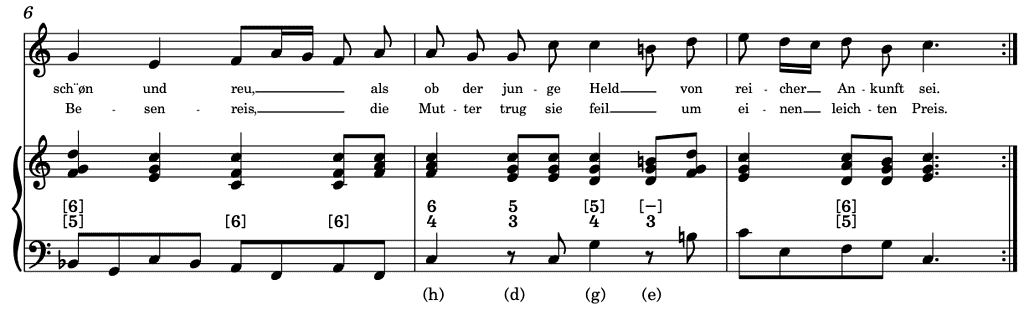
In aria 47, there are also several instances of right-hand chords that are played on rest in the bass.
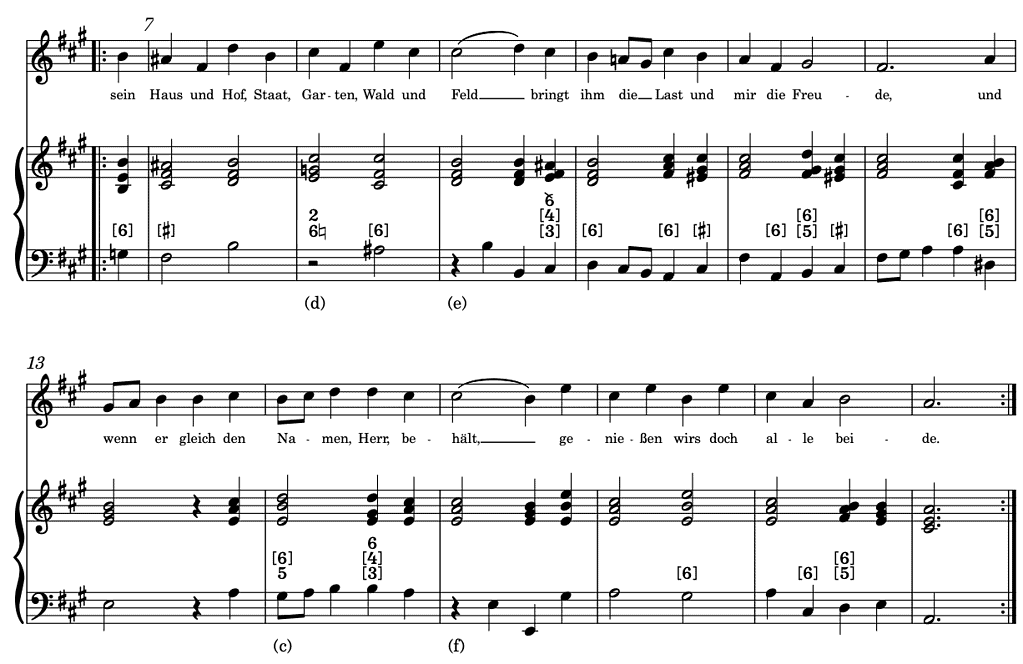
With regard to those instances, Telemann gives the following important information:
“That chords [in the right hand] may also be struck on rests [in the bass] is shown in (d), (e), and (f); yet one must proceed with caution when these are not figured, since at times the rest is connected to the preceding note (d), whereas often it belongs to the harmony of the following one (e), (f).”
“Dass auch beÿ pausen angeschlagen werde, zeigen (d) (e) (f); es ist aber behutsam dabeÿ zu verfahren, wenn sie nicht beziefert sind: denn bisweilen wird die pause mit der vorhergehenden note gebunden (d); oft aber gehöret sie zu harmonie der folgenden (e) (f);”
Ignoring Obvious Chords on a Weak Part of the Beat to Clarify the Metre
Returning to an aria already discussed, aria 44 Heuchler (Hypocrite), let us consider bar 16.
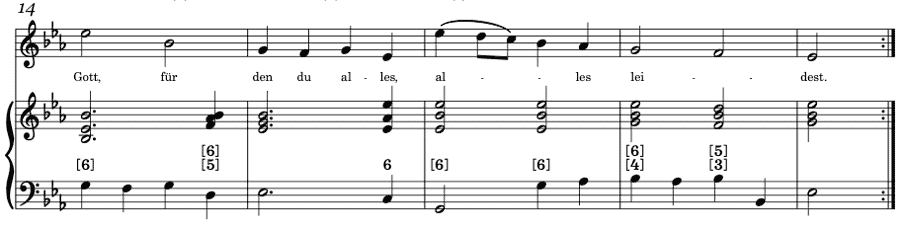
While an A-flat-major chord on the final quarter note would seem an obvious choice, given the presence of A♭ in both the bass and the vocal line, Telemann deliberately avoids this option, instead treating the A♭ in both parts as a passing note. The most plausible explanation is that he does so in order to clarify that C is to be understood as 2/2 rather than 4/4.
Rule of Thumb
First and foremost, it is essential to distinguish between C representing 4/4 (with the quarter note functioning as the beat) and C representing 2/2 (with the half note functioning as the beat). In both cases, a useful point of departure for realizing a bass according to Telemann’s practice is to articulate a single chord on each beat. When, however, the music suggests a faster chordal rhythm, this may be observed by supplying additional chords. Even so, such decisions remain, to some extent, a matter of judgement. Telemann’s examples show that the deliberate absence of such ‘extra’ chords can serve to clarify the metre, even in cases where their inclusion would be harmonically more correct.
Notes
Select Bibliography
Arnold, Franck Thomas. The Art of Accompaniment from a Thorough-Bass (2 volumes) (Oxford: Oxford University Press, 1931; unabridged and unaltered republication by Dover Publications in 1965 (with a new introduction) and 2003).
Christensen, Jesper Bøje. Die Grundlagen des Generalbaßspiels im 18. Jahrhundert: Ein Lehrbuch nach zeitgenössischen Quellen (Kassel: Bärenreiter, 1992).
Christensen, Jesper Bøje. Les Fondements de la Basse Continue au XVIIIe siècle : Une méthode basée sur les sources d’époques (Bâle: Bärenreiter, 1995).
Christensen, Jesper Bøje. 18th Century Continuo Playing: A Historical Guide to the Basics (Kassel: Bärenreiter, 2002).
Heinichen, Johann David. Der General-Bass in der Composition (Dresden, 1728).
Houle, George. Meter in Music, 1600-1800: Performance, Perception, and Notation (Bloomington: Indiana University Press, 1987).
Mattheson, Johann. Kleine General-Bass-Schule (Hamburg, 1735).
Miehling, Klaus. Das Tempo in der Musik von Barock und Vorklassik — Die Antwort der Quellen auf ein umstrittenes Thema — Verbesserte und stark erweiterte Neuausgabe 2003 (Wilhelmshaven: Florian Noetzel Verlag “Heinrichshofen-Bücher”, 2003).
Niedt, Friedrich Erhard. Musicalische Handleitung Oder Gründlicher Unterricht (Hamburg, 1710).
Rampe, Siegbert. Generalbasspraxis 1600–1800 (Laaber: Laaber Verlag, 2014).
Speer, Daniel. Grund-richtiger/ kurtz/ leicht und nöthiger Unterricht Der Musicalischen Kunst (Ulm, 1687).
Speer, Daniel. Grund-richtiger/ Kurtz- Leicht- und Nöthiger/ jetzt Wol-vermehrter Unterricht der musikalischen Kunst. Oder/ Vierfaches musikalisches Kleeblatt (Ulm, 1697).
Walther, Johann Gottfried. Praecepta der Musicalischen Composition (Weimar, 1728). Modern edition, ed. Peter Benary (Leipzig: Breitkopf & Härtel, 1955).
Zohn, Steven. Music for a Mixed Taste: Style, Genre, and Meaning in Telemann’s Instrumental Works (New York: Oxford University Press, 2008).