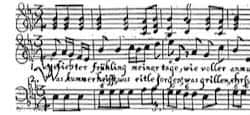
This essay is the second in a series examining Telemann’s views on chordal rhythm in a thoroughbass realization. Here, I discuss chordal rhythm in a 3/4 time signature, as presented in his Singe-, Spiel- und General-Bass-Übungen.
In the SSGBÜ, Telemann often writes a single chord above each bass note in arias in 3/4, mostly when that note lasts a beat or longer. When shorter bass notes belong to a single harmony, he prefers marking the beats, although he finds restriking a chord on each bass note also acceptable.
All musical examples are taken from Derek Remeš’s digital and freely available edition of the SSGBÜ, which can be downloaded at https://doi.org/10.17877/TUDODATA-2025-MC06WAYR. Note further that
- the translations of Telemann’s quotes are mine
- “bar 1a” refers to the first half of bar 1, and “bar 1b” to the second half
- the term “Oberstimme” refers to the upper part of the thoroughbass realization.
Of the 48 arias in the SSGBÜ, eight are entirely written in 3/4 (nos. 5, 12, 16, 20, 24, 25, 34 and 46), while the following two arias contain 3/4 passages:
- aria 9: the first section (the second section, from the upbeat to bar 13 onward, is in 2/4)
- aria 42: bars 1–2 and 10–12 (this aria also contains passages in 2/4, 3/8, 9/8 and 4/4).
Rule of Thumb: A Single Chord on Each Bass Note
As with chordal rhythm in 2/4, a good starting point for realizing a bass in 3/4 according to Telemann’s views is to play a single chord on each bass note. See, for example, bars 8 and 15 of aria 46:
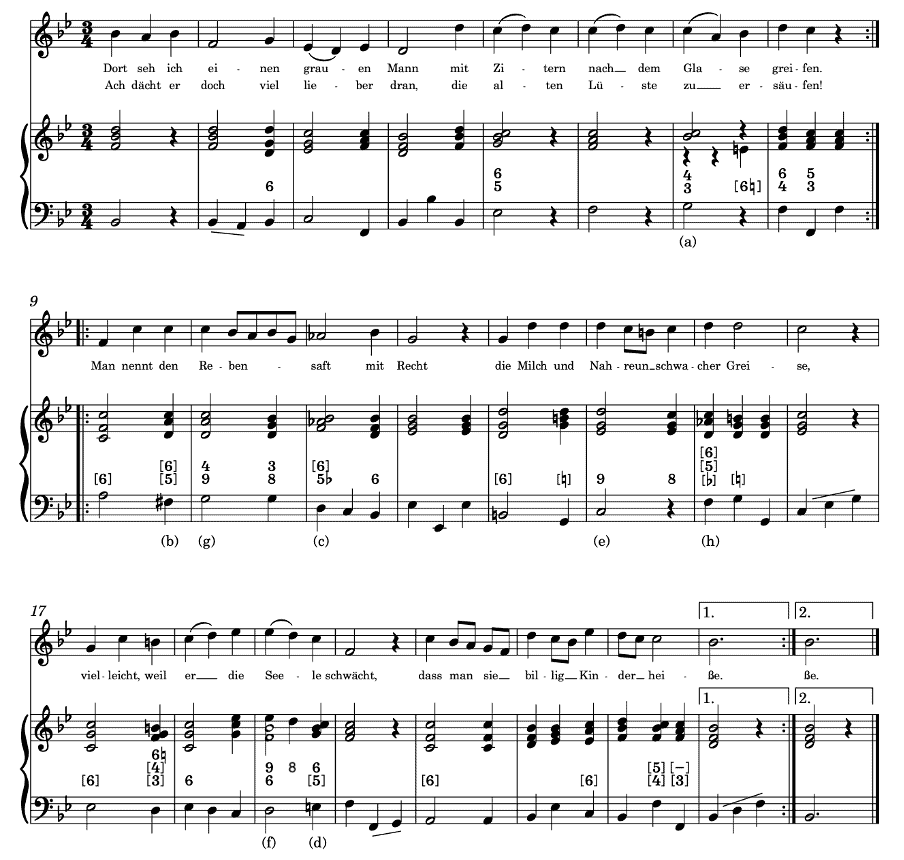
In both bars, Telemann could have written a half-note chord starting on beat 2, but instead he writes two repeated quarter-note chords. As discussed in my essay Telemann’s SSGBÜ: Chordal Rhythm in 2/4, an important task of the continuo player, according to Telemann, is to make the metre clear by sufficiently marking the beats, even if this results in merely repeated chords.
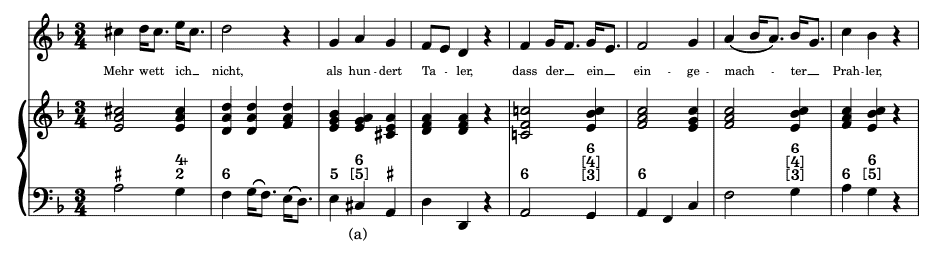
Even when a phrase ends on a weak syllable and beat, prolonging the harmony of the preceding strong beat, as in bar 4 of aria 16, Telemann does not write a half-note D-minor triad on beat 1, but instead opts for two repeated quarter-note triads:
Perhaps the clearest example from the SSGBÜ illustrating that several, even multiple, repetitions of the same chord are by no means to be avoided according to Telemann occurs in the final phrase of aria 25:
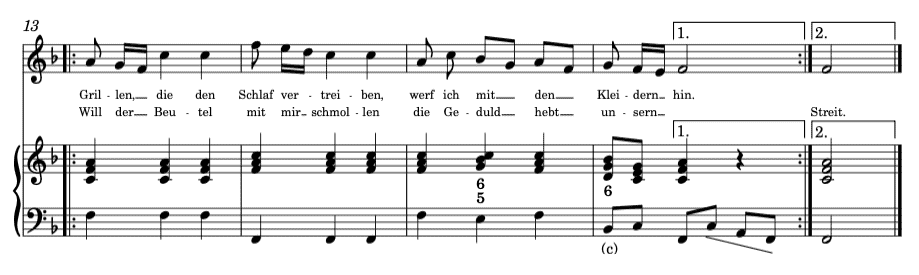
In bars 13–15a, seven successive F-major quarter-note chords occur. It is nevertheless noteworthy that from the downbeat of bar 14 onward Telemann changes position: whereas in bar 13 the Oberstimme has a1, from the downbeat of bar 14 it moves to c2, possibly for reasons of metric clarity, even though the octave leap in the bass already provides this.
When bass notes shorter than a beat occur, the same rule of thumb still applies, especially when the harmony changes within the beat, as in the example above on beat 1 of bar 16. When the harmony does not change within the beat, however, Telemann allows two options: eighth-note chords or quarter-note chords. In connection with aria 20, he nevertheless warns against making too much noise when playing eighth-note chords:
“In arias like this one, where the bass maintains a uniform rhythmic motion throughout, one may also play a chord on every bass note, though only briefly, so that it does not create too much of a rustling effect.”
“In arien, wie diese, wo der bass durchgehends eine gleiche bewegung hat, mögen oben auch alle noten, iedoch kurz, angeschlagen werden, damit es nicht zu stark rausche.”
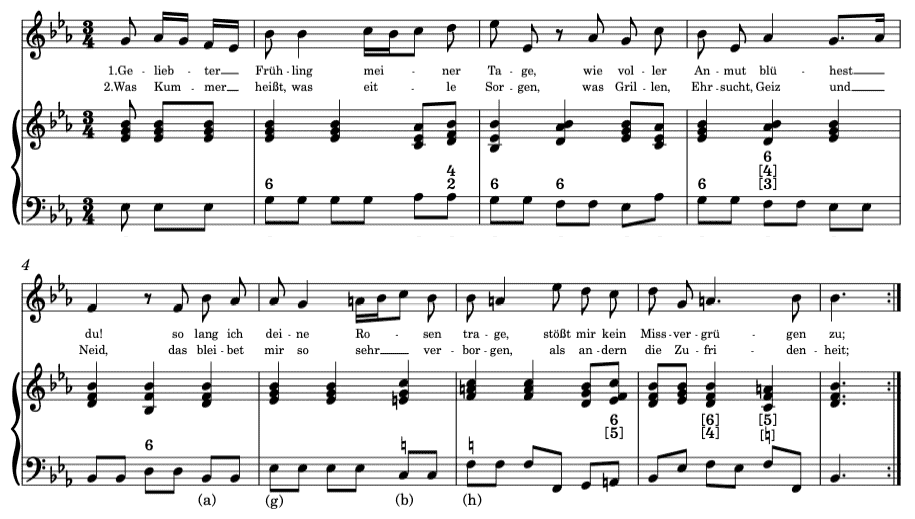
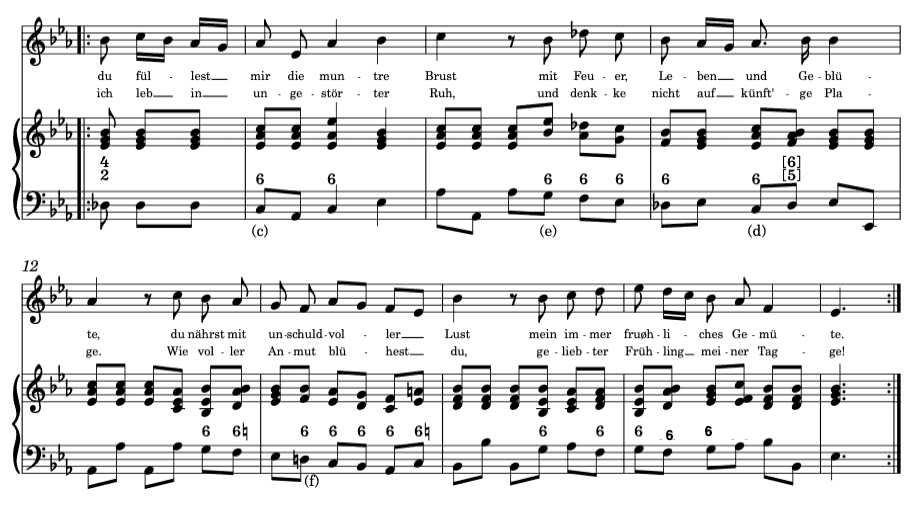
I will return to the realization of bass notes shorter than a beat below, in the paragraph Ignoring Chords on the Weak Eighth Note of a Beat.
Slower Chordal Rhythm
Conversely, the SSGBÜ also contain instances in which a chord is not repeated over two identical quarter-note bass notes —whether or not separated by an octave— nor over two different bass notes implying (almost) the same harmony in the right hand. See, for example, bars 4 and 12 of aria 46, where Telemann writes a half-note chord spanning beats 1 and 2, despite the presence of two quarter notes in the bass, which repeat the same note an octave higher and lower, respectively.
This aria is interesting in this respect, as it contains both repeated quarter-note chords and half-note chords spanning two identical quarter-note bass notes separated by an octave.
Consider also the final eight bars of aria 16:
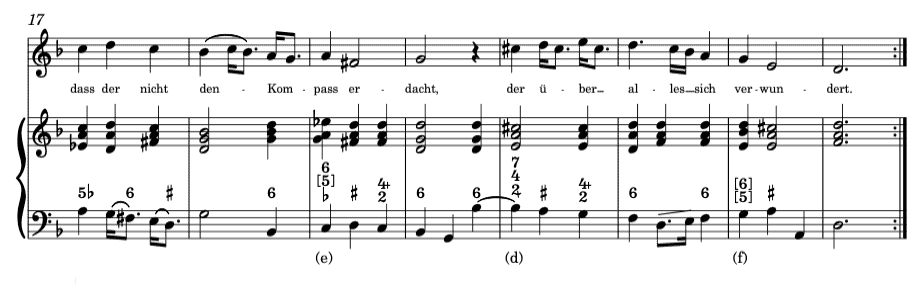
In the penultimate bar, the two quarter notes a–A (both ⑤ in D minor) are not set this time with repeated quarter-note chords but with a single half-note chord spanning both beats. Likewise, in bars 20 and 21, the half-note chords could also have been realized as two repeated quarter-note chords (although this would require a b♭1 on beat 2 of bar 20).
(Note that what we would today call a ninth on beat 1 of bar 21 (b♭) occurs in the bass, sounding simultaneously beneath the note it suspends (a1). I will return to this type of voice leading in a future essay.)
A Chord on a Rest
For what seems to be the purpose of ensuring metric clarity, Telemann occasionally writes a chord on a rest in the bass. This occurs, for example, on beat 2 of bar 2 of aria 5, where he simply repeats the C-minor chord of beat 1:
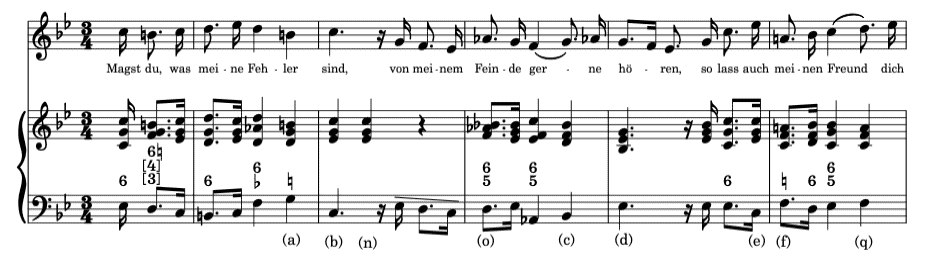
Regarding this chord on the rest in the bass, Telemann provides the following comment:
“The striking [of the chord] during the rest occurs, so that the ear does not remain empty.”
“(n) Der anschlag in währender pause geschicht darum, damit das ohr nicht leer bleibe.”
Note, however, that he does not writes a chord on beat 2 of bar 4, possibly because the vocal line already marks that beat, which it doesn’t in bar 2.
Yet in bar 9 of aria 12, he does mark the second beat in the right hand, even though the vocal line also marks it and the chord begins as an open-fifth triad. (True, Telemann clearly thinks an f♯ on the start of beat 2, but perceptually it sounds more like a prolongation of the d of beat 1.)
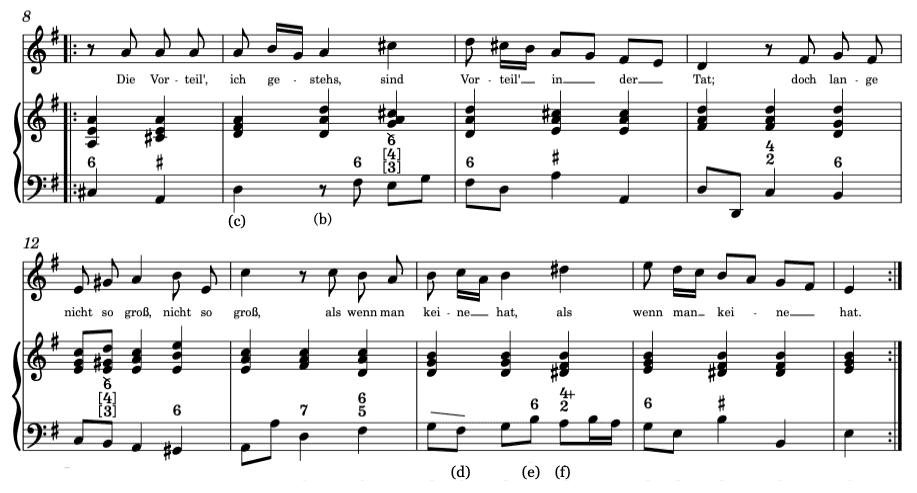
Regarding this beat —and several others in the example— Telemann comments as follows:
“(b) Such striking [of chords] over rests is then very appropriate when, as here, it aims to preserve the weight of the metre, which was also the intention at (c), where the vocal line implies the figures of a 6/4; at (d), where 6/5 intervenes; and at (e), where otherwise the 6 would have to be struck. There are, however, other examples in which such striking is not appropriate.”
“(b) Dergleichen anschlagen über pausen ist alsdann sehr gut, wann es, wie hier, das gewicht des tactes zu unterhalten abzielet, welchen zweck man auch beÿ (c) gehabt, wo die figuren in der singe-stimme 6/4, beÿ (d), wo 6/5 durchwischen, u. beÿ (e), wo sonst die 6 angeschlagen werden sollte. Es kommen aber andere exempel vor, wobeÿ solches anschlagen nicht angehet.”
Ignoring Chords on the Weak Eighth Note of a Beat
Note how Telemann, in the above directive referring to (c), (d) and (e) in aria 12, states that ‘obvious extra’ chords on the weak eighth note of a beat can be ignored in order to preserve a clear perception of the metre, even when the vocal line and the bass strongly suggest, or even seem to demand, a faster chordal rhythm. In the cases of (d) and (e), this guideline thus goes against the usual rule of thumb of playing one chord per bass note. The ‘obvious extra’ chords on the weak part of a beat that are ignored are:
- a 6/4 chord over d on the second half of beat 1 of bar 9
- a 6/5 chord over f♯ on the second half of beat 1 of bar 14 (in the current realization, the f♯ in the bass is treated as a neighbour note)
- a sixth chord over b on the second half of beat 2 of bar 14.
(Telemann makes a similar remark regarding an aria in 2/4. For more information, see my essay Telemann’s SSGBÜ: Chordal Rhythm in 2/4.)
Another notable instance of ignoring chords on the weak eighth of a beat occurs in bar 7 of aria 25.
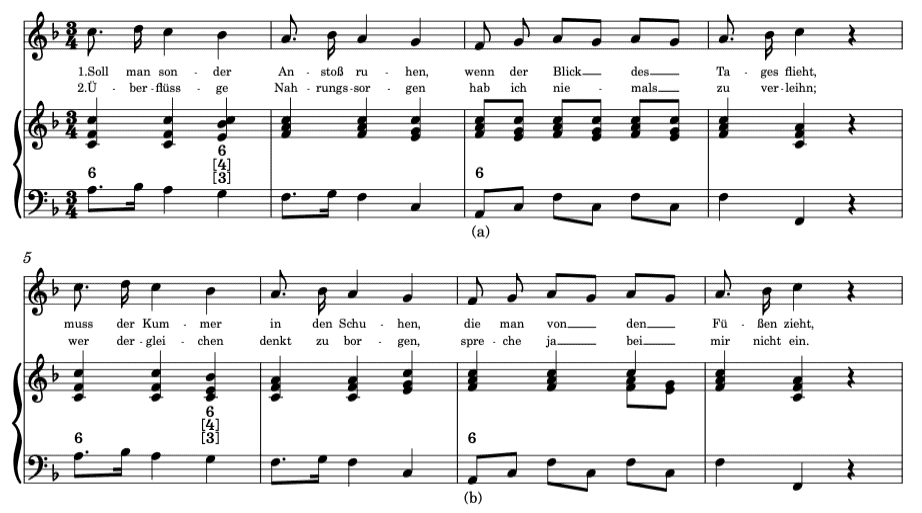
In fact, this bar offers an alternative realization to bar 3, where each bass note does receive its own chord. So, from bars 3 and 7, we learn that both realizations are good for Telemann. Still, at least in the context of what he calls die lustige polnische ernsthaftigkeit (the cheerful Polish earnestness), he tends to favour a ‘less is more’ approach:
“When I have the choice here between the chords in bars (a) and those in (b), I prefer the latter: one hears more of the singing, and it enhances the cheerful Polish seriousness.”
“Wann ich hier von den griffen in den tacten (a) u. (b) die wahl habe, so halte ich es mit den letztern: man höret singen, u. bevördert die lustige polnische ernsthaftigkeit.”
Note also that the chords on the sixteenth following the dotted eighth in bars 1, 2, 5 and 6 are ignored, despite the vertical thirds between the bass and the vocal line. These ignored ‘extra’ chords are:
- a triad in bars 1 and 5
- a sixth chord or a 6/4/3 chord in bars 2 and 6.
6/4–5/3 or 5/4–5/3 Instead of 5/3 on ⑤
Note that, when ⑤ lasts two beats, Telemann allows the addition of 6/4 or 5/4 at the start of ⑤, even when (♯)3 is indicated above its start and the vocal line seems at first sight to suggest 5/3. For more information, see my essay Telemann’s SSGBÜ: Chord Substitutions and Additions
Select Bibliography
Arnold, Franck Thomas. The Art of Accompaniment from a Thorough-Bass (2 volumes) (Oxford: Oxford University Press, 1931; unabridged and unaltered republication by Dover Publications in 1965 (with a new introduction) and 2003).
Christensen, Jesper Bøje. Die Grundlagen des Generalbaßspiels im 18. Jahrhundert: Ein Lehrbuch nach zeitgenössischen Quellen (Kassel: Bärenreiter, 1992).
Christensen, Jesper Bøje. Les Fondements de la Basse Continue au XVIIIe siècle : Une méthode basée sur les sources d’époques (Basel: Bärenreiter, 1995).
Christensen, Jesper Bøje. 18th Century Continuo Playing: A Historical Guide to the Basics (Kassel: Bärenreiter, 2002).
Heinichen, Johann David. Der General-Bass in der Composition (Dresden, 1728).
Mattheson, Johann. Kleine General-Bass-Schule (Hamburg, 1735).
Rampe, Siegbert. Generalbasspraxis 1600–1800 (Laaber: Laaber Verlag, 2014).
Telemann, Georg Philipp. Singe-, Spiel- und General-Bass-Übungen (Hamburg, 1733–34).
Telemann, Georg Philipp. Singe-, Spiel- und General-Bass-Übungen TWV 25:39-85 für Singstimme & Tasteninstrument — Revidierte Neuausgabe, ed. Wolf Hobohm (Magdeburg: Edition Walhall – Verlag Franz Biersack, 2003).
Zohn, Steven. Music for a Mixed Taste: Style, Genre, and Meaning in Telemann’s Instrumental Works (New York: Oxford University Press, 2008/2015 (revised paperback edition)).