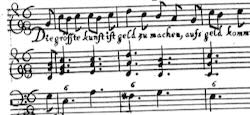
This essay explores Telemann’s views on the range of the right hand and on the possible doubling of the singing voice by its upper part, as presented in his Singe-, Spiel- und General-Bass-Übungen.
In the Singe-, Spiel- und General-Bass-Übungen, Telemann defines the standard range of the upper part of the right hand as extending from b1 to e2. When necessary, it may reach as high as f 2 and (probably) as low as f 1. Moreover, the right hand may freely double, and even exceed, the vocal line.
As we shall see, however, Telemann includes one notable exception in which the upper part of the right hand lies considerably lower. This essay concludes with a brief assessment, in the context of range and doubling, of the intended audience of the SSGBÜ.
All musical examples are taken from Derek Remeš’s digital and freely available edition of the SSGBÜ, which can be downloaded at https://doi.org/10.17877/TUDODATA-2025-MC06WAYR. Note further that
- the translations of Telemann’s quotes are mine
- “bar 1a” refers to the first half of bar 1, and “bar 1b” to the second half
- the term “Oberstimme” refers to the upper part of the thoroughbass realization.
Upper Limit of the Oberstimme
The very first guideline Telemann provides in the SSGBÜ is as follows:
“(1) In order to play comfortably, the right hand should, as far as possible, be kept in the chord position from the very beginning, just as its entire range in the upper register does not extend beyond b1 to e2’.”
“(1) Um gemächlich zu spielen, ist die rechte hand, so viel es seÿn kann, in der gleich anfangs genommenen accord_lage zu erhalten, gleichwie sich hier durchaus derselben ganzer umfang in der höhe nicht weiter, als von h’ bis ins e’’ erstrecket.”
The first aria already exemplifies this guideline, the Oberstimme spanning only from b1 to e2:
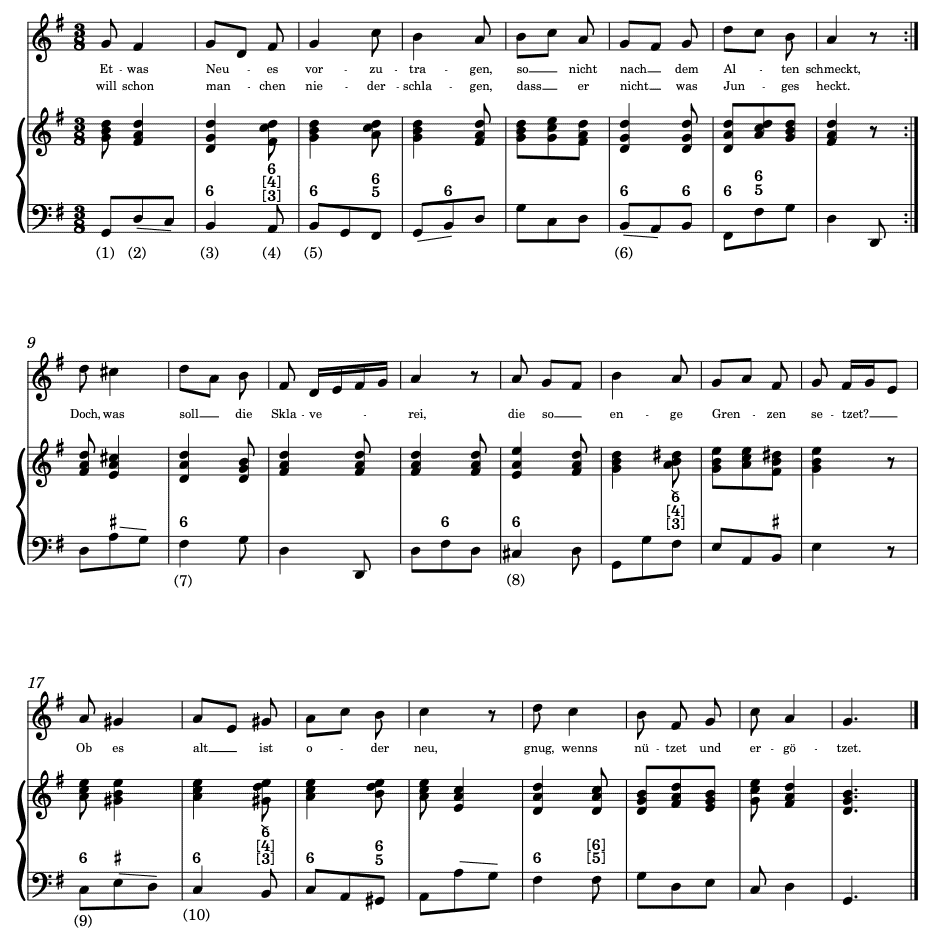
Note that
- the right hand follows its own logic regarding voice leading and does not consider the range or register of the singing voice: the Oberstimme freely doubles, and even exceeds, the vocal line
- Telemann pays no attention to the melodic quality of the Oberstimme, resulting in a realization dominated by just two notes: d 2 (especially in bars 1–14) and e 2 (especially in bars 15–20).
In relation to bar 7a of aria 11, Telemann provides the following elaboration of the above rule:
“(f) The f 2 is otherwise the upper limit to which the little finger should venture; but if the bass ascends unusually high, or if more modern clefs are used, then that is another matter.”
“(f) Das f’’ oben ist sonst die äusserste grenze, so weit sich der kleine finger wagen darf; gehet aber der bass ungewöhnlich hoch, oder kommen iüngere schlüssel vor, so ist es ein anders.”
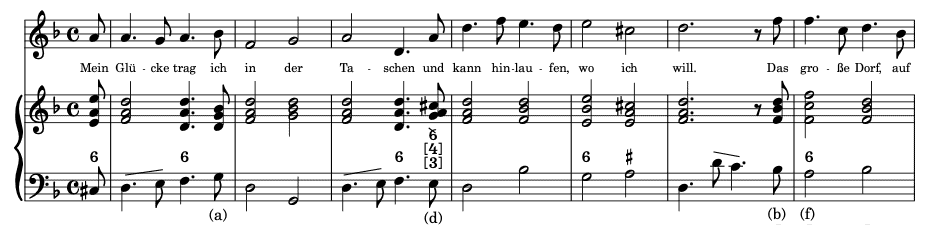
Note here also
- the ‘independence’ of the Oberstimme, whose upper part freely doubles and even exceeds the vocal line
- the total lack of melodic concern in the Oberstimme, resulting in a static line dominated by an omnipresent d 2.
(Telemann does not provide an example of an “unusually high” bass passage, whether or not using modern clefs, in which the Oberstimme exceeds the limit of f 2.)
Lower Limit of the Oberstimme
With regard to expanding the lower limit of the Oberstimme, Telemann offers no explicit comment. His realizations, however, make it clear that the ‘regular expansion’ of the lower limit is to g1. This is illustrated, for instance, in aria 8, where g1 frequently appears in the Oberstimme (bars 2, 3, 8, 9, 19 and 20):
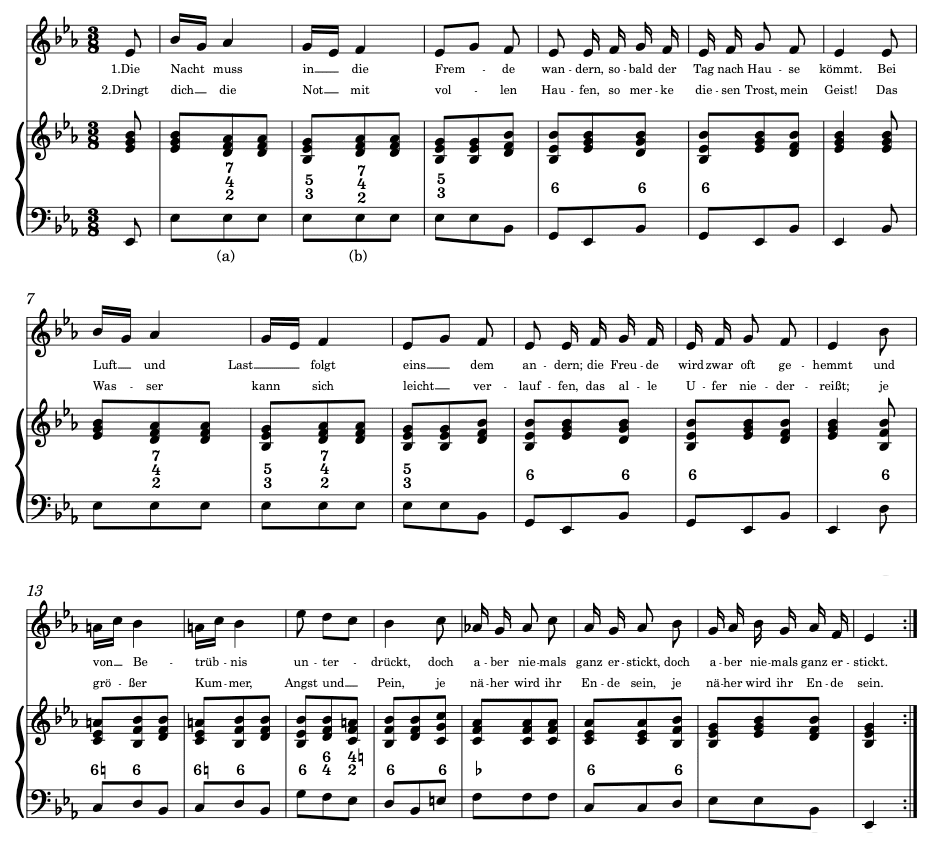
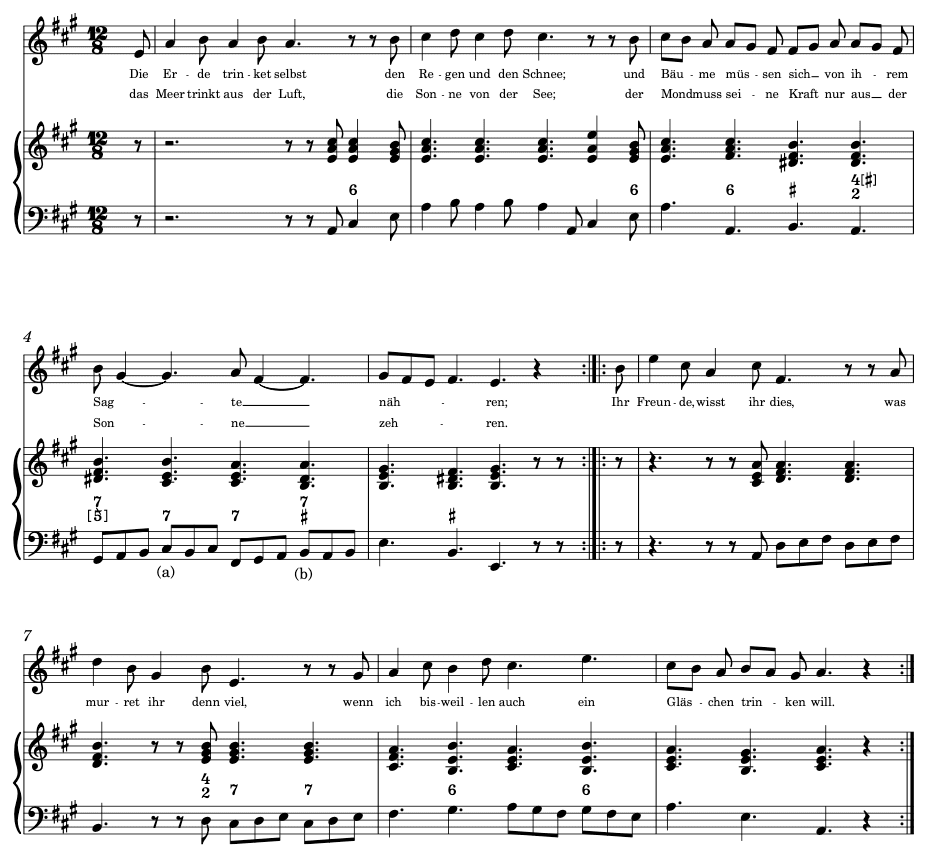
In the SSGBÜ, I found three instances where the Oberstimme descends even lower. The first occurs in bar 5 of aria 10, where it reaches f♯1:
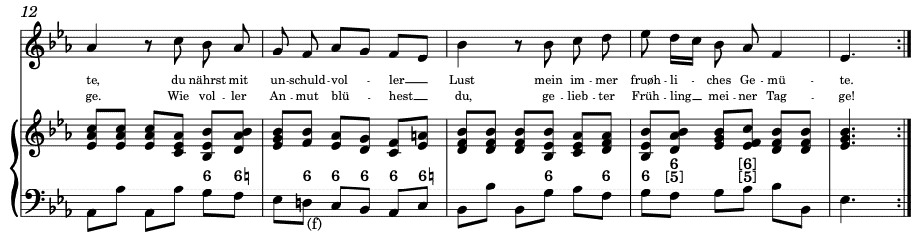
Secondly, in bar 13 of aria 20, the Oberstimme descends even further, to f 1. This realization, however, is somewhat special because of its parallel sixth chords (see below and also my essay Telemann’s SSGBÜ: Number of Parts).
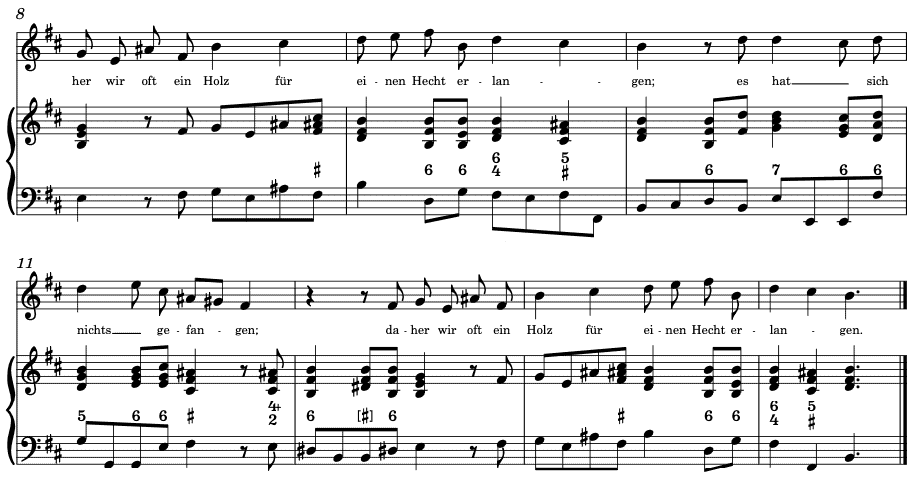
Note that in bars 8 and 13 of aria 38, the right hand even plays an e1, though this happens when doubling the bass in octaves rather than in a genuine continuo realization (see also my essay Telemann’s SSGBÜ: Number of Parts).
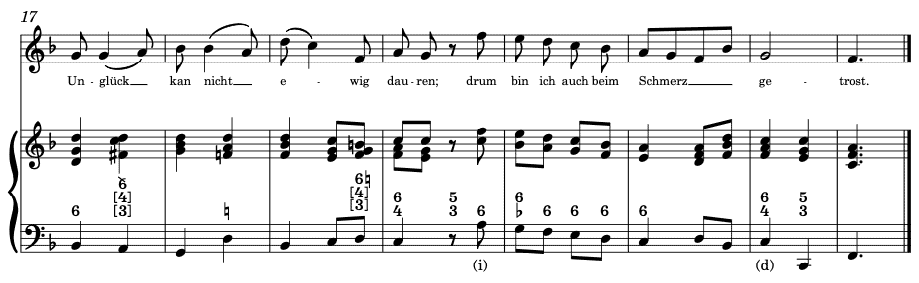
Thirdly, in relation to bars 20b–22a of aria 6, Telemann provides one further possible exception to the range/register of the right hand, again in connection with this particular setting of parallel sixth chords, in which the lower limit is considerably exceeded:
“(i) By many consecutive 6s, where the bass moves stepwise up or down, one omits the fourth voice. If a tenor is singing here, the right hand should play an octave lower.”
“(i) Beÿ vielen auf einander folgende 6, wobeÿ der bass stufen-weise hinauf oder hinunter gehet, lasse man die 4.te Stimme fahre. Sünge hier ein Tenor, so spielte die rechte eine 8 tiefer.”
Assessing Range and Doubling: For Kenner or Liebhaber?
At first glance, the limited range of the right hand/Oberstimme might suggest that Telemann’s SSGBÜ were intended for amateurs. The reality, however, is more nuanced. Unlike many of his contemporaries, Telemann makes no distinction between amateur and professional styles of playing. Moreover, the Übungen include several instructions that his colleagues would have regarded as ‘professional’, such as the option of vollstimmiges Accompagnement (full-voiced accompaniment, which Telemann restricts to recitatives) and the strict rules concerning the avoidance of direct fifths and octaves, even between a middle and an outer part. More on all this in future essays.
Select Bibliography
Arnold, Franck Thomas. The Art of Accompaniment from a Thorough-Bass (2 volumes) (Oxford: Oxford University Press, 1931; unabridged and unaltered republication by Dover Publications in 1965 (with a new introduction) and 2003).
Christensen, Jesper Bøje. Die Grundlagen des Generalbaßspiels im 18. Jahrhundert: Ein Lehrbuch nach zeitgenössischen Quellen (Kassel: Bärenreiter, 1992).
Christensen, Jesper Bøje. Les Fondements de la Basse Continue au XVIIIe siècle : Une méthode basée sur les sources d’époques (Basel: Bärenreiter, 1995).
Christensen, Jesper Bøje. 18th Century Continuo Playing: A Historical Guide to the Basics (Kassel: Bärenreiter, 2002).
Rampe, Siegbert. Generalbasspraxis 1600–1800 (Laaber: Laaber Verlag, 2014).
Telemann, Georg Philipp. Singe-, Spiel- und General-Bass-Übungen (Hamburg, 1733–34).
Telemann, Georg Philipp. Singe-, Spiel- und General-Bass-Übungen TWV 25:39-85 für Singstimme & Tasteninstrument — Revidierte Neuausgabe, ed. Wolf Hobohm (Magdeburg: Edition Walhall – Verlag Franz Biersack, 2003).
Telemann, Georg Philipp. Singe-, Spiel- und General-Bass-Übungen (Hamburg, 1733–34).
Telemann, Georg Philipp. Singe-, Spiel- und General-Bass-Übungen TWV 25:39-85 für Singstimme & Tasteninstrument — Revidierte Neuausgabe, ed. Wolf Hobohm (Magdeburg: Edition Walhall – Verlag Franz Biersack, 2003).
Zohn, Steven. Music for a Mixed Taste: Style, Genre, and Meaning in Telemann’s Instrumental Works (New York: Oxford University Press, 2008/2015 (revised paperback edition)).